Technical Analysis Summary
Bring everything together and understand how professionals actually use technical analysis in real trading conditions.
Learning Objectives
This final lesson brings the entire technical analysis module together. By now, you have learned about market structure, support and resistance, candlestick patterns, chart patterns, trendlines, channels, multi-timeframe analysis, and market context. The goal now is to stop seeing these ideas as separate lessons and start using them as one complete trading framework.
- Combine all technical concepts into one practical framework.
- Understand how professionals read charts holistically.
- Avoid jumping from one random signal to another.
- Use context, structure, levels, alignment, confirmation, and risk together.
- Avoid overcomplicating analysis with too many tools.
- Focus on clarity instead of chart clutter.
- Prepare for real trade execution in live market conditions.
- Build a repeatable checklist before risking capital.
The Big Picture
Technical analysis is not about memorizing every candlestick pattern or drawing as many lines as possible. It is about understanding how price behaves. Every candle represents buyers and sellers making decisions. Every swing high, swing low, breakout, pullback, rejection, and consolidation gives you information about market behavior.
The mistake many traders make is treating technical analysis like a prediction machine. They think, “If this pattern appears, price must go up,” or “If this candle forms, price must go down.” That is not how professional trading works. A pattern by itself is not enough. A signal by itself is not enough. A level by itself is not enough.
Good technical analysis helps you ask better questions. Is the market trending or ranging? Are buyers or sellers in control? Is price near an important level? Is there enough room for the trade to move? Is the lower timeframe agreeing with the higher timeframe? Am I entering based on confirmation, or am I guessing?
If your analysis feels complicated, you are probably trying to process too much. Professional traders simplify. They remove noise. They focus only on the information that improves the decision. If something does not help you decide whether to enter, wait, reduce risk, or avoid the trade, it probably does not belong on your chart.
This is why the full technical analysis process should connect back to market context, market structure, and support and resistance before any entry idea is considered.
Your Complete Technical Analysis Framework
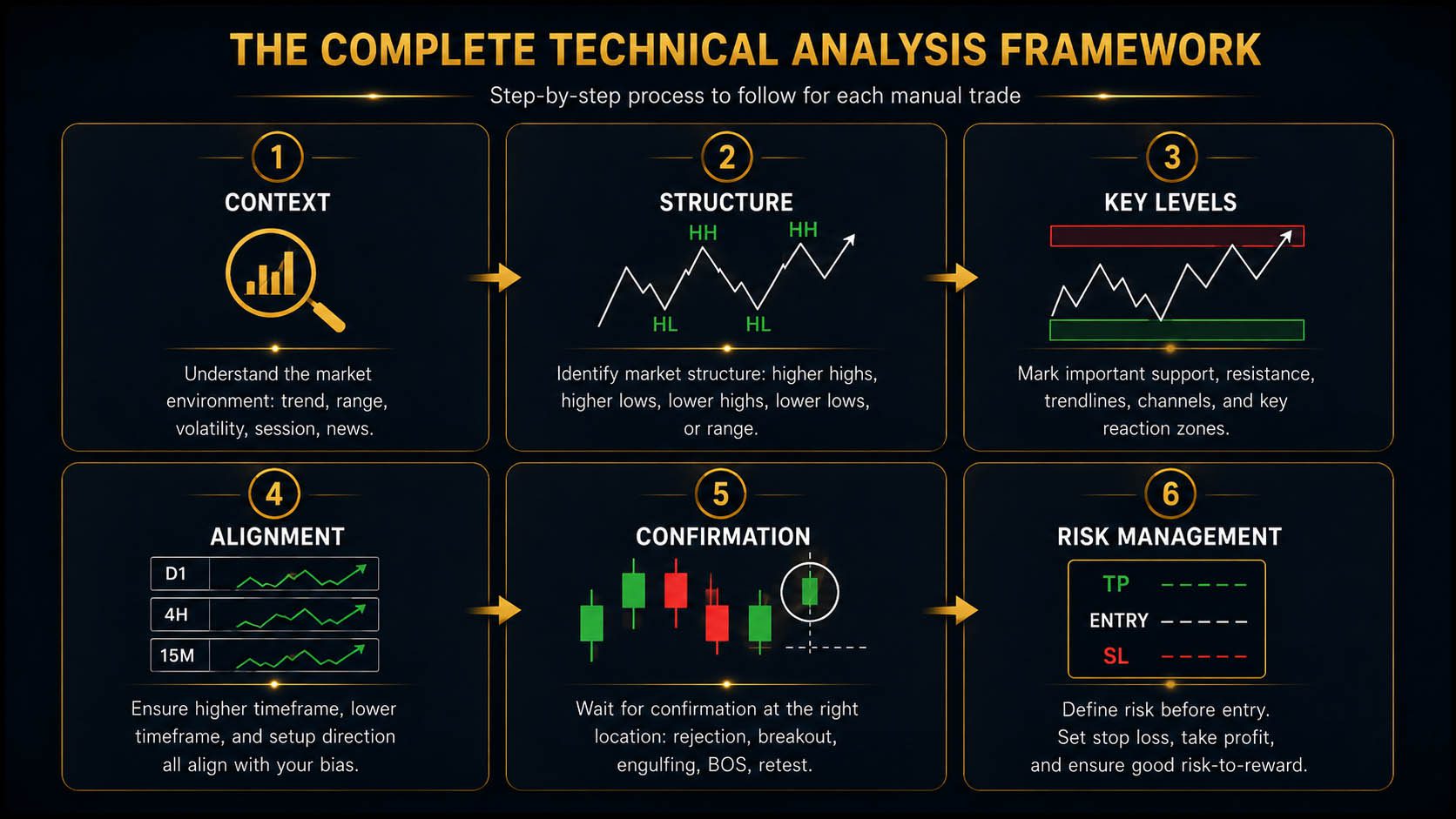
This framework is the foundation of clean technical analysis. You do not need to use it perfectly at first. The goal is to practice the same process repeatedly until it becomes natural. When you follow a repeatable framework, your trading becomes less emotional because you are no longer making random decisions from candle to candle.
Step 1 — Market Context
Market context is the environment you are trading in. Before you look for an entry, you need to understand what type of market you are dealing with. Is price trending strongly? Is it stuck in a range? Is volatility high? Is the market choppy and unclear? Is it London session, New York session, Asian session, or close to major news?
This matters because the same setup can work beautifully in one environment and fail completely in another. A breakout setup may perform well in a strong trending market but fail repeatedly inside a choppy range. A support bounce may work in a range but get destroyed during a strong bearish trend.
Before taking any trade, ask yourself: “What kind of market am I trading right now?” If you cannot answer that clearly, you are probably not ready to enter.
Step 2 — Structure
Structure shows you how price is moving. In an uptrend, price usually creates higher highs and higher lows. In a downtrend, price usually creates lower highs and lower lows. In a range, price moves sideways between support and resistance. Structure tells you whether buyers or sellers are currently in control.
Many traders skip structure and go straight to entries. That is a major mistake. If you do not understand structure, you may buy into resistance, sell into support, or trade against the dominant direction. Structure gives your trade a logical foundation.
Step 3 — Key Levels
Key levels are the areas where price has reacted before and may react again. These levels can include support, resistance, previous highs, previous lows, breakout retest zones, liquidity areas, trendlines, and channel boundaries.
A key level matters because it gives your trade location. Without location, you are usually entering in the middle of nowhere. Buying directly into resistance is weak location. Selling directly into support is weak location. Entering in the middle of a range often gives poor reward compared to risk.
Step 4 — Alignment
Alignment means your trade idea agrees across multiple pieces of analysis. The higher timeframe should support your direction. The lower timeframe should provide a cleaner entry. The market context should match the type of setup you are trading. The key level should make sense. The confirmation should appear in the right place.
For example, if the daily chart is bullish, the 4H chart is creating higher lows, and the 15M chart gives a bullish rejection from support, that is alignment. The trade has a stronger foundation because multiple pieces are pointing in the same direction.
Step 5 — Confirmation
Confirmation is the final piece before entry. It shows that price is reacting in the way your analysis expected. Confirmation can come from a candlestick rejection, engulfing candle, break of minor structure, strong close, retest, or momentum shift on the lower timeframe.
The key is that confirmation must happen at the right location and in the right context. A bullish engulfing candle in the middle of nowhere is not the same as a bullish engulfing candle at higher timeframe support during an uptrend. The candle is only meaningful because of where it forms and what the market is already doing.
Step 6 — Risk
Risk is what turns analysis into professional trading. A good trade idea can still damage your account if the risk is too large, the stop loss is emotional, or the reward is too weak. Technical analysis should help you define the trade, but risk management protects you when the trade is wrong.
Before entering, know where the idea is invalidated. Your stop loss should not be placed randomly. It should be placed where the trade idea no longer makes sense. Your target should also be realistic based on structure, not fantasy.
This six-step process connects directly to multi-timeframe analysis, candlestick confirmation, and risk-to-reward planning.
How the Pieces Work Together
Technical analysis becomes much easier when you understand the order of importance. Most struggling traders start with the entry. Professionals start with the environment. The entry is only the final piece of the decision.
| Step | Question to Ask | Why It Matters |
|---|---|---|
| Context | What type of market am I in? | It tells you whether your strategy fits the current environment. |
| Structure | Who is currently in control? | It shows whether buyers, sellers, or indecision are dominating price. |
| Levels | Where is price likely to react? | It helps you avoid entering in random locations. |
| Alignment | Do the timeframes agree? | It keeps you from fighting the bigger picture. |
| Confirmation | Has price proven the idea? | It helps reduce guessing and emotional entries. |
| Risk | Is the trade worth taking? | It protects your account when the idea is wrong. |
This order also prevents random strategy-hopping. You are not looking for the next magic entry signal. You are building a decision from context to execution.
What Actually Matters
Clean Structure
Clean structure means you can clearly see what price is doing. The market is either trending, ranging, breaking structure, or reacting from important zones. If you need to force the analysis or draw ten lines to explain it, the structure may not be clean enough.
Clean structure helps you avoid random trades. It gives you direction, context, and a reason behind the setup. If structure is messy, the best decision is often to wait.
Clear Levels
Clear levels are areas where price has reacted before and may react again. These levels should be obvious, not imaginary. Support, resistance, previous highs, previous lows, trendlines, channels, and breakout retest zones are all examples of levels that can matter.
The cleaner the level, the easier it is to build a plan. A strong level helps you decide where to wait, where to enter, where to place risk, and where price may struggle.
Strong Context
Context tells you whether the market condition supports your idea. A trend-following setup should appear in a trending market. A range setup should appear inside a range. A breakout setup should appear when volatility and structure support continuation.
Without context, you are only looking at signals. With context, you are reading the market environment. This is the difference between reacting to candles and understanding price behavior.
Patience
Patience is one of the most underrated trading skills. Many traders do not lose because they cannot analyze. They lose because they enter too early, chase price, overtrade, or force setups that are not ready.
Waiting is not weakness. Waiting is control. A patient trader allows the market to prove the setup before risking capital.
This is why patience and discipline are just as important as chart reading.
What Does NOT Matter
Overloading Indicators
Indicators can be helpful, but too many indicators create confusion. When one indicator says buy and another says sell, traders freeze or choose the one that confirms what they already wanted to do. This leads to emotional decision-making disguised as analysis.
Price action, structure, levels, and context should come first. Indicators should support your analysis, not replace it.
Forcing Trades
Forcing trades means entering when the setup is not really there. This usually happens because a trader wants action, wants to recover a loss, or feels pressure to make money today. Forced trades are usually low-quality trades.
A professional trader understands that no trade is also a decision. Sometimes the best move is to wait for a cleaner opportunity.
Chasing Every Move
Chasing happens when price already moved and the trader enters late out of fear of missing out. The problem is that late entries usually have poor reward-to-risk. The stop loss becomes too wide, the target becomes too close, and the trader is emotionally attached from the start.
If you missed the move, you missed the move. Let it go. There will always be another setup.
Looking for Perfect Setups
There is no perfect setup. Every trade has uncertainty. Waiting for a perfect trade can lead to hesitation, missed opportunities, and frustration. The goal is not perfection. The goal is a reasonable edge, clear risk, and disciplined execution.
Many of these mistakes are connected to overtrading, revenge trading, and poor preparation.
Professional Example
Let’s say a funded trader sees price approaching resistance in a trending market. A beginner may instantly think, “Price is at resistance, I should sell.” But a professional does not react that quickly. The professional looks deeper.
First, they ask what the broader context is. If the market is in a strong uptrend, resistance may not be a selling area. It may become a breakout area or a place where price pauses before continuing higher.
Next, they study structure. Is price creating higher highs and higher lows? Is momentum still strong? Did price break above previous resistance? Is the pullback shallow or aggressive?
Then they wait. Instead of jumping in, they allow price to show its hand. If price rejects resistance strongly and breaks lower timeframe structure, a short may become valid. If price pulls back, holds support, and breaks above resistance, the better trade may be long.
A beginner sees the same chart and jumps in randomly. They may enter because price “looks high” or because they feel the move cannot continue. That is not analysis. That is guessing.
The difference between the professional and the beginner is not that the professional knows the future. The difference is that the professional has a process.
Common Mistakes
Overcomplicating Analysis
Overcomplication happens when a trader adds more and more information but loses the ability to make a clear decision. They mark too many levels, use too many indicators, watch too many timeframes, and constantly change their opinion.
The solution is to simplify. Start with context, structure, levels, alignment, confirmation, and risk. If something does not help those areas, remove it.
Ignoring Context
A setup is only as good as the environment it appears in. Buying a bullish candle in a strong downtrend is not the same as buying a bullish candle at support in an uptrend. Context changes the meaning of everything.
Trading Without a Plan
A trade without a plan becomes emotional the moment price moves against you. You start moving stops, closing too early, holding too long, or adding more risk. A plan protects you from making decisions under pressure.
Not Waiting for Confirmation
Many traders have decent analysis but enter too early. They predict the reaction instead of waiting for evidence. This often leads to unnecessary losses because price reaches a level but does not actually react.
Emotional Decision-Making
Fear, greed, revenge, and impatience can ruin even good analysis. A trader may know exactly what to do but fail to execute because emotions take over. This is why discipline matters as much as technical skill.
Every technical setup should fit inside a written professional trading plan.
Professional Checklist
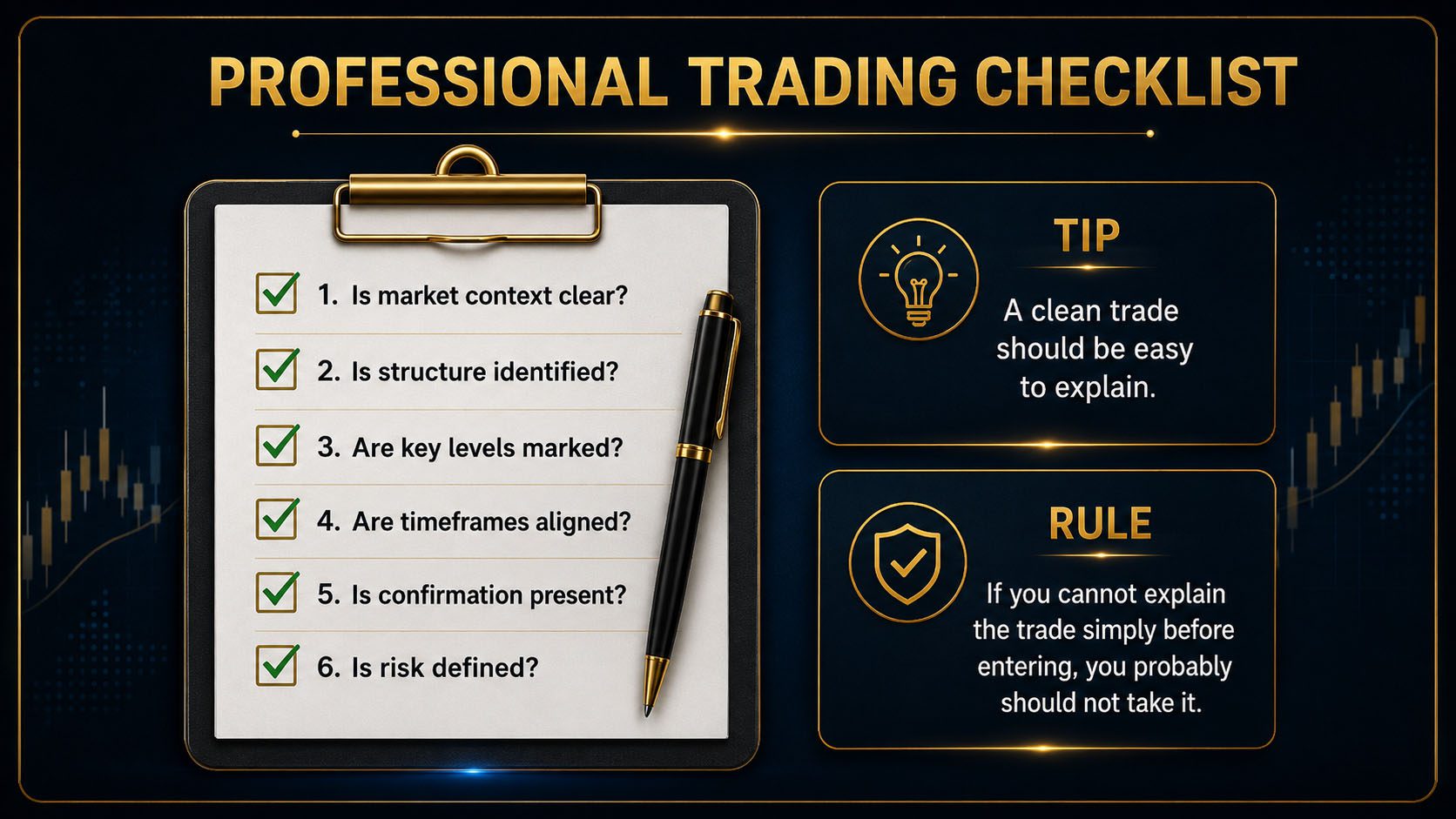
- Is market context clear? Identify whether the market is trending, ranging, volatile, or choppy. If the environment is unclear, your trade idea is probably weaker.
- Is structure identified? Know whether price is creating higher highs, higher lows, lower highs, lower lows, or moving sideways. Structure gives your trade direction.
- Are key levels marked? Mark only the levels that matter most. Support, resistance, previous highs, previous lows, trendlines, channels, and reaction zones should be clean and obvious.
- Are timeframes aligned? Check whether the higher timeframe supports the lower timeframe setup. Strong trades usually align across multiple timeframes.
- Is confirmation present? Wait for price to react. Look for a clear signal such as rejection, engulfing candle, break of lower timeframe structure, or momentum shift.
- Is risk defined? Know exactly how much you are risking before you enter. Your stop loss should be placed where the trade idea is invalidated, not where you emotionally hope price will not reach.
- Does the trade respect prop firm rules? Check daily drawdown, max drawdown, news restrictions, lot size, and challenge rules before entering.
- Can you explain the trade simply? If the setup takes too long to justify, it is probably not clean enough.
For funded accounts, this checklist should also include daily drawdown, maximum drawdown, and position sizing.
FAQ
Do I need indicators?
No, you do not need indicators to understand technical analysis. Price action, structure, support and resistance, market context, and risk management are enough to build strong trade ideas. Indicators can help, but they should never become the foundation of your decisions.
How do I improve?
You improve by practicing chart reading the right way. Do not just scroll through charts looking for entries. Study how price moves. Mark structure. Identify key levels. Ask what the market was doing before the move happened. Review both winning and losing trades so you can learn from the process.
Why do traders fail?
Most traders fail because they overcomplicate the process, ignore risk, chase trades, and make emotional decisions. They often know enough technical analysis to find setups, but they do not have enough discipline to wait for quality or manage the trade properly.
What is the real edge?
The real edge is not one secret strategy. It is consistency, discipline, patience, and the ability to repeat a clean process over time. A simple strategy executed with discipline is usually better than a complicated strategy executed emotionally.
How long does it take?
It takes as long as it takes for you to stop rushing. Some traders learn the concepts quickly but struggle with patience and emotional control. Technical analysis can be learned, but discipline has to be trained through repetition, review, and experience.
Knowledge Quiz
- What do the best traders focus on?
Answer: Clarity. - What is step one of the technical analysis framework?
Answer: Market context. - Are indicators required?
Answer: No. Indicators are optional. - What is a common technical analysis mistake?
Answer: Overcomplication. - Where does edge come from?
Answer: Discipline, consistency, and repeatable decision-making. - What does clean structure help traders understand?
Answer: Who is currently in control. - Where should good confirmation happen?
Answer: At the right location. - Where do professional traders usually start analysis?
Answer: The bigger picture. - When should risk be defined?
Answer: Before entry. - What should a good trade be?
Answer: Easy to explain.
Key Takeaways
- Technical analysis is about clarity, not complexity. The goal is not to fill your chart with tools. The goal is to understand what price is doing and make better decisions.
- Context is everything. A setup only makes sense when the market environment supports it.
- Structure guides decisions. Higher highs, higher lows, lower highs, lower lows, ranges, and breakouts help you understand who is in control.
- Levels give trades location. Support, resistance, trendlines, channels, and retests help you avoid random entries.
- Alignment improves quality. Higher timeframe bias and lower timeframe execution should work together.
- Confirmation improves probability. Waiting for price to react helps you avoid guessing and entering too early.
- Risk management protects the account. No setup matters if position size, stop loss, and reward-to-risk are not controlled.
- Discipline creates consistency. Your process only works if you follow it repeatedly, especially when emotions are high.

🎉 Module 5 Complete
You have completed Technical Analysis Foundations.
You now understand how to read market structure, support and resistance, trendlines, channels, candlestick patterns, chart patterns, multi-timeframe alignment, and market context as one complete trading process.
Next up: Module 6 — Trade Execution & Strategy Development
Lesson Summary
Technical analysis becomes powerful when it is simple, structured, and repeatable. Instead of chasing random signals, professional traders follow a clear framework: market context, structure, key levels, alignment, confirmation, and risk. This process helps traders avoid emotional entries, reduce overcomplication, improve trade selection, and protect prop firm accounts. The goal is not to predict every move. The goal is to wait for clean conditions, execute with discipline, and manage risk professionally.