
Building Discipline
Discipline is the ability to follow your trading plan when your emotions want something else. It is not built by motivation. It is built through rules, repetition, review, and self-control under pressure.
Learning Objectives
By the end of this lesson, you should understand how trading discipline is built and how to create systems that make disciplined execution easier.
- Understand what discipline means in professional trading.
- Learn why discipline matters more than motivation.
- Identify the habits that strengthen or weaken discipline.
- Build a daily structure for consistent execution.
- Create rules that protect your account when emotions rise.
- Use journaling and review to improve your behavior over time.
What Discipline Really Means
Discipline does not mean you never feel fear, greed, frustration, or excitement. It means those emotions do not get permission to control your trades.
A disciplined trader follows the plan even when the market is tempting, boring, volatile, or frustrating.
Undisciplined Trading
Random entries, emotional sizing, chasing price, breaking limits, and changing rules during the session.
Disciplined Trading
Prepared sessions, fixed risk, planned entries, controlled exits, and consistent review after trading.
This lesson builds on Confidence vs Ego, because true confidence only works when discipline keeps ego under control.

Discipline Beats Motivation
Motivation is unreliable. Some days you will feel focused and sharp. Other days you will feel tired, impatient, or distracted. If your trading depends on motivation, your results will be inconsistent.
Discipline works because it does not rely on how you feel. It relies on structure.
| Motivation | Discipline |
|---|---|
| Comes and goes. | Uses rules even when emotions change. |
| Feels strong after wins. | Stays steady after wins and losses. |
| Depends on mood. | Depends on process. |
| Can lead to overconfidence. | Keeps risk controlled. |
Why Discipline Matters in Prop Firm Trading
Prop firm accounts are unforgiving. One emotional decision can break daily drawdown, max loss, consistency rules, news rules, or payout requirements.
This is why discipline is not just a personality trait. It is a survival skill.
Example
A trader has a solid setup and a strong win rate. But after one loss, they increase size, take two extra trades, and break the daily loss limit. The strategy was not the problem. The lack of discipline was.
That is why every prop firm trader must understand daily drawdown, maximum drawdown, and when to stop before the firm forces them to stop.
The Four Pillars of Trading Discipline
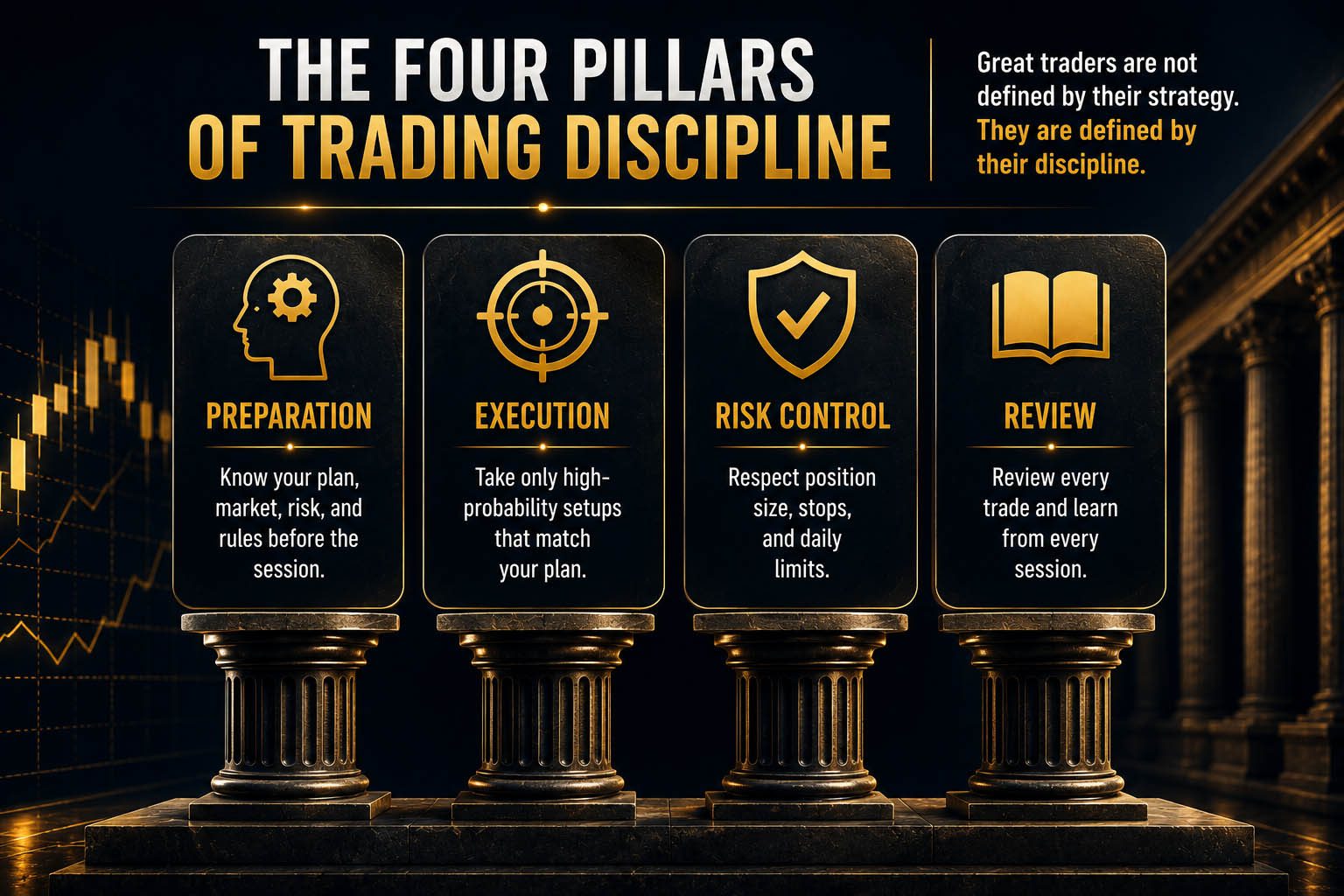
Discipline becomes easier when it is built around clear pillars. These are the foundations of professional execution.
| Pillar | What It Means | Why It Matters |
|---|---|---|
| Preparation | You know your setup, session time, risk, and rules before trading. | Reduces emotional decisions. |
| Execution | You only take trades that match your plan. | Protects consistency. |
| Risk Control | You respect position size, stops, and daily limits. | Protects the account. |
| Review | You study your trades after the session. | Turns experience into improvement. |
How Discipline Breaks Down
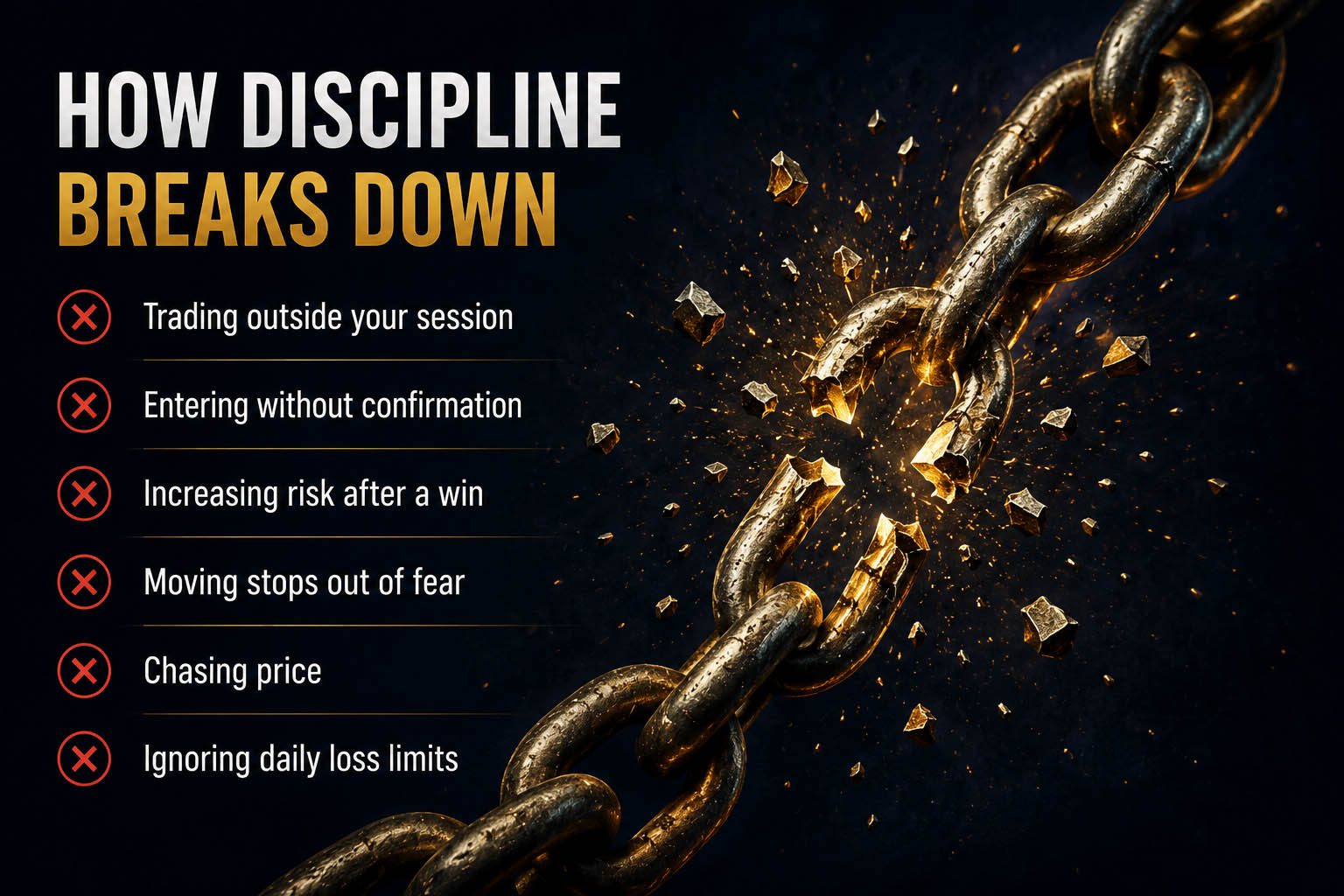
Discipline usually breaks down gradually. A trader bends one small rule, then another, then another. Eventually the plan becomes optional.
Common Discipline Breakdowns
- Taking trades outside your trading session.
- Entering before confirmation because you fear missing out.
- Increasing risk because you feel confident.
- Moving stop loss because you do not want to be wrong.
- Continuing to trade after reaching your daily target.
- Ignoring your max loss because you want to recover.
This is exactly why overtrading and revenge trading must be stopped early.
The Daily Discipline Framework
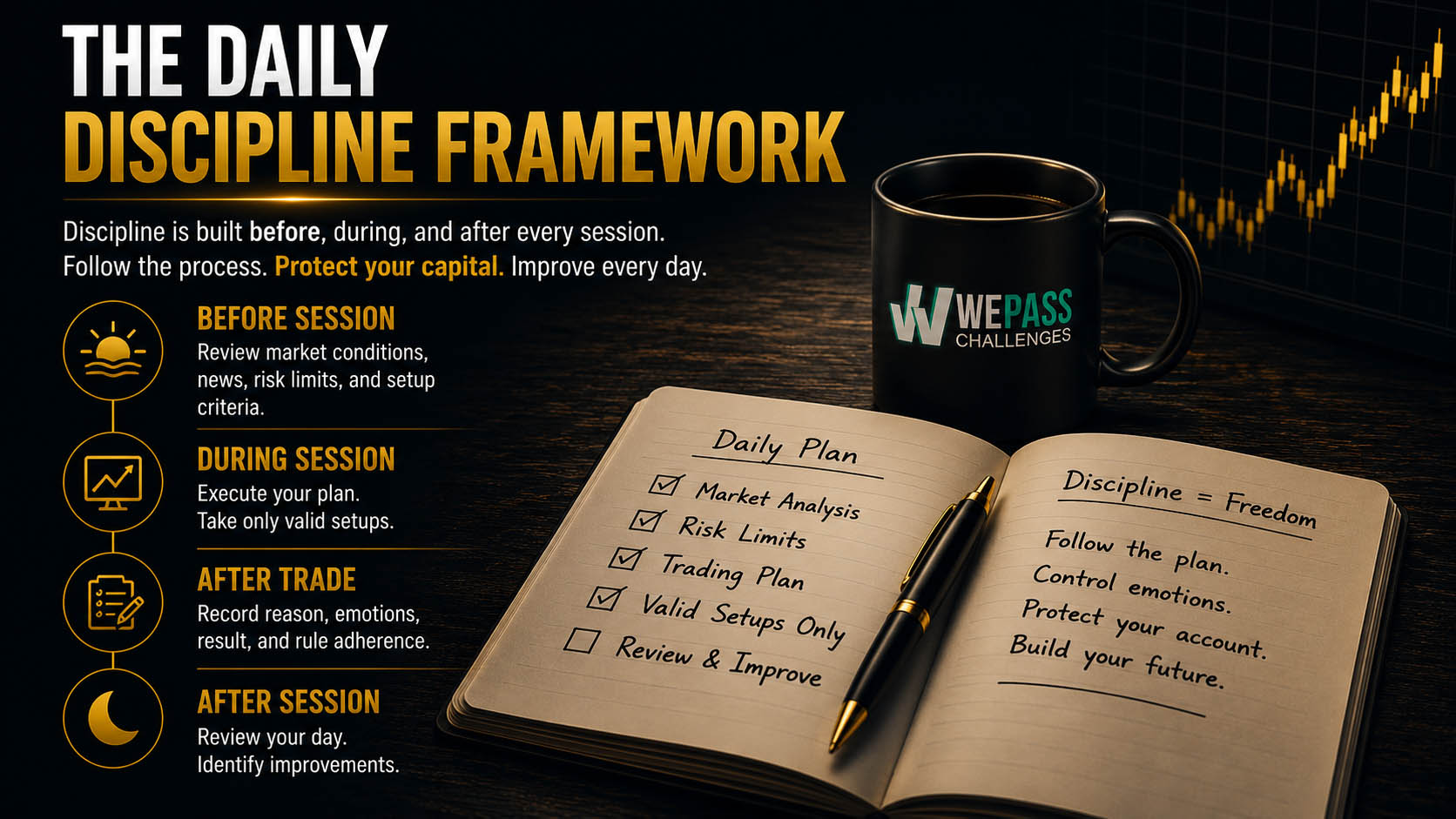
Discipline becomes easier when you follow the same structure every trading day. This removes guesswork and reduces emotional decisions.
| Stage | Action | Purpose |
|---|---|---|
| Before Session | Review market conditions, news, risk limits, and setup criteria. | Prepares your mind before money is at risk. |
| During Session | Only trade setups that match your plan. | Keeps execution objective. |
| After Trade | Record entry reason, emotions, result, and rule adherence. | Builds awareness. |
| After Session | Review whether you followed the plan. | Improves tomorrow’s discipline. |
This framework should be part of your written professional trading plan.
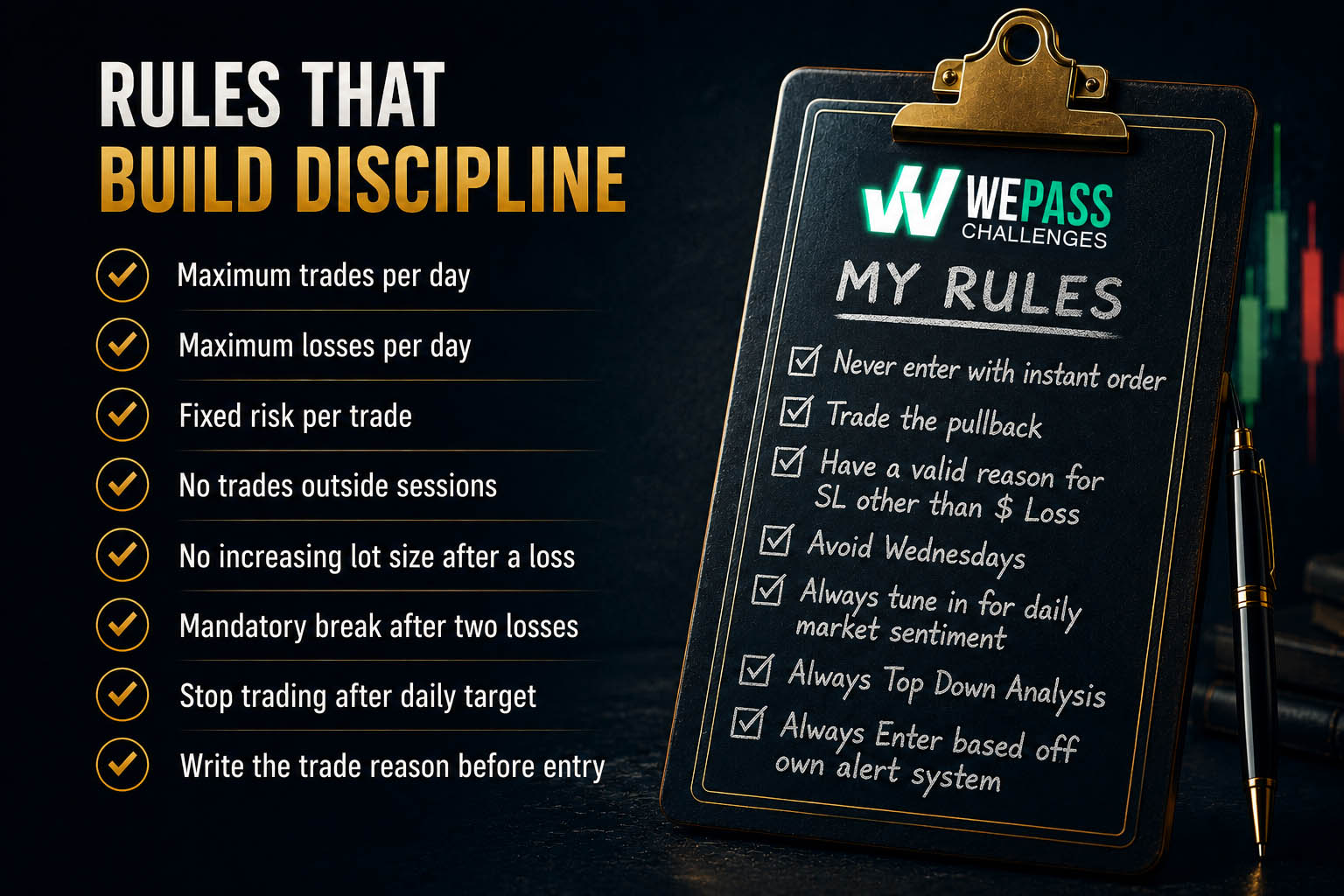
Rules That Build Discipline
Good rules protect you from your worst trading moments. They should be simple, clear, and easy to follow.
- Maximum trades per day.
- Maximum losses per day.
- Fixed risk per trade.
- No trades outside planned sessions.
- No increasing lot size after a loss.
- Mandatory break after two losing trades.
- Stop trading after daily target is reached.
- Write the trade reason before entering.
Fixed risk rules are easier to follow when you understand position sizing before every trade.

Building Discipline Through Journaling
A trading journal is one of the strongest discipline tools because it forces you to face your behavior. Without journaling, traders often remember the outcome but forget the mistake.
Track These Items
- Was the trade part of your plan?
- Did you enter at the correct level?
- Did you use the correct position size?
- Did you respect the stop loss?
- What emotion was strongest before entry?
- Would you take the same trade again?

The Discipline Scorecard
Do not only score your day by profit or loss. Score your day by execution quality.
| Question | Score Yourself |
|---|---|
| Did I trade only my planned setup? | Yes / No |
| Did I respect my risk per trade? | Yes / No |
| Did I stop when my plan said to stop? | Yes / No |
| Did I avoid revenge trading? | Yes / No |
| Did I journal my trades honestly? | Yes / No |
FAQ
Can discipline be learned?
Yes. Discipline is built through repeated behavior, clear rules, and honest review.
Why do I break rules even when I know better?
Because emotion can overpower knowledge in real time. That is why systems and limits are necessary.
Is discipline more important than strategy?
You need both. But even a strong strategy fails if the trader cannot execute it properly.
What is the easiest way to become more disciplined?
Start with fewer rules and follow them perfectly. Max trades, fixed risk, and mandatory stops are a strong beginning.
How do I know if I am improving?
Your trades become more consistent, your rule violations decrease, and your emotional reactions become easier to control.
10-Question Quiz
- What is trading discipline?
Answer: Following your plan even when emotions disagree. - Why is motivation unreliable?
Answer: It depends on mood and can disappear. - Why does discipline matter in prop firm trading?
Answer: Prop firms have strict rules. - What is one pillar of trading discipline?
Answer: Preparation. - What usually starts major rule violations?
Answer: Small exceptions. - What should a trader do before the session?
Answer: Review rules, risk, and setup criteria. - Why is journaling useful?
Answer: It helps identify behavior patterns. - What is a strong discipline rule?
Answer: Fixed risk per trade. - How should traders score their day?
Answer: By execution quality and rule adherence. - What is better long term?
Answer: A disciplined losing day.
Key Takeaways
- Discipline means following the plan even when emotions want something else.
- Motivation comes and goes, but structure creates consistency.
- Prop firm trading requires discipline because rule violations can fail accounts quickly.
- Daily routines, fixed risk, trade limits, and journaling help build discipline.
- A disciplined losing day is better than a profitable day built on bad habits.
Lesson Summary
Building discipline means creating rules and routines that keep you consistent when emotions want control. Motivation is temporary, but structure can guide your decisions every trading day. Professional traders use preparation, execution rules, risk control, review, journaling, and daily scorecards to protect the account and improve over time.