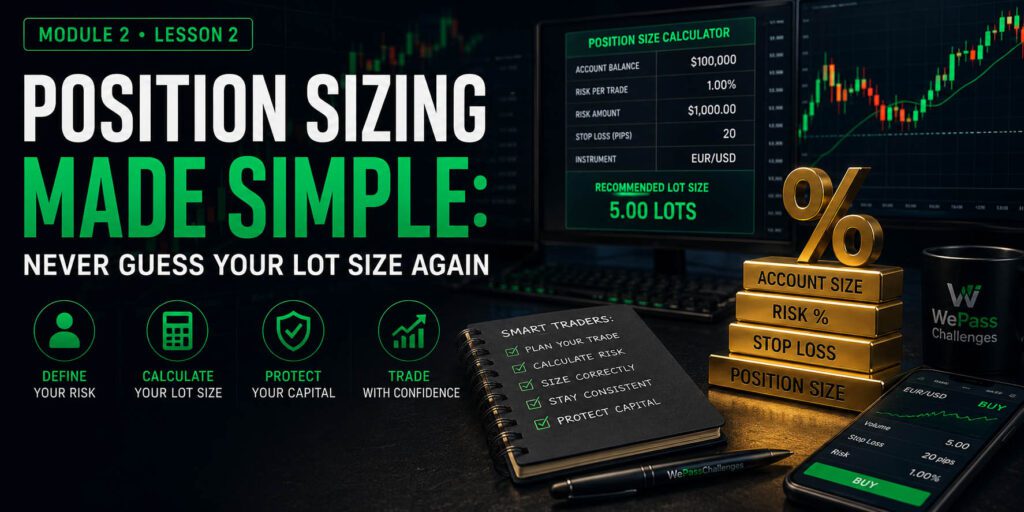
Position Sizing Made Simple: Never Guess Your Lot Size Again
Learn how professional traders calculate lot size, control risk per trade, and protect prop firm accounts with smarter position sizing.
Lesson Goal
Many traders spend years searching for the perfect strategy while completely ignoring one of the biggest factors behind long-term success: position sizing. You can have an excellent strategy and still fail a prop firm challenge if your position sizes are too large.
Professional traders don’t choose lot sizes based on emotions or intuition. Every trade begins with a predefined amount of risk, and the position size is calculated from that number.
What Is Position Sizing?
Position sizing is the process of determining how large your trade should be before entering the market. Instead of choosing a random lot size, professional traders calculate their position based on account size, risk percentage, and stop loss distance.
Your lot size should always be the result of your risk management plan — not your emotions.
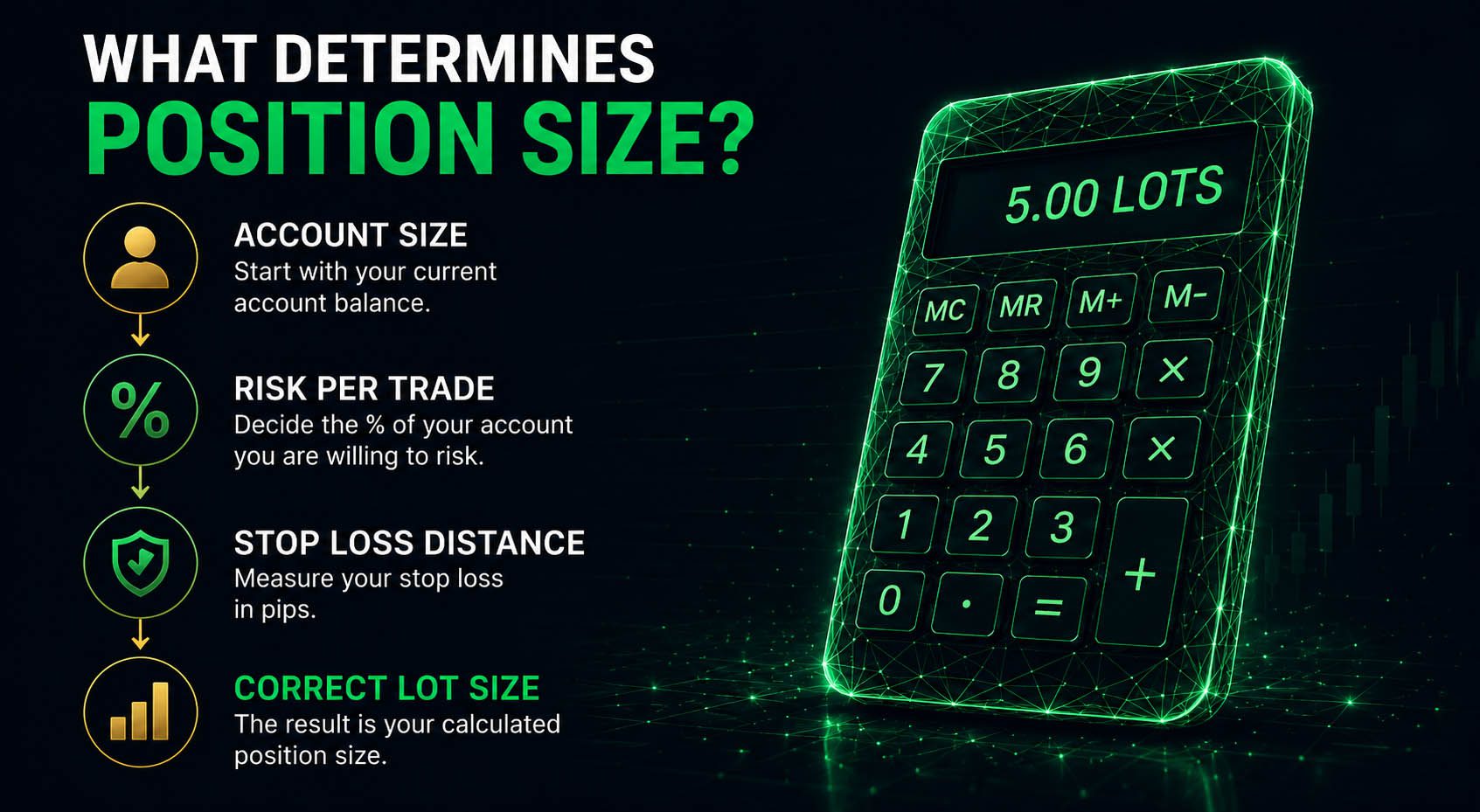
The Three Numbers You Need
Before you calculate position size, you need three numbers. These numbers keep your trade controlled before you ever click buy or sell.
- Account Balance
- Risk Per Trade
- Stop Loss Distance
Once you know these three values, your position size can be calculated accurately every single time.
Example Trade
| Account | Risk | Stop Loss | Lot Size |
|---|---|---|---|
| $100,000 | 1% | 20 Pips | 5.00 Lots* |
*Illustrative example. Actual position size depends on the instrument traded, contract specifications, and pip value.
Calculate Your Position Size in Seconds
Never guess your lot size again. Our free Position Size Calculator instantly calculates the correct lot size based on your account balance, risk percentage, stop loss distance, and trading instrument — helping you stay compliant with prop firm risk rules.
Open Free Lot Size Calculator → ✓ Free to Use ✓ No Login RequiredUnderstanding how position sizing works is important, but calculating it accurately before every trade is even more important. That’s why professional traders rely on calculators and predefined risk rules instead of estimating lot sizes manually.
Position sizing also affects your risk-to-reward ratio. A stop loss that is too wide, paired with a position size that is too large, can destroy a good trade idea before the setup even has a chance to work.
Why Beginners Get This Wrong
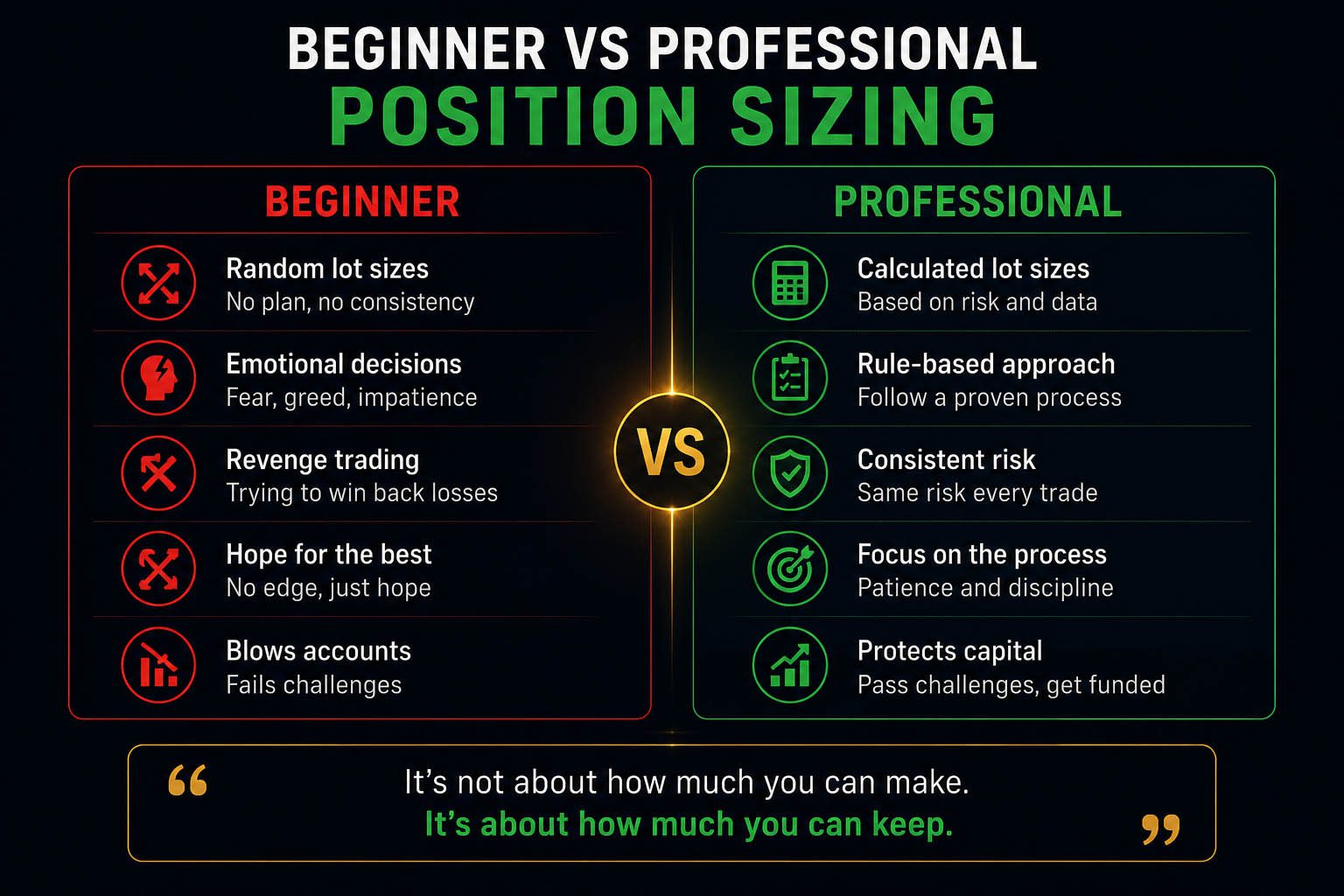
Many traders increase their lot size after a winning streak because they feel invincible. Others double their position after a loss, hoping to recover quickly. Both approaches usually end with a failed evaluation.
Common Mistakes
- Choosing a random lot size
- Ignoring stop loss distance
- Increasing risk after wins
- Doubling down after losses
- Trading based on emotion
These mistakes become even more dangerous when a trader is close to the firm’s maximum daily loss limit or near the account’s maximum drawdown rule.
Consistency Beats Size
A trader risking the same amount on every trade develops consistency. Over time, this creates predictable performance, easier journaling, and better emotional control.
The goal isn’t to trade bigger. The goal is to trade smarter.
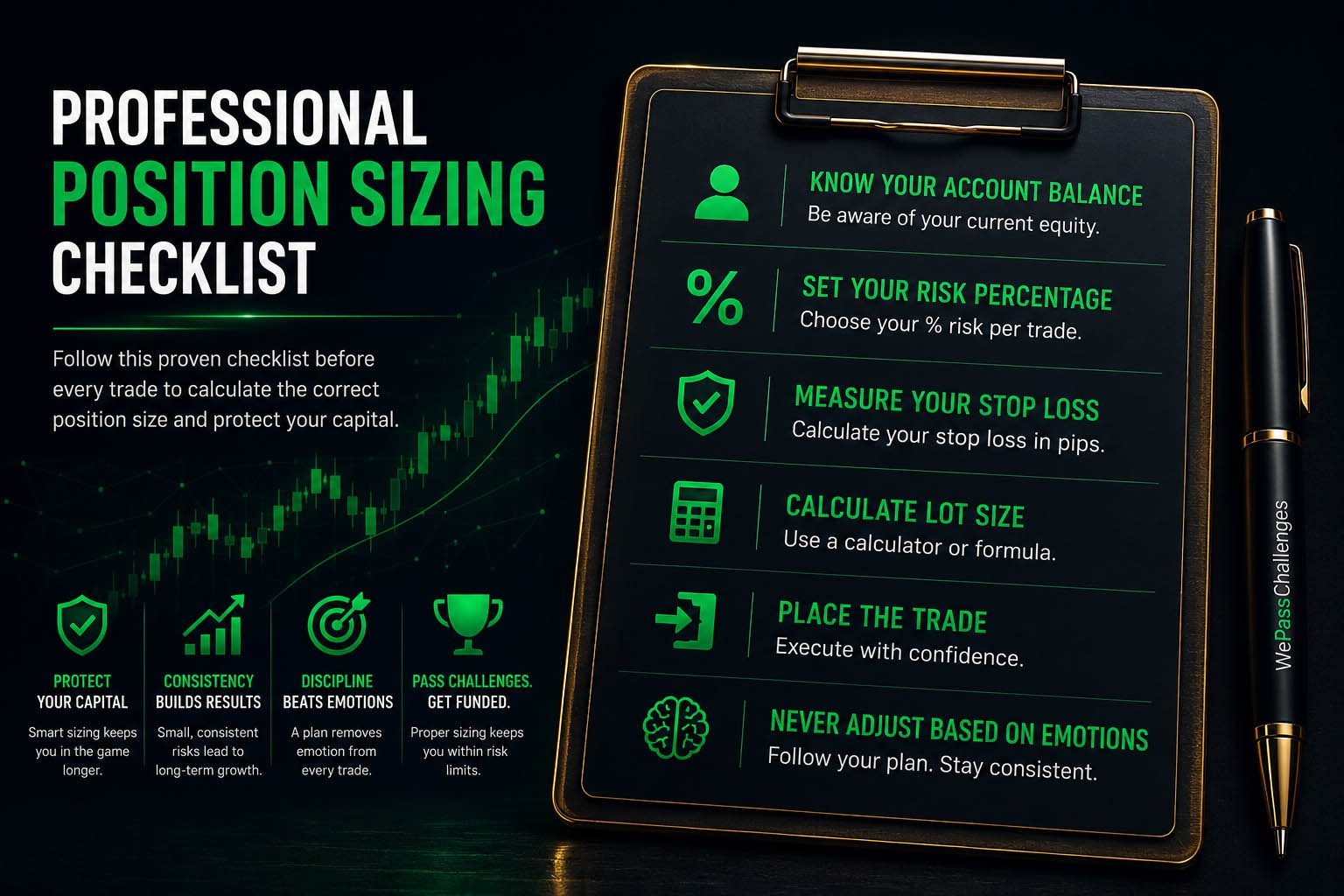
Professional Checklist
- Know your account balance.
- Decide your risk percentage first.
- Measure your stop loss.
- Calculate the correct position size.
- Never increase size because of emotion.
- Review every trade in your journal.
How WePassChallenges Uses Position Sizing
At WePassChallenges, every position begins with predefined risk. Before a trade is placed, we determine the acceptable dollar risk, calculate the appropriate position size for the specific instrument, and verify that the trade remains within the prop firm’s daily and maximum drawdown limits. This disciplined process helps remove emotion and keeps risk consistent from one trade to the next.
We also avoid unnecessary exposure during bad market conditions. Proper position sizing works even better when combined with knowing when not to trade and when to protect the account.
Key Takeaways
- Your lot size should never be random. It should be calculated before the trade begins.
- Position size is based on risk, not confidence. Feeling good about a trade is not a reason to increase size.
- Every trade should risk a consistent amount. Consistency makes performance easier to track and improve.
- Proper position sizing protects funded accounts. It helps keep trades inside prop firm risk limits.
- Consistency is more important than trading larger. Professional trading is about survival, not showing off.
Lesson Quiz
- What three numbers are needed to calculate position size?
- Should lot size be based on confidence or predefined risk?
- Why is increasing lot size after a winning streak dangerous?
- Why should stop loss always be considered before entering a trade?
- How does consistent position sizing improve long-term trading performance?
Lesson Summary
Successful traders don’t guess their lot sizes — they calculate them. By determining your risk before every trade and adjusting position size accordingly, you create consistency, protect your capital, and significantly improve your chances of passing and keeping a funded account.
This is one of the biggest foundations of capital preservation. The trader who controls risk has a real chance to survive, improve, and stay funded.