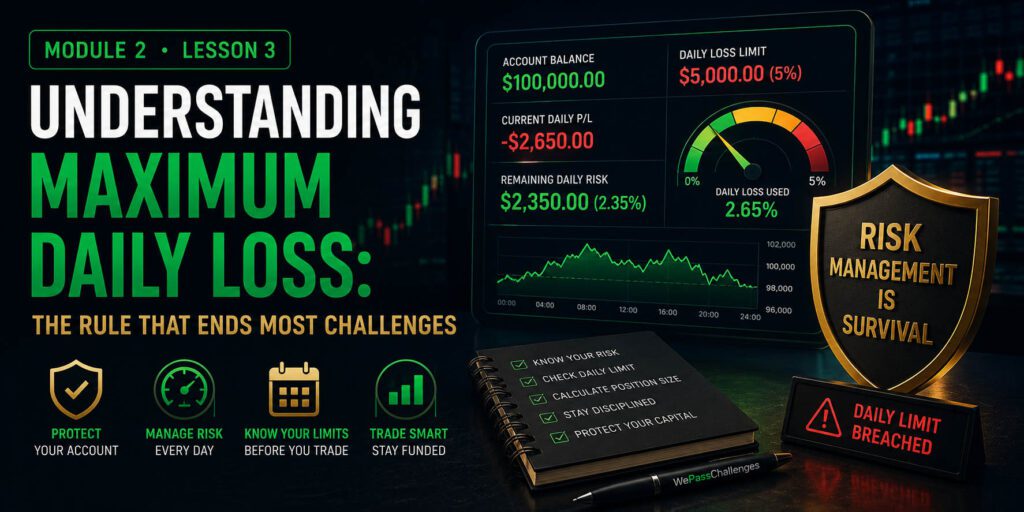
Understanding Maximum Daily Loss: The Rule That Ends Most Challenges
Learn how maximum daily loss works, why daily drawdown rules fail so many traders, and how to protect your prop firm account from accidental violations.
Lesson Goal
You can have an excellent trading strategy and still fail a prop firm challenge if you don’t understand one of the most important rules in funded trading: the Maximum Daily Loss. Every year, thousands of traders lose their evaluations — not because they couldn’t trade, but because they unknowingly exceeded their daily loss limit.
Professional traders don’t simply focus on finding winning trades. They constantly monitor their remaining daily risk, ensuring they stay well within the firm’s rules regardless of market conditions.
What Is Maximum Daily Loss?
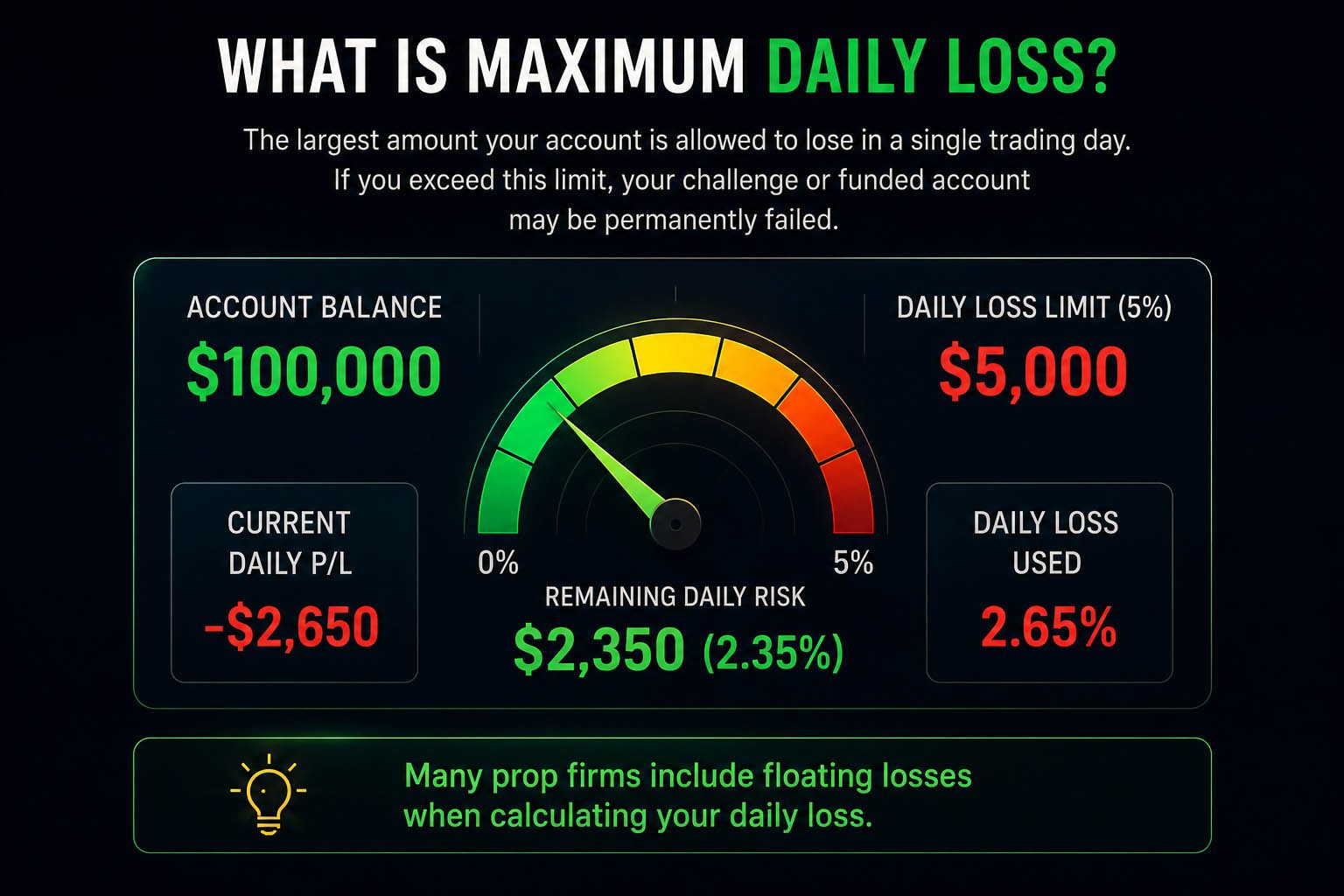
Maximum Daily Loss is the largest amount of money your account is allowed to lose during a single trading day. Once this limit is exceeded, your challenge or funded account may be permanently failed — even if your strategy would have recovered later.
For many prop firms, this rule applies to both closed trades and floating losses. That means even if a losing trade hasn’t been closed yet, your account could still violate the rule.
| Account Size | Daily Loss Limit | Maximum Daily Loss |
|---|---|---|
| $100,000 | 5% | $5,000 |
Daily Loss vs Maximum Drawdown
Daily loss and maximum drawdown are related, but they are not the same thing. Daily loss focuses on what happens during one trading day. Maximum drawdown focuses on the total loss allowed across the full life of the account.
| Daily Loss | Maximum Drawdown |
|---|---|
| Resets every trading day* | Applies across the life of the account |
| Usually 4–5% | Usually 8–10% |
| Protects against bad trading days | Protects total account capital |
| Can be triggered by floating losses | Can be static, trailing, or end-of-day based |
*Rules vary by prop firm. Always review your firm’s specific evaluation agreement.
How Close Are You to Breaking Your Drawdown?
Knowing your remaining daily loss is just as important as finding good trades. Our free Drawdown Calculator instantly shows how much room you have left before violating your prop firm’s rules.
Open Free Drawdown Calculator → ✓ Free ✓ Instant Results ✓ No Login Required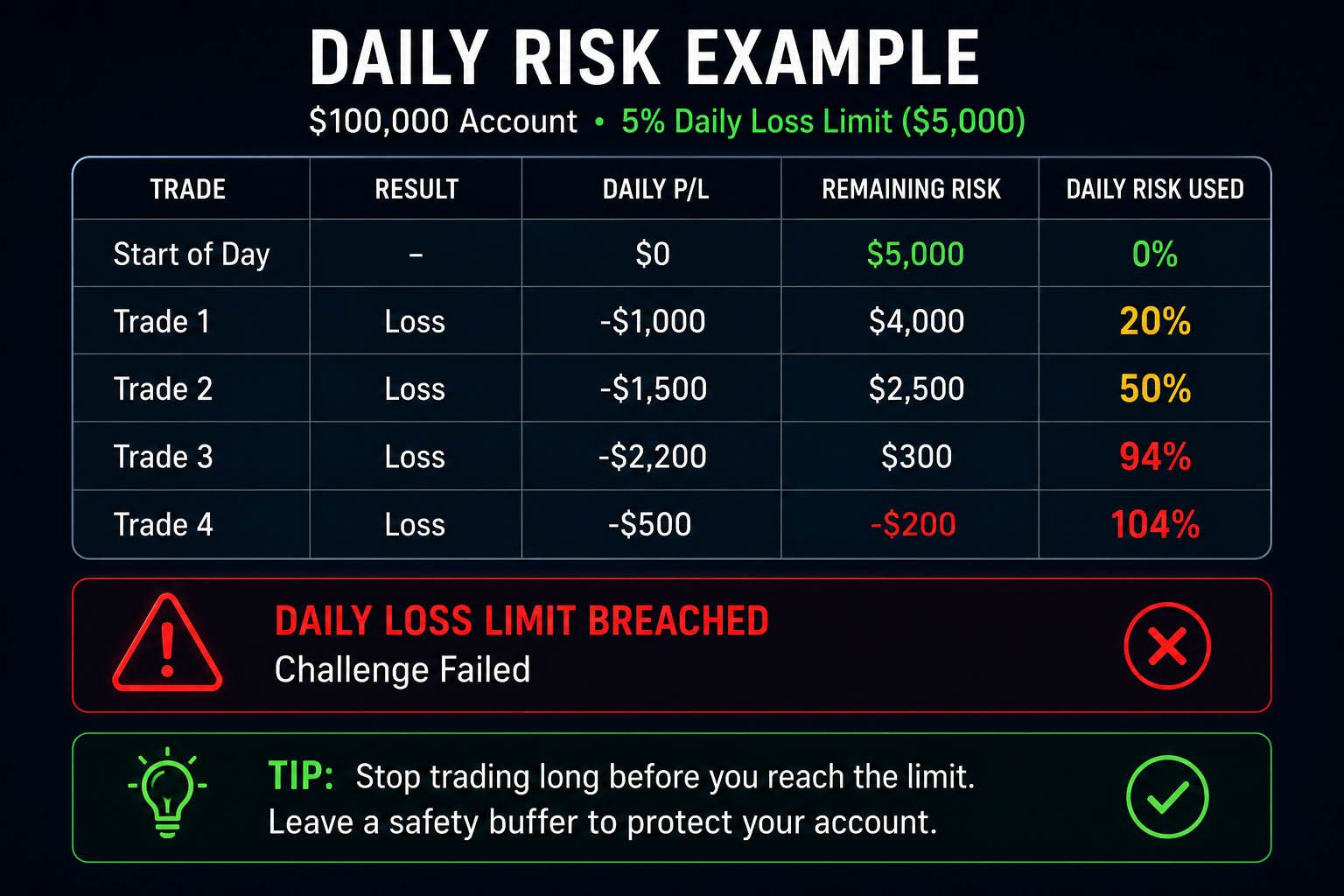
Example: How Daily Loss Adds Up
Imagine you’re trading a $100,000 challenge with a 5% daily loss limit.
- Account Size: $100,000
- Maximum Daily Loss: $5,000
- Trade 1: -$1,000
- Trade 2: -$1,500
- Trade 3: -$2,200
At this point, continuing to trade aggressively would place the account at serious risk of breaching the daily loss rule. Even a small spread spike, slippage, or floating loss could push the account beyond the allowed daily limit.
This is exactly why proper position sizing matters. If your lot size is too large, your remaining daily risk can disappear quickly.
Balance vs Equity
This is where many traders get caught. Your balance only reflects closed trades. Your equity includes open floating profit or loss. Many prop firms monitor equity, which means an open losing position can trigger a daily loss breach before you close the trade.
| Balance | Equity |
|---|---|
| Closed trade results only | Balance plus open floating P/L |
| Updates after trades close | Moves live with the market |
| Can look safe | Can breach rules instantly |
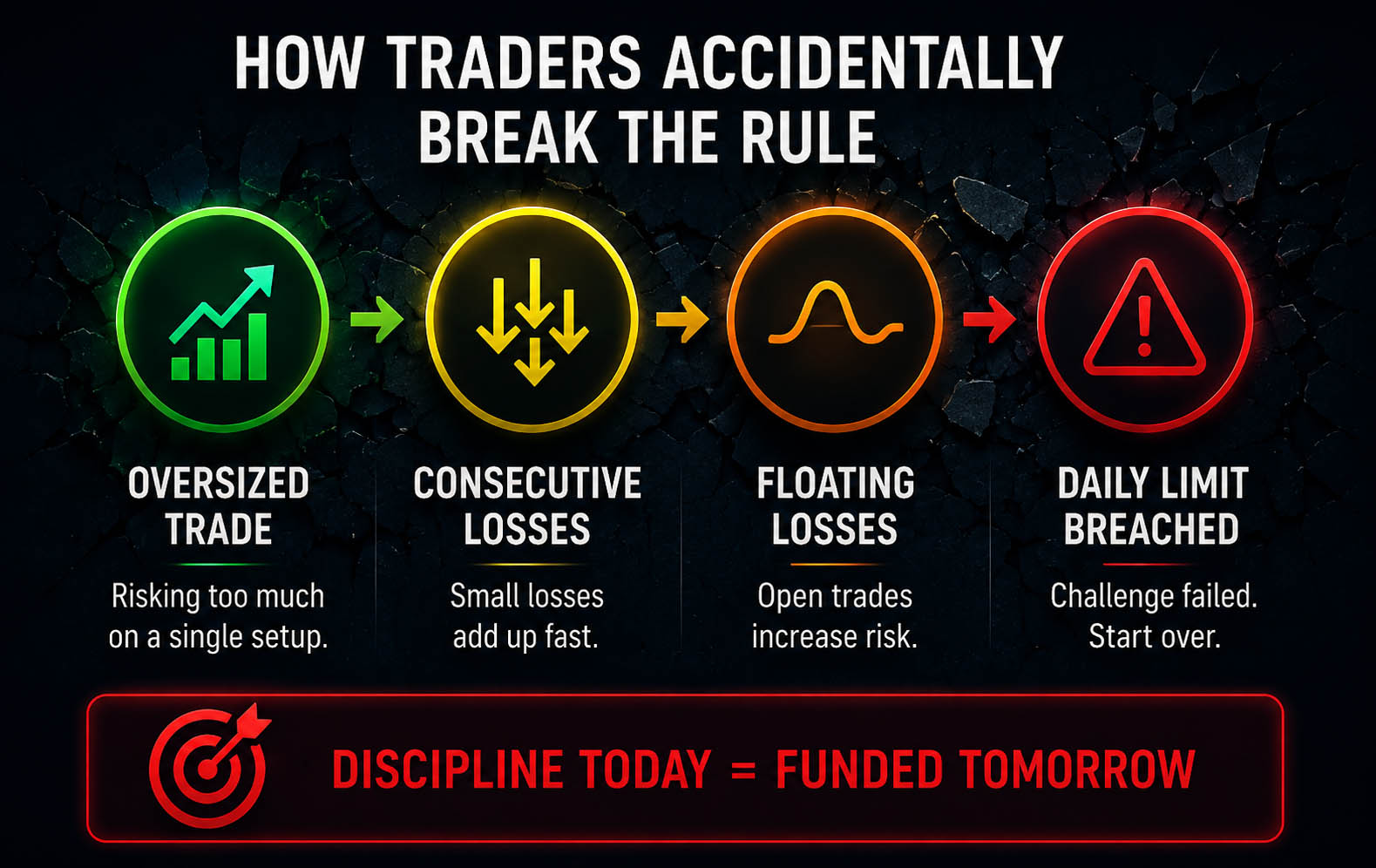
Why Traders Accidentally Break Daily Loss Rules
Very few traders intentionally violate the daily loss rule. Most breaches happen because of small decisions that snowball into larger problems. A trader increases position size after two losses, refuses to close a losing trade, or believes the market will reverse “any minute now.” Before they realize it, the account has exceeded its daily risk allowance.
Professional traders avoid this by treating their remaining daily loss like a fuel gauge. As the available risk decreases, they reduce position size — or stop trading altogether.
Common Breach Triggers
- Increasing lot size after a losing trade
- Holding open losses too long
- Moving stop losses farther away
- Trading during high-impact news
- Taking too many trades in one session
- Revenge trading after a frustrating loss
These are not strategy problems. They are trading plan and discipline problems.
The 80% Rule
One habit used by many professional traders is stopping long before the maximum daily loss is reached. The goal is not to use every dollar of risk the firm allows. The goal is to protect the account so you can trade again tomorrow.
Example
If your firm’s daily loss limit is $5,000, consider stopping for the day after losing around $4,000. Leaving a safety buffer protects you from accidental slippage, spread widening, or floating losses that could otherwise breach the account.
This mindset connects directly to capital preservation. Professional traders are not trying to squeeze every dollar out of the limit. They are trying to stay funded.
How Professionals Stay Safe
- Know the remaining daily risk before entering another trade.
- Reduce position size after consecutive losses.
- Stop trading when emotional.
- Never revenge trade.
- Leave a safety buffer below the firm’s limit.
- Avoid trading during major news unless the rules allow it.
- Use stop losses and respect them.
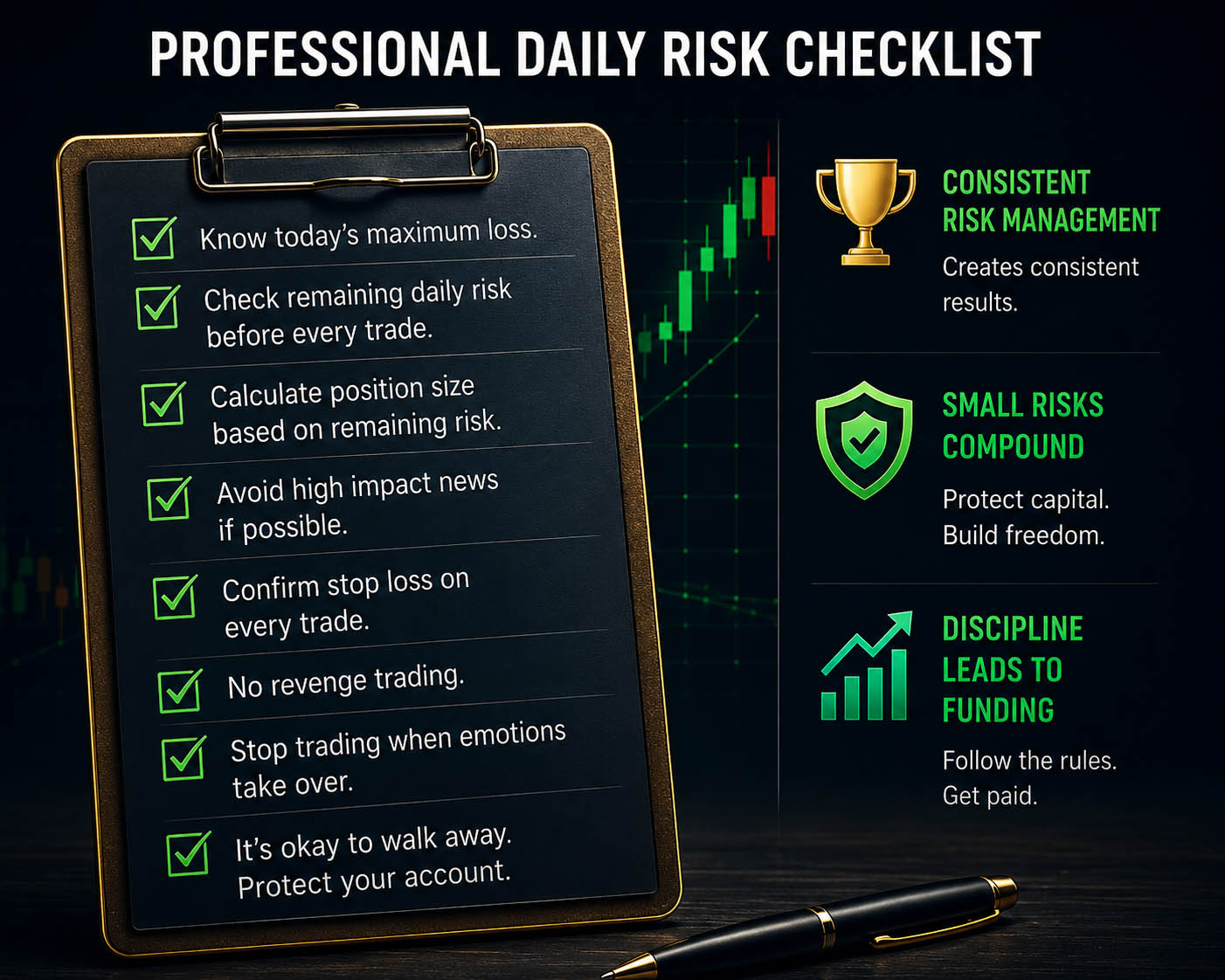
Professional Daily Risk Checklist
- ✓ Know today’s maximum loss.
- ✓ Check remaining daily risk before every trade.
- ✓ Calculate position size before entering.
- ✓ Reduce lot size after consecutive losses.
- ✓ Stop trading if emotions take over.
- ✓ Never revenge trade.
- ✓ Finish the day with capital still protected.
Need the Correct Lot Size Too?
Daily loss protection and position sizing work together. Before placing another trade, use the free Lot Size Calculator to calculate risk based on your account size, stop loss, and instrument.
Open Free Lot Size Calculator →The WePassChallenges Approach
At WePassChallenges, protecting the account always comes before chasing profits. Before each trading session begins, we establish a daily risk budget based on the firm’s rules and the account’s remaining drawdown. Throughout the day we continuously monitor realized and unrealized losses, adjusting position size as necessary to remain comfortably within the firm’s limits.
If market conditions become unfavorable or the daily risk budget is nearly exhausted, we simply stop trading. The market will always be open tomorrow, but a failed challenge cannot be undone. That is why disciplined risk management is not optional — it is the foundation of funded trading.
Knowing when not to trade is just as important as knowing when to enter. A protected account gives you another chance tomorrow.
Key Takeaways
- Maximum Daily Loss is one of the most common reasons traders fail evaluations. Traders often lose because they mismanage the rule, not because they lack a strategy.
- Floating losses may count toward your limit. Equity-based rules can trigger violations before trades are closed.
- Always know your remaining daily risk. You should never enter a trade without knowing how much room is left.
- Use smaller position sizes after losing trades. Reducing risk helps prevent one bad day from becoming a failed account.
- Leave a safety buffer below the firm’s maximum limit. Spread, slippage, and floating losses can push accounts over the line.
- Protect your account first. Opportunities will always return tomorrow.
Lesson Quiz
- What is Maximum Daily Loss?
- Does every prop firm calculate it exactly the same way?
- Can floating losses count toward your daily limit?
- Why should traders leave a safety buffer?
- What is the safest decision when your remaining daily risk becomes very small?
Frequently Asked Questions
What happens if I exceed the maximum daily loss?
Most prop firms consider exceeding the maximum daily loss a rule violation that results in the immediate failure of the challenge or funded account. Always review your firm’s specific policies.
Do floating losses count toward daily drawdown?
Many firms calculate daily loss using equity rather than balance, meaning open losing trades may count toward your daily limit. Check your firm’s documentation to understand exactly how the rule is applied.
Can I continue trading after a large losing trade?
You can only continue if doing so keeps you within your firm’s rules. Many experienced traders choose to stop well before reaching the maximum daily loss to avoid unnecessary risk.
Should I use a drawdown calculator before every trade?
Yes. Monitoring your remaining drawdown helps you make informed decisions about position size and whether it makes sense to continue trading that day.
How can I reduce the chance of breaking my daily loss limit?
Risk only a small percentage per trade, avoid revenge trading, monitor your remaining daily risk, use tools like the Drawdown Calculator, and stop trading once your daily risk budget has largely been used.
Is Maximum Daily Loss the same as Daily Drawdown?
They are often used to describe the same risk rule, but the exact calculation can vary by firm. Some firms calculate from starting balance, some from equity, and some from the prior day’s ending balance.
Lesson Summary
The Maximum Daily Loss rule exists to protect both traders and prop firms from catastrophic trading days. By understanding how it works, monitoring your remaining daily risk, leaving a safety buffer, and trading with discipline, you’ll dramatically increase your chances of completing an evaluation and keeping a funded account.