
Module 7 · Lesson 4
Consistency, Trading Frequency & Risk Distribution
Learn how to control the number of trades you take, distribute account risk across valid opportunities, avoid oversized performance days, and build results that can be repeated across multiple payout cycles.Professional consistency is not making the same amount every day. It is applying the same disciplined process to every valid opportunity.
Consistency Is Built Through Controlled Behavior
A funded trader does not need to win every day. The trader needs to prevent one emotional day, oversized trade, or uncontrolled session from dominating the entire account.
Many traders misunderstand consistency. They believe it means producing profit every day or trading a fixed number of times during every session. That interpretation often creates forced activity. Professional consistency is different. It means:- Using stable risk from one qualified setup to the next.
- Following the same entry and management rules.
- Limiting the number of daily trading attempts.
- Avoiding dependence on one oversized winning day.
- Distributing risk across a meaningful sample of trades.
- Accepting that some days and weeks will contain no valid opportunities.
Consistency is not the absence of variance. It is the ability to prevent normal variance from turning into uncontrolled risk.
This lesson builds on Protecting Your Funded Account and Building a Consistent Payout Strategy.
What You Will Learn
1Define professional consistency
Understand the difference between stable execution and unrealistic daily profit expectations.
2Control trading frequency
Set daily and weekly activity limits that reduce overtrading and emotional decision-making.
3Distribute risk correctly
Avoid concentrating too much account exposure in one trade, one market, or one session.
4Manage winning days
Prevent one large result from creating overconfidence or violating consistency requirements.
5Measure performance distribution
Track how profits, losses, trades, and risk are spread across the payout cycle.
6Build a stable trading rhythm
Create a repeatable weekly structure based on quality rather than constant activity.
What Does Consistent Trading Actually Mean?
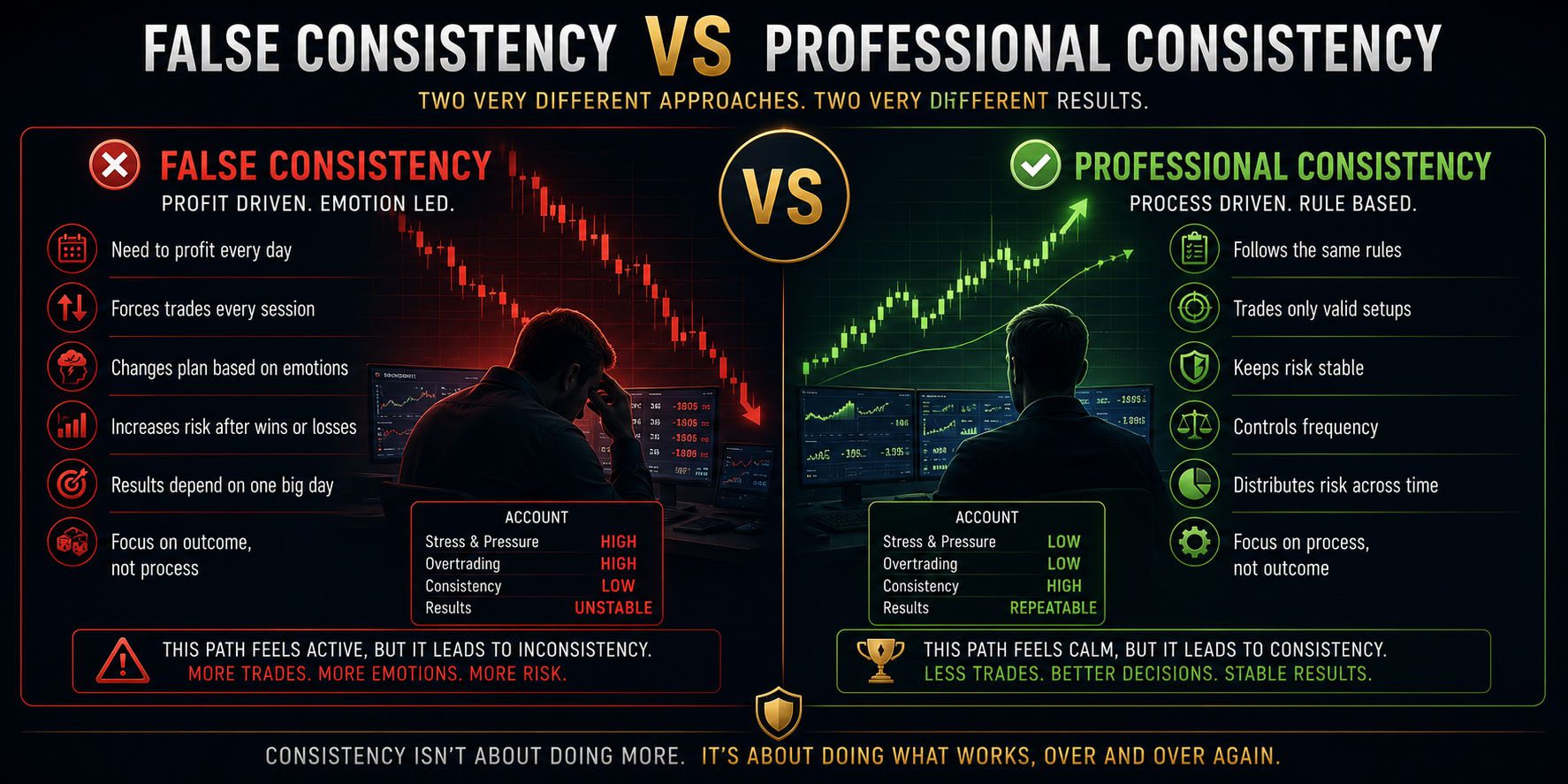
Consistent trading does not mean that every trade has the same outcome. It means that the decision-making process remains stable even though outcomes naturally vary.False Consistency
- Trying to make profit every day.
- Taking a trade during every session.
- Forcing the same monetary target regardless of market conditions.
- Increasing size after a slow week.
- Trading more often after a loss.
- Judging consistency only by account balance.
Professional Consistency
- Applying the same strategy rules repeatedly.
- Using stable predefined risk.
- Waiting for qualified setups.
- Accepting inactive sessions.
- Limiting the impact of any single day.
- Measuring both performance and rule adherence.
More Trades Do Not Automatically Create More Profit
Trade frequency is the number of positions a trader opens during a defined period. That period may be a session, day, week, month, or payout cycle. The correct frequency depends on the strategy. A scalping strategy may naturally produce more valid setups than a swing strategy. The problem begins when traders create additional trades that do not belong to the tested system. Every extra trade creates:- Additional transaction costs.
- Additional exposure to spread and slippage.
- Another opportunity to make an execution mistake.
- More emotional stimulation.
- More account drawdown if the setup is weak.
- A larger chance of violating daily or consistency rules.
Professional Trading Frequency
Valid Strategy Setups Available − Forced or Duplicate Trades
Quality Determines FrequencyDo not set a minimum number of trades that must be taken. A minimum activity target can force the trader to manufacture opportunities that do not exist.
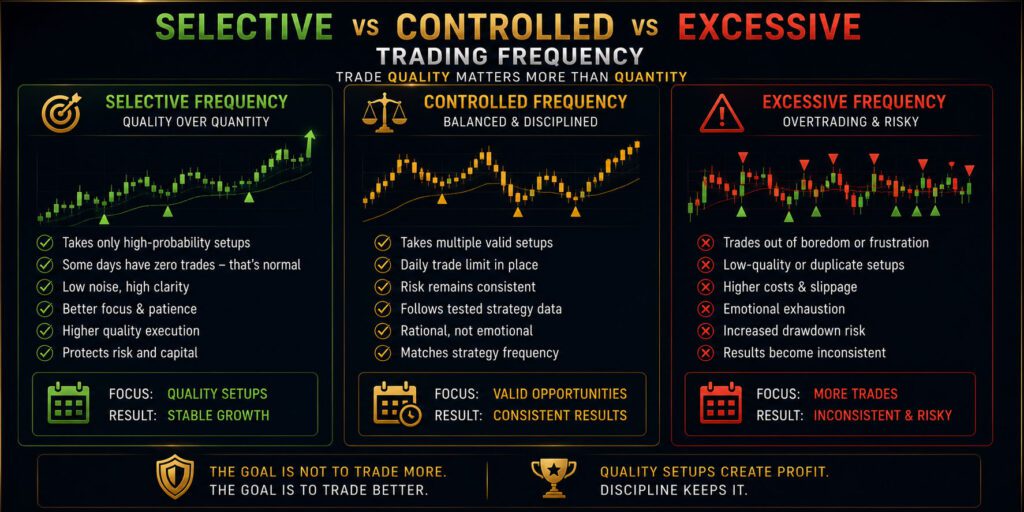
Low, Controlled and Excessive Trading Frequency
Selective Frequency
- Only top-tier setups qualify.
- Some sessions contain no trades.
- Risk is reserved for strong market conditions.
- Execution quality is easier to review.
- Emotional fatigue remains low.
Controlled Frequency
- Several valid setups may be taken.
- A daily maximum still applies.
- Correlated positions are treated as combined risk.
- Each trade must meet the full checklist.
- Frequency matches tested strategy data.
Excessive Frequency
- Trades are taken from boredom or urgency.
- Similar setups are repeated without justification.
- Quality declines as the session continues.
- Daily risk limits are approached quickly.
- Results become dependent on constant activity.
Set a Maximum Number of Trading Attempts
A daily trade limit protects the trader from continuing to participate after decision quality begins to deteriorate. The maximum number should be connected to:- The strategy’s historical setup frequency.
- Risk per trade.
- The personal daily loss limit.
- The number of markets being monitored.
- The trader’s ability to maintain focus.
- The probability of correlated exposure.
| Risk Per Trade | Example Daily Loss Limit | Maximum Full-Loss Attempts | Professional Consideration |
|---|---|---|---|
| 0.25% | 1% | Up to four | Only when the strategy naturally produces several independent setups. |
| 0.50% | 1% | Two | A third trade would exceed the daily boundary after two full losses. |
| 0.75% | 1.5% | Two | Little room remains for slippage or correlated exposure. |
| 1.00% | 1% | One | One full loss should end the session under this model. |
Do Not Concentrate the Entire Week Into One Trade
Risk distribution refers to how total account exposure is spread across trades, sessions, markets, and days. Professional distribution prevents one idea from having an outsized effect on the account.Per TradeLimit exposure on every individual setup.
Per MarketAvoid excessive concentration in one instrument.
Per SessionPrevent one session from using the full weekly risk budget.
Per WeekPreserve enough room for future valid opportunities.
Risk should be available for future opportunities. Do not spend the entire week’s risk budget on the first attractive setup.
One Trade Can Quietly Become Several Trades
Risk may appear distributed because several tickets are open, while the account is actually concentrated in one idea. This occurs when positions share:- The same base or quote currency.
- The same economic event.
- The same market direction.
- The same index-sector exposure.
- The same commodity or risk-sentiment theme.
- The same entry trigger across several timeframes.
Example: False Diversification
A trader opens the following positions:- EURUSD long with 0.5% risk.
- GBPUSD long with 0.5% risk.
- AUDUSD long with 0.5% risk.
Avoid Depending on One Oversized Winning Day
Some prop firms use formal consistency rules that limit how much of total profit may come from one trading day. Even when no written rule exists, traders should still monitor profit concentration. If one day produces most of the payout-cycle profit, the performance may be unstable.Best-Day Profit Concentration
Best Trading Day Profit ÷ Total Payout-Cycle Profit × 100
Best-Day Percentage = Best Day ÷ Total ProfitExample
A trader earns $5,000 during a payout cycle. One trading day produced $3,500.$3,500 ÷ $5,000 × 100 = 70%
One day produced 70% of the total payout-cycle profit.
This does not automatically mean the trading was poor. A strong valid setup may naturally create an exceptional day. However, it tells the trader that the cycle is highly dependent on one outcome.
The wrong response is to force smaller profits on additional days merely to improve the ratio. The correct response is to keep risk stable, continue following valid setups, and understand the firm’s exact consistency calculation.
Never take unnecessary trades only to manipulate a consistency statistic. The cure for concentration is stable future execution, not forced activity.
The Next Session Is Often More Dangerous Than the Winning Session
A large winning day can create relief, excitement, and excessive confidence. The trader may begin treating part of the profit as disposable. Common post-win mistakes include:- Increasing position size without data.
- Taking lower-quality setups.
- Opening more trades than usual.
- Trading outside approved sessions.
- Trying to repeat the same dollar amount immediately.
- Ignoring the fact that market conditions may have changed.
Emotional Post-Win Response
- I am trading extremely well right now.
- I can afford to risk some of the profit.
- I should increase size while momentum is strong.
- I need another large day.
- The next setup does not need to be perfect.
Professional Post-Win Response
- The next trade is independent of the last result.
- Risk remains unchanged.
- Profit protection now matters more.
- I will only take the next complete setup.
- I may stop early if the payout objective is near.
Small Controlled Losses Are Easier to Recover From
Consistency also applies to losses. A trader who loses 0.25% to 0.5% on several valid trades may be experiencing normal strategy variance. A trader who loses 3% in one uncontrolled session has created a much larger operational problem.| Loss Pattern | Account Impact | Psychological Impact | Professional Interpretation |
|---|---|---|---|
| Several small valid losses | Gradual controlled drawdown | Usually manageable | May represent normal strategy variance. |
| One oversized loss | Immediate account damage | Creates urgency and fear | Often indicates risk or execution failure. |
| Repeated losses from one theme | Concentrated exposure | Creates confusion | May indicate hidden correlation. |
| Losses after daily stop | Preventable drawdown | Creates revenge trading | Represents a discipline violation. |
Build a Stable Weekly Operating Structure
A funded trader benefits from a defined weekly rhythm. The rhythm should organize preparation, execution, and review without requiring daily activity.Prepare the Week
Review major economic events, approved markets, account condition, payout-cycle position, and personal risk limits.Define the Risk Budget
Know the maximum daily and weekly exposure before the first trade is placed.Trade Qualified Sessions
Focus on approved London and New York opportunities rather than monitoring the market continuously.Stop at the Daily Boundary
End the session after the maximum loss, trade count, profit boundary, or emotional stop is reached.Review Midweek Exposure
Measure remaining weekly risk, recent losses, correlation, and whether the strategy is matching current conditions.Complete the Weekly Review
Evaluate risk distribution, execution quality, best-day concentration, and whether any trades were forced.Measure How Results Are Distributed
Profit alone does not reveal whether the account is being managed consistently. A trader should also track how profit and risk are distributed.Professional Consistency Metrics
- Best-day percentage: The percentage of total profit produced by the strongest day.
- Average risk per trade: Whether position exposure remains stable.
- Largest risk per trade: Whether any setup received unusual size.
- Trades per day: Whether activity increases after wins or losses.
- Maximum daily loss: The largest account decline during one session.
- Maximum daily gain: Whether the cycle depends on one unusually large result.
- Profit by session: London, New York, or other approved periods.
- Profit by instrument: Whether performance depends on one market.
- Correlated exposure: How often several positions express the same idea.
- Rule-adherence rate: The percentage of trades that met the complete strategy checklist.
Two Traders With the Same Monthly Profit
Monthly Result
Trader A and Trader B both finish the month with a 3% profit on a funded account.Trader A
- Made 6% during one large winning day.
- Lost 3% during the rest of the month.
- Took 48 trades.
- Increased size after wins.
- Broke the daily trade limit twice.
- Best day produced 200% of the final net profit.
Trader B
- Built profit across several qualified setups.
- Largest winning day was 1%.
- Largest losing day was 0.75%.
- Took 14 trades.
- Used consistent position risk.
- Followed every daily and weekly boundary.
The Funded Trader Consistency Process
Define Valid Setup Frequency
Use backtesting and forward-testing data to estimate how many qualified trades the strategy normally produces.Set Daily Activity Limits
Establish the maximum number of trades and maximum financial loss permitted during one session.Distribute Risk
Keep individual positions small enough to preserve room for future independent opportunities.Control Correlation
Measure several related positions as one combined risk event.Protect Large Winning Days
Do not increase risk or frequency after unusually strong performance.Review Distribution
Measure best-day concentration, daily loss size, trade frequency, and rule adherence after each week and payout cycle.Consistency, Frequency & Risk Distribution Checklist
My trade frequency matches my tested strategy.
I do not require a minimum number of daily trades.
I have a maximum number of daily attempts.
I know my daily financial loss limit.
I know my weekly risk boundary.
I keep risk stable from trade to trade.
I do not increase size after winning trades.
I treat correlated trades as combined exposure.
I preserve risk for future opportunities.
I do not force activity to improve consistency statistics.
I track my best-day profit percentage.
I track the number of trades taken each day.
I track my largest daily gain and loss.
I review whether one market dominates performance.
I accept no-trade days as part of consistency.
I judge consistency by process, not daily profit.
Funded Trader Consistency FAQ
Does consistency mean I need to make profit every day?
No. Professional consistency refers to stable execution, controlled risk, and repeated rule adherence. Daily outcomes will naturally vary.How many trades should I take each day?
The correct number depends on your tested strategy and risk limits. Set a maximum, not a required minimum. Some days may correctly contain no trades.Is taking more trades a good way to improve monthly profit?
Only when the additional trades are valid strategy setups. Increasing frequency without a real edge usually increases transaction costs, mistakes, and drawdown.What should I do after a very large winning day?
Keep risk stable or become more protective. Do not assume the next session will produce similar conditions. Review payout-cycle position and consistency rules before trading again.Is one large winning day bad?
Not automatically. A valid setup may produce an exceptional result. The concern is whether the result came from oversized risk and whether the account becomes dependent on one day.How do I reduce best-day profit concentration?
Do not force additional trades. Continue using normal controlled risk on future qualified setups and allow the payout-cycle sample to develop naturally.Should I divide risk equally across every trade?
Risk should normally remain stable, but some strategies use predefined setup grades. Any variation must be written, tested, and limited. Risk should never change because of emotion.What is the biggest sign of excessive trading frequency?
The clearest sign is that later trades do not meet the same quality standard as earlier trades. Activity begins to come from boredom, frustration, or the desire to recover or repeat profit.Lesson Quiz
1. What does professional consistency primarily mean?
2. What should determine trading frequency?
3. Why is a maximum daily trade count useful?
4. What is risk distribution?
5. What does best-day profit concentration measure?
6. What should a trader do after a large winning day?
7. How should correlated positions be treated?
8. Which trader is more consistent?
Quiz Answers
1. B — Consistency is stable execution and controlled risk across valid opportunities.
2. B — Frequency should come from the strategy’s actual setup production.
3. B — A trade-count limit helps prevent emotional overtrading.
4. B — Risk distribution preserves account room across independent setups.
5. B — It measures how dependent total profit is on the best day.
6. C — Large winning days should be protected, not used to justify greater risk.
7. B — Related positions should be measured as one combined exposure.
8. C — Stable rules and repeatable execution define professional consistency.
What Consistent Funded Traders Understand
Consistency is behavioralStable decision-making matters more than producing profit every day.
Frequency must come from the strategyAdditional trades are only valuable when they meet tested setup requirements.
Risk must remain distributedNo single trade, session, or theme should dominate the account.
Large winning days require protectionStrong results should not trigger larger size or lower-quality activity.
Correlation hides concentrationSeveral positions may still represent one combined market idea.
Measure the distributionTrack daily gains, losses, frequency, exposure, and best-day percentage.
Build Results That Do Not Depend on One Trade or One Day
Professional consistency is not created by forcing daily profit. It is created by repeating the same disciplined process across a meaningful sample of trades.
A funded trader should control trading frequency, define a maximum number of daily attempts, distribute risk across independent opportunities, and avoid concentrating the account in one market theme.
Large winning days should be protected rather than immediately repeated. Large losses should be prevented through smaller position risk, daily limits, and a stable weekly structure.
In the next lesson, you will learn how to manage drawdowns correctly, reduce risk without panic, separate normal strategy losses from execution problems, and rebuild account performance through a staged recovery process.