
Capital Preservation: The Secret Behind Long-Term Traders
Learn why professional traders protect capital first, manage drawdown carefully, and use disciplined risk rules to survive prop firm challenges long term.
Lesson Goal
Most beginner traders wake up asking, “How much money can I make today?” Professional traders ask a better question: “How do I protect my trading capital today?” That simple shift is the foundation of long-term trading success, funded account risk management, and professional forex risk management.
Capital preservation is not the loudest or most exciting part of trading, but it is the reason serious traders survive. If you protect your account, you protect your opportunity. If you destroy your account, every future setup becomes irrelevant.
Badge Earned
🏅 Capital Protector
You have reached the final lesson of Module 2. This lesson brings together the full professional risk management system: controlled exposure, position sizing, drawdown protection, trade planning, patience, and discipline.
Why Survival Comes Before Profit
Every prop firm account, hedge fund, bank trading desk, and professional money manager has one priority before making money: stay in the game. Profit matters, but survival comes first because you cannot recover from an account that has already failed.
A trader who protects capital can trade tomorrow, next week, and next month. A trader who ignores risk management may get lucky for a while, but eventually one oversized trade, one revenge session, or one emotional decision can erase the entire opportunity.
Hard Truth
You do not need one amazing trade to become a professional trader. You need to avoid the one reckless decision that destroys your account.
This is exactly why the 1% Rule matters. Smaller controlled losses keep you alive long enough for your edge to work.
Think Like a Fund Manager
Retail traders often think in terms of fast profits. Professional traders think in terms of controlled exposure, account longevity, consistent execution, and repeatable performance. This is especially important in prop firm trading, where one rule violation can end the challenge or funded account.
| Amateur Trader | Professional Trader |
|---|---|
| Chases fast profits | Protects trading capital |
| Trades every day | Trades only when conditions are valid |
| Takes unnecessary risk | Manages risk before entry |
| Wants excitement | Wants consistency |
| Focuses on today’s profit | Focuses on long-term survival |
Small Losses Create Big Winners
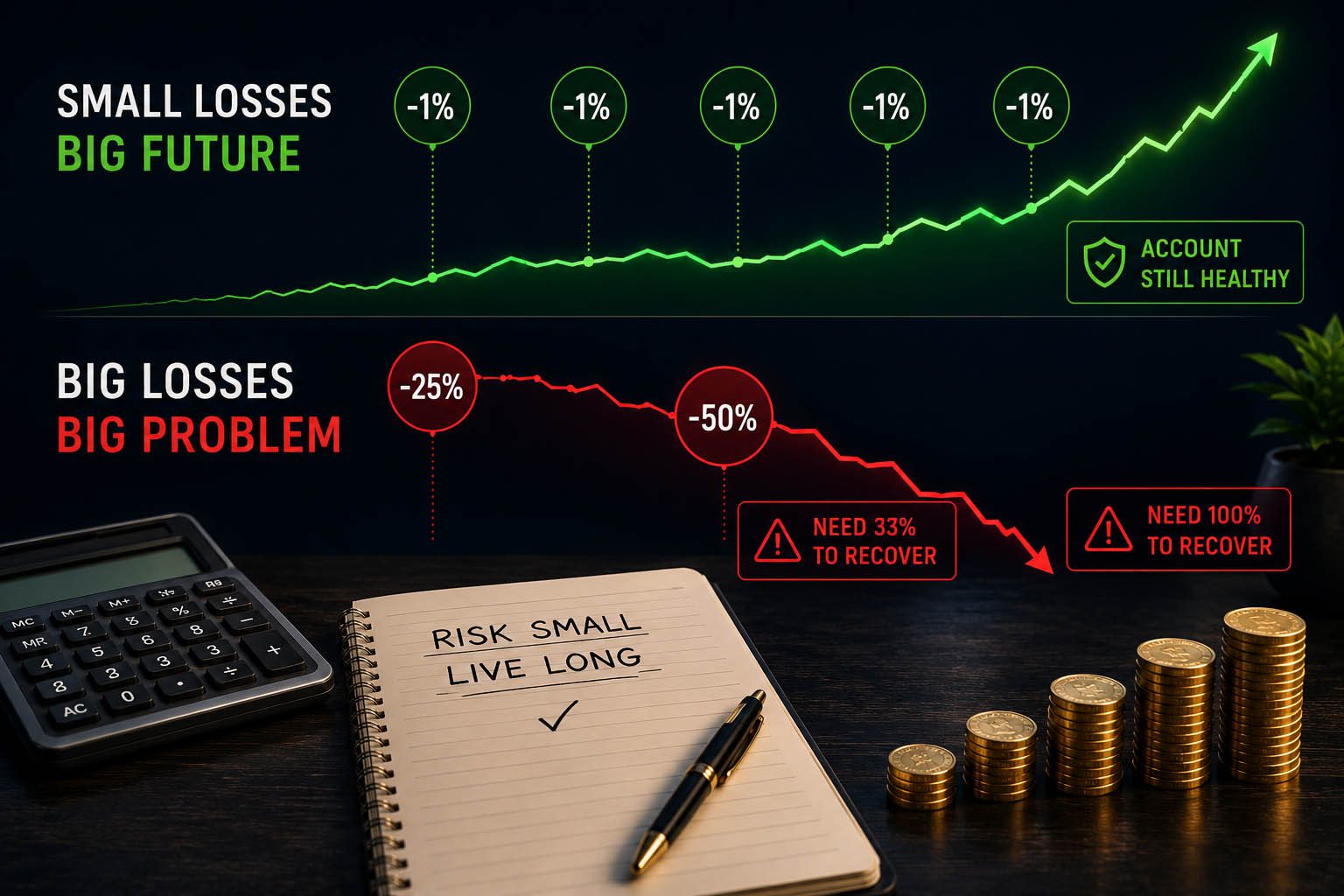
Capital preservation does not mean avoiding losses. Losses are part of trading. The goal is to keep losses small enough that they do not damage the account or your psychology.
Five small 1% losses are manageable. A single 25% loss is dangerous. A single 50% loss can force a trader into desperation because the recovery needed becomes massive.
| Scenario | Account Impact | Professional View |
|---|---|---|
| Five 1% losses | Account remains healthy | Recoverable |
| One 10% loss | Pressure increases | Dangerous |
| One 25% loss | Recovery becomes difficult | Unprofessional |
Small losses only stay small when your position sizing is controlled before the trade starts.
Why Compounding Loves Small Risk
Many traders underestimate what small, consistent growth can do over time. They look for huge gains because they do not understand compounding. Professional traders know that consistent growth can become powerful when drawdown stays controlled.
| Month | Starting Capital | 2% Monthly Growth |
|---|---|---|
| 1 | $100,000 | $102,000 |
| 3 | $104,040 | $106,121 |
| 6 | $110,408 | $112,616 |
| 9 | $117,166 | $119,509 |
| 12 | $124,337 | $126,824 |
A trader who grows slowly while avoiding major drawdown can build trust, confidence, and long-term consistency. A trader who swings aggressively may make money quickly, but they usually give it back just as fast.
The Mathematics of Recovery
The larger the loss, the harder it is to recover. This is why professional risk management is not about being scared. It is about respecting the math. Losing 50% does not require a 50% gain to recover. It requires 100% just to return to break even.
| Account Loss | Gain Needed to Recover |
|---|---|
| 5% | 5.3% |
| 10% | 11.1% |
| 20% | 25% |
| 30% | 42.9% |
| 40% | 66.7% |
| 50% | 100% |
| 70% | 233% |
| 90% | 900% |
The Snowball Effect of Good Risk Management
Good forex risk management creates a positive snowball effect. Small risk helps you stay funded longer. Staying funded gives you more market experience. More experience improves execution. Better execution builds confidence. Confidence leads to better discipline. Discipline allows capital to compound.
This snowball effect depends on obeying your maximum daily loss and maximum drawdown limits. One reckless day can erase weeks of clean progress.
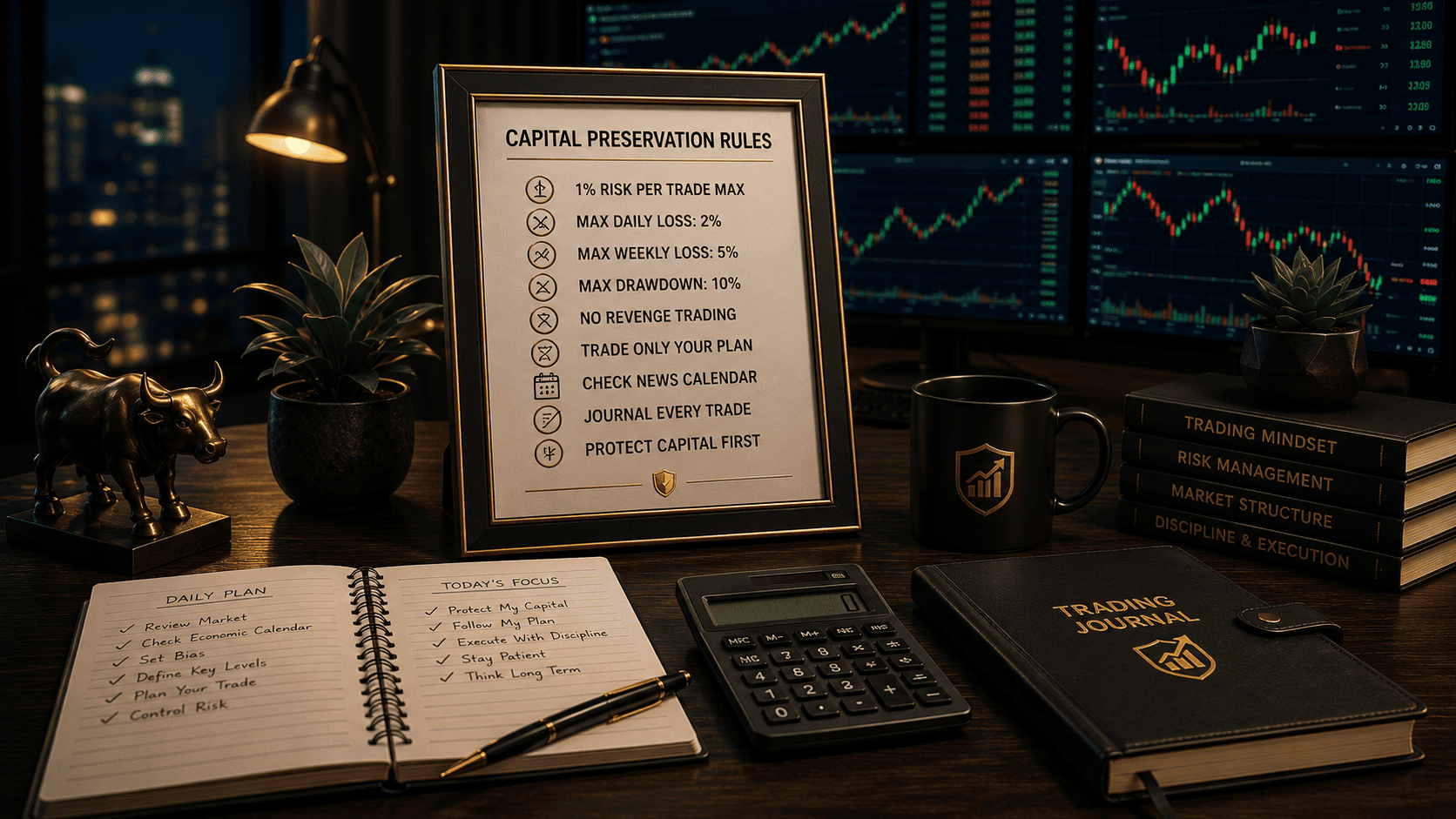
Your Personal Capital Preservation Rules
Every trader needs personal rules that are stricter than emotion. These rules protect you when confidence is too high, frustration is building, or the market becomes unpredictable.
- Maximum risk per trade: 1% or less.
- Maximum daily loss: stop before the firm forces you to stop.
- Maximum weekly drawdown: reduce risk after a difficult week.
- Maximum trades per day: avoid overtrading.
- Minimum risk-to-reward: only take trades with enough reward potential.
- No revenge trading after a loss.
- No trading during major high-impact news unless your strategy is built for news.
- Journal every trade before judging the strategy.
- Take a mandatory break after an emotional trading day.
Protect Your Account Before You Chase Profit
Before taking another prop firm challenge, make sure you understand your position size, drawdown limits, risk-to-reward, and daily stop rules. Your edge means nothing if your risk is uncontrolled.
Open Free Lot Size Calculator → ✓ Free to Use ✓ Risk Management ToolProfessional Habits That Protect Capital
Capital preservation is not only about stop losses and lot sizes. It is also about habits. A tired, distracted, emotional trader is more likely to break rules. A prepared trader is more likely to protect the account.
| Professional Habit | Why It Matters |
|---|---|
| Sleep well | Reduces impulsive decisions |
| Prepare before the session | Prevents random entries |
| Use a trading journal | Reveals patterns and mistakes |
| Take breaks after losses | Stops revenge trading |
| Follow a written plan | Keeps trading objective |
These habits work best when they are written into a professional trading plan. If the rules only live in your head, emotions can rewrite them during live market pressure.
Bringing Module 2 Together
This module was designed to build a complete prop firm risk management system. Each lesson adds one layer of protection. Together, they teach you how to trade with structure instead of emotion.
- The 1% Rule teaches controlled exposure.
- Position Sizing Made Simple teaches accurate lot sizing.
- Understanding Maximum Daily Loss teaches daily survival.
- Maximum Drawdown Explained teaches total account protection.
- Risk-to-Reward teaches how winners can outweigh losers.
- How to Build a Professional Trading Plan teaches structure.
- When Not to Trade teaches patience and discipline.
- Capital Preservation brings the entire system together.
Key Takeaways
- Capital preservation comes before profit. If you protect the account, you protect the opportunity.
- Small losses keep your account alive. Controlled losses are part of professional trading.
- Large drawdowns are mathematically difficult to recover from. The deeper the loss, the harder the comeback.
- Professional traders think in years, not single trading days. Long-term survival beats short-term excitement.
- Compounding rewards patience and consistency. It only works when the account survives.
- Funded account risk management requires strict personal rules. Your personal rules should be tighter than the firm’s limits.
- The best traders protect the opportunity first. Profit comes after survival.
Frequently Asked Questions
What is capital preservation in trading?
Capital preservation means protecting your trading account from large losses so you can continue trading long enough for your edge and consistency to work.
Why is capital preservation important for prop firm traders?
Prop firm traders must follow strict daily loss, maximum drawdown, and rule requirements. Preserving capital helps avoid account failure and gives the trader more time to reach the profit target safely.
How much should I risk per trade?
Many disciplined traders risk 1% or less per trade. Some prop firm traders risk even less depending on the drawdown model, account phase, and market conditions.
Can I make good money risking only 1%?
Yes, if the strategy has positive expectancy and the trader stays consistent. Professional trading is not about risking heavily. It is about repeating a controlled edge over time.
Why do professionals avoid aggressive trading?
Aggressive trading increases emotional pressure and drawdown risk. Professionals prefer controlled growth because it is easier to repeat and easier to protect.
What happens if I ignore risk management?
Ignoring risk management can lead to blown accounts, failed challenges, emotional decisions, and large drawdowns that are difficult or impossible to recover from.
Lesson Quiz
- Why does capital preservation come before profit?
- What is the difference between an amateur trader and a professional trader?
- Why are large drawdowns dangerous?
- How does compounding reward consistency?
- Name three personal rules that can protect a funded trading account.
Lesson Summary
Capital preservation is the foundation of long-term trading success. Great traders are not great because they avoid every losing trade. They are great because they keep losses controlled, protect their account, avoid emotional decisions, and give consistency enough time to work. In prop firm trading, preserving capital is not optional. It is the difference between staying funded and starting over.

Module 2 Complete: Professional Risk Management
Congratulations. You’ve completed Module 2 and now understand the core risk management principles used by serious traders: the 1% rule, position sizing, daily loss, maximum drawdown, risk-to-reward, professional trading plans, when not to trade, and capital preservation.
Next, you’ll move into Module 3: Choosing Your Funding Partner, where you’ll learn how to evaluate prop firms, compare their rules, and select the funding program that best matches your trading style.