Risk-to-Reward Trading for Prop Firm Challenges
Learn how risk-to-reward, break-even win rate, expectancy, and disciplined trade planning help traders pass prop firm challenges without needing to win every trade.
Lesson Goal
Risk-to-reward is one of the most important concepts in prop firm trading, funded account management, and professional risk management. Many beginner traders believe they need a very high win rate to pass a prop firm challenge, but great traders understand that profitability is not only about how often you win. It is about how much you make when you are right compared to how much you lose when you are wrong.
A trader can win less than half of their trades and still grow a funded account if their winning trades are larger than their losing trades. This is why risk-to-reward, expectancy, position sizing, and trade discipline matter so much inside prop firm evaluations.
The Biggest Myth About Win Rate
Most new traders think a high win rate is the secret to passing a prop firm challenge. They believe if they can win 70%, 80%, or 90% of their trades, they will automatically make money. That sounds logical, but it is not always true.
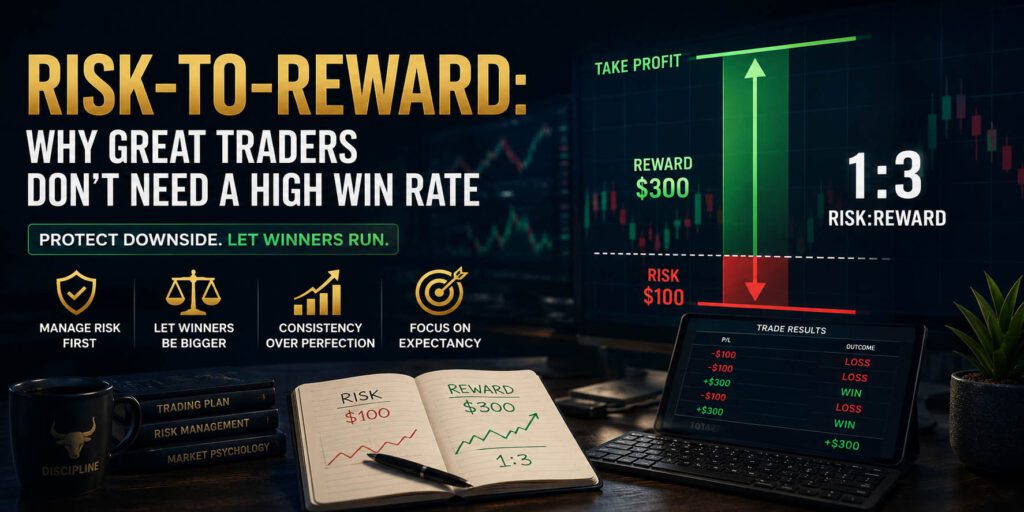
A trader with a high win rate can still lose money if their losing trades are much larger than their winning trades. On the other hand, a trader with a lower win rate can still be profitable if their winners are bigger than their losses.
| Trade | Result | P/L |
|---|---|---|
| Trade 1 | Loss | -$100 |
| Trade 2 | Loss | -$100 |
| Trade 3 | Win | +$300 |
| Net Result | +$100 | |
In this example, the trader only won one out of three trades. That is a 33% win rate. But because the winning trade was three times larger than each loss, the trader still finished profitable.
What Is Risk-to-Reward?
Risk-to-reward compares how much money you are willing to risk on a trade versus how much money you expect to make if the trade works. In simple terms, it measures your potential loss compared to your potential profit.
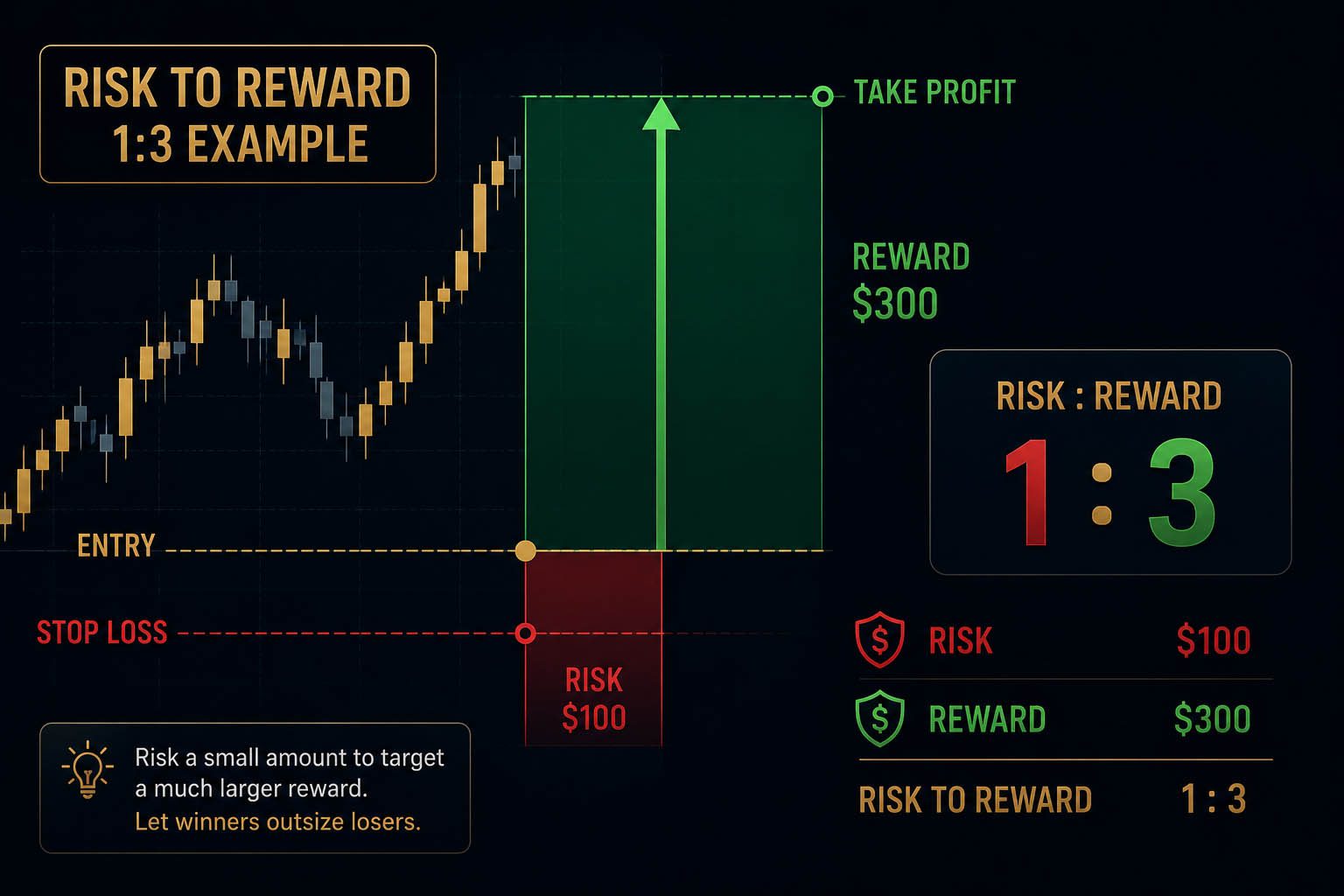
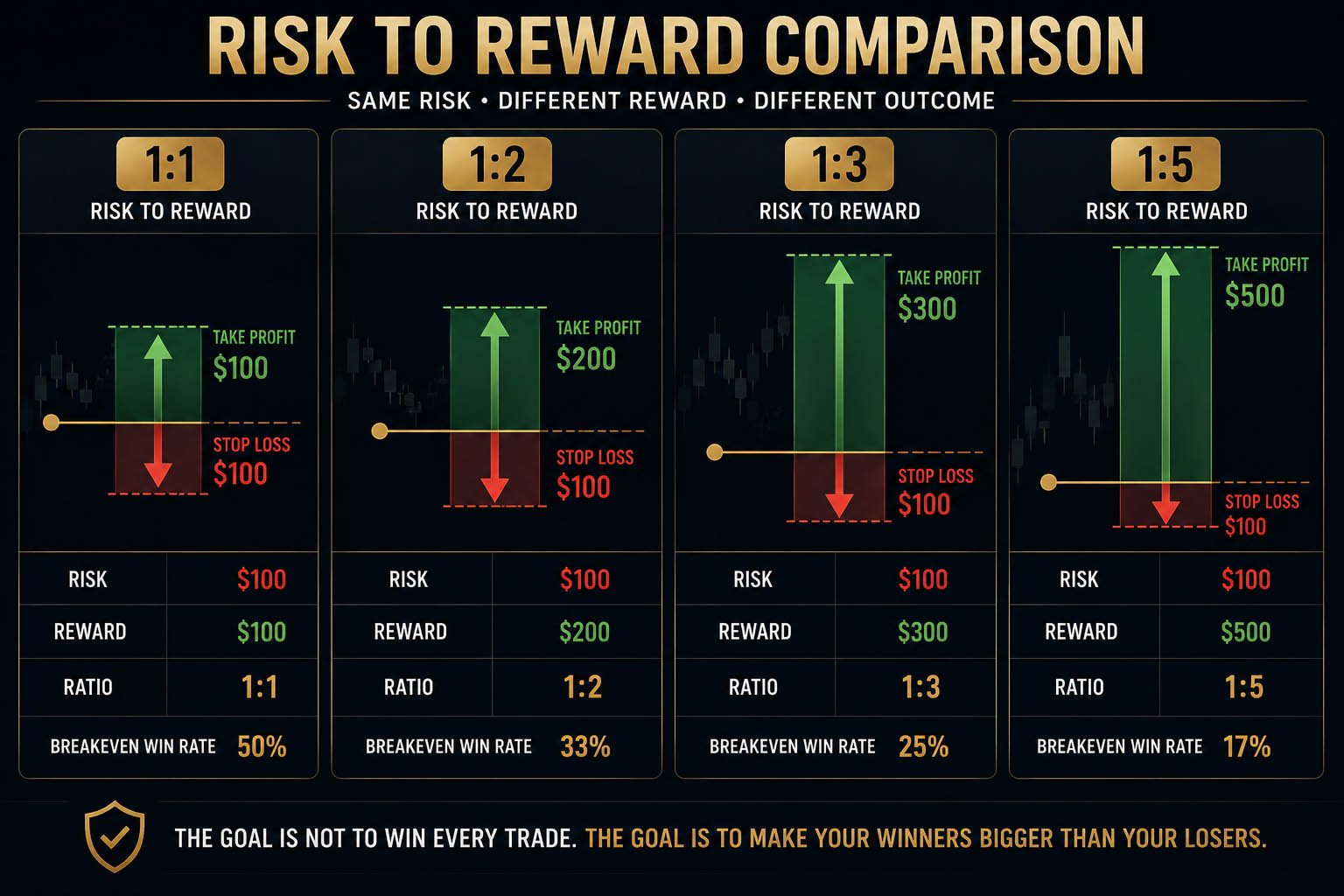
If you risk $100 to make $100, your risk-to-reward ratio is 1:1. If you risk $100 to make $300, your risk-to-reward ratio is 1:3. The first number represents the risk. The second number represents the reward.
Simple Formula
Risk-to-reward = Amount Risked compared to Potential Reward. If you risk $500 to make $1,500, the trade has a 1:3 risk-to-reward ratio.
Risk-to-reward only works when your risk is controlled first. That is why the 1% Rule and proper lot sizing are so important.
Common Risk-to-Reward Ratios
Different trading strategies use different risk-to-reward ratios. A scalper may take smaller targets. A swing trader may look for larger moves. The key is not to copy someone else’s ratio blindly. The key is to understand what your setup realistically offers and whether the potential reward is worth the risk.
| Amount Risked | Potential Reward | Risk-to-Reward Ratio |
|---|---|---|
| $100 | $100 | 1:1 |
| $100 | $200 | 1:2 |
| $100 | $300 | 1:3 |
| $100 | $500 | 1:5 |
For prop firm challenges, many traders focus on setups between 1:2 and 1:3 because those ratios allow room for losses while still giving the account a realistic chance to reach the profit target.
Break-Even Win Rate Explained
Break-even win rate tells you how often you need to win just to avoid losing money. This is one of the most powerful ideas in professional trading because it proves that you do not need to win every trade.
The better your risk-to-reward ratio, the lower your required break-even win rate becomes.
| Risk-to-Reward | Break-Even Win Rate | Meaning |
|---|---|---|
| 1:1 | 50% | You need to win half your trades to break even. |
| 1:2 | 33% | You can lose more than you win and still survive. |
| 1:3 | 25% | One winner can cover three planned losses. |
| 1:4 | 20% | Larger winners reduce the pressure to be perfect. |
| 1:5 | 17% | Very strong reward potential, but harder to hit consistently. |
This is why professional traders focus on expectancy instead of ego. They are not trying to look right on every trade. They are trying to create a trading system where the average winner outweighs the average loss over time.
Calculate Your Risk Before You Trade
Risk-to-reward only works when your lot size is controlled. Use our free Lot Size Calculator before entering trades so your risk stays aligned with your prop firm account size and drawdown limit.
Open Free Lot Size Calculator → ✓ Free to Use ✓ Built for Risk ControlProp Firm Example: 1:3 Risk-to-Reward
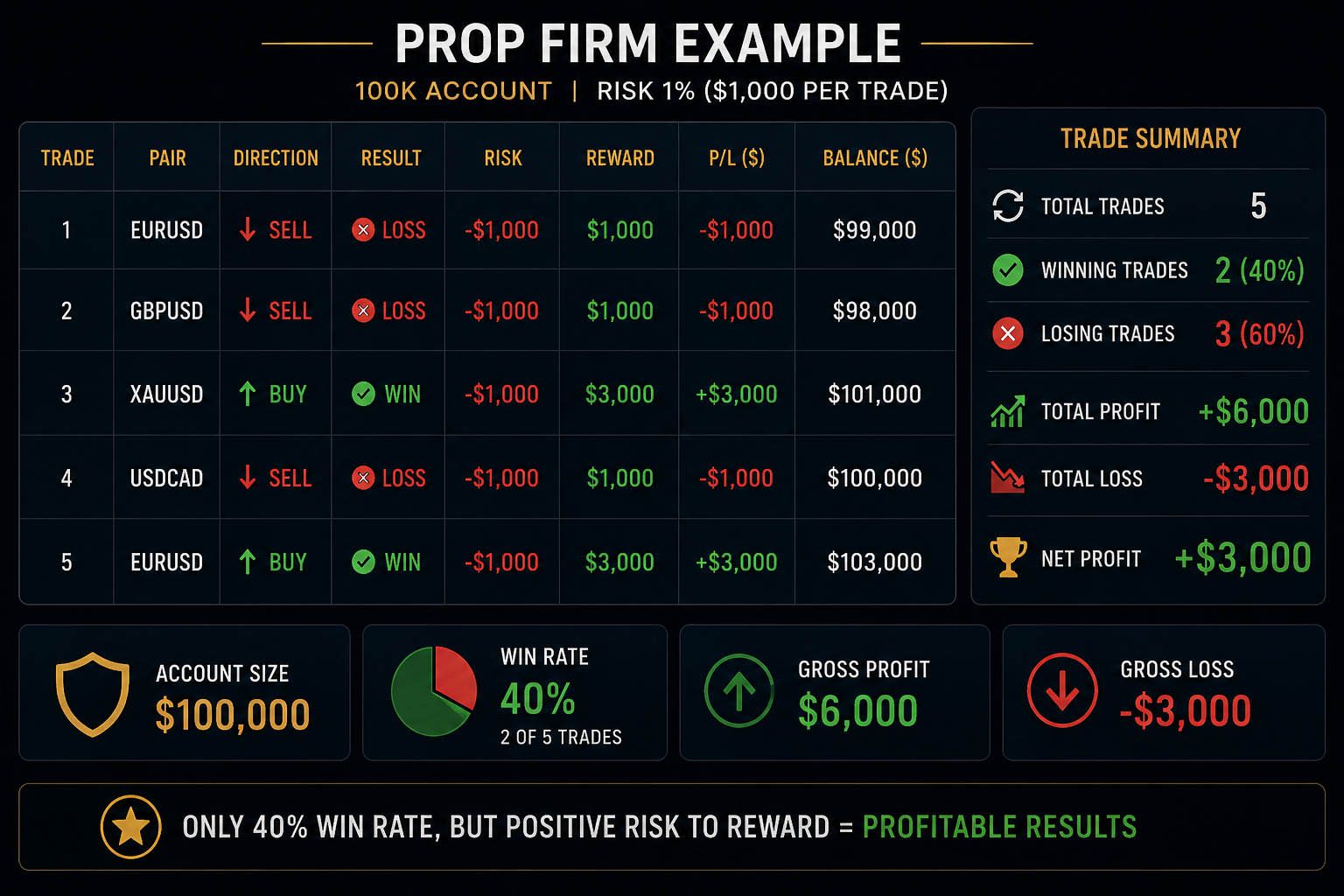
Let’s use a $100,000 prop firm challenge account. If the trader risks 1% per trade, each planned loss is $1,000. With a 1:3 risk-to-reward ratio, each winning trade has a potential reward of $3,000.
| Trade | Result | Account Impact |
|---|---|---|
| Trade 1 | Loss | -$1,000 |
| Trade 2 | Loss | -$1,000 |
| Trade 3 | Win | +$3,000 |
| Trade 4 | Loss | -$1,000 |
| Trade 5 | Win | +$3,000 |
| Net Result | +$3,000 | |
The trader only won 40% of the trades, but the account still gained $3,000. That is the power of controlled risk and proper reward planning.
Why Beginners Still Fail With Good Risk-to-Reward
Risk-to-reward is powerful, but it is not magic. A trader can still fail a prop firm challenge if they break their rules, move stop losses, close winners too early, or chase unrealistic targets that the market is not actually offering.
The best risk-to-reward ratio is the one you can execute consistently. A 1:3 trade setup means nothing if the trader panics at 1:1 and closes early every time.
Common Mistake
Many traders plan a 1:3 setup, then close the trade at 1:0.5 because they are scared to lose the open profit. Over time, this destroys the math of the strategy.
This is why your risk-to-reward rules need to be written into a professional trading plan. If the plan is not clear before the trade, emotions usually take over during the trade.
Risk-to-Reward and Trading Psychology
The hardest part of risk-to-reward is not the math. The hardest part is the psychology. Taking a planned loss feels uncomfortable. Watching a trade move toward profit and then pull back feels even worse. This is why many traders interfere with their trades before the setup has enough time to work.
Professional traders accept that losses are part of the business. They do not treat every losing trade like a personal failure. They treat it like a cost of doing business, as long as the trade followed the plan.
Expectancy: The Professional Trader’s Scorecard
Expectancy measures whether your trading strategy is likely to make money over a large number of trades. It combines win rate, average win size, and average loss size. This is more useful than looking at win rate alone.
A professional trader wants positive expectancy. That means the average trade has a positive expected value over time. A trader with positive expectancy does not need every trade to work. They need the long-term math to stay in their favor.
Our View
Winning trades are not the goal. Professional execution is the goal. If the strategy has positive expectancy and the trader follows the rules, the results can take care of themselves over time.
Positive expectancy also depends on staying inside the firm’s maximum daily loss and maximum drawdown rules. A good system means nothing if one bad day violates the account.
Professional Risk-to-Reward Checklist
- Define your stop loss before entering the trade.
- Know your potential take profit before entering the trade.
- Only take trades where the potential reward justifies the risk.
- Use proper position sizing so one loss does not damage the account.
- Do not move your stop loss farther away after entering.
- Do not cut every winning trade too early out of fear.
- Track win rate, average win, average loss, and expectancy.
Key Takeaways
- Risk-to-reward compares your planned loss to your potential profit. It helps you understand whether a trade is worth taking.
- A trader does not need a high win rate to be profitable. Bigger winners can offset controlled losses.
- At 1:3 risk-to-reward, a trader only needs about a 25% win rate to break even. That is why reward size matters.
- Positive expectancy matters more than ego or being right. Trading is about math and execution, not proving a point.
- Closing winners too early can destroy a profitable trading plan. Cutting the reward side breaks the system.
- Professional traders protect downside first, then let winners work. Risk control comes before profit chasing.
Frequently Asked Questions
What is risk-to-reward in trading?
Risk-to-reward compares how much you are risking on a trade to how much you expect to make if the trade reaches the target.
What does 1:3 risk-to-reward mean?
A 1:3 risk-to-reward ratio means you are risking one unit to potentially make three units. For example, risking $100 to make $300 is a 1:3 setup.
Can you pass a prop firm challenge with a low win rate?
Yes. A trader can pass a prop firm challenge with a lower win rate if their winning trades are larger than their losing trades and they stay within all risk rules.
What win rate do I need with 1:2 risk-to-reward?
At 1:2 risk-to-reward, the approximate break-even win rate is 33%. Anything above that can become profitable if trade size, fees, spreads, and execution are controlled.
Is a higher risk-to-reward ratio always better?
Not always. A higher target can reduce how often trades reach take profit. The best ratio is one that fits your strategy, market conditions, and ability to execute consistently.
Why do traders close winning trades too early?
Many traders close winners early because they fear giving back open profit. The problem is that cutting winners too early can destroy the reward side of the trading plan.
Lesson Quiz
- What does risk-to-reward measure?
- What does a 1:3 risk-to-reward ratio mean?
- What is the approximate break-even win rate at 1:3?
- Why can a trader be profitable with a 40% win rate?
- Why is expectancy more important than win rate alone?
Lesson Summary
Risk-to-reward is one of the core principles of professional prop firm trading. It teaches traders to stop obsessing over win rate and start focusing on expectancy, controlled losses, and larger winning trades. When risk is planned properly and reward is realistic, a trader can lose trades, stay disciplined, and still move closer to passing a prop firm challenge or protecting a funded account.