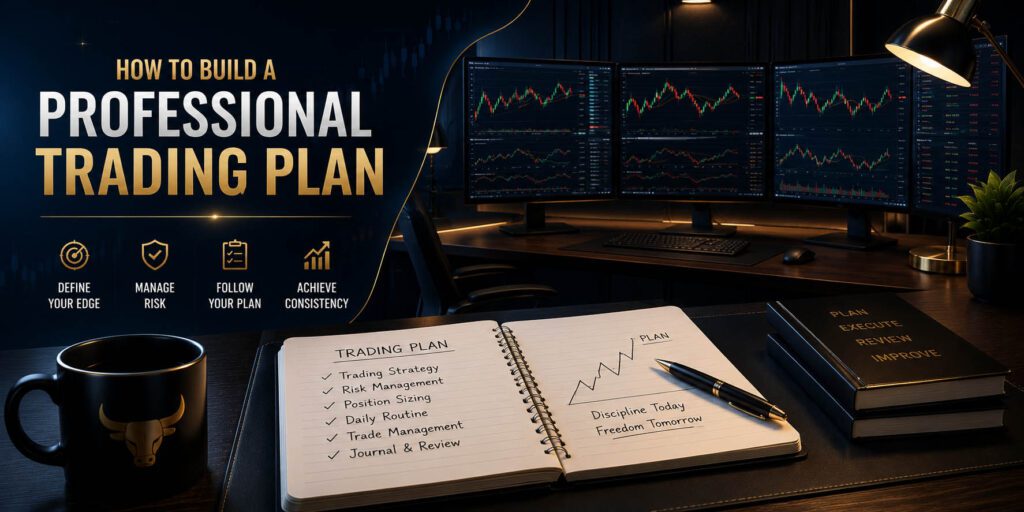
How to Build a Professional Trading Plan
Learn how to create a professional trading plan with risk rules, trading sessions, news filters, checklists, journaling, and prop firm discipline.
Lesson Goal
A professional trading plan is one of the most important tools a trader can have. Most beginners focus only on finding entries, indicators, signals, or the next winning setup. Professional traders think differently. They build a complete trading plan that controls risk, defines their routine, filters bad decisions, and keeps their account protected.
If you are trading a prop firm challenge, funded trading account, forex account, futures evaluation, or personal capital, your trading plan is your rulebook. It tells you what to do before the market opens, when to trade, when to stop, how much to risk, and how to review your performance.
What Is a Professional Trading Plan?
A professional trading plan is a written set of rules that guides your trading decisions. It is not just a strategy. A strategy tells you when to enter and exit. A trading plan tells you how to operate like a professional trader from start to finish.
Your trading plan should define the markets you trade, the sessions you trade, the maximum risk per trade, the maximum number of trades per day, the setups you accept, the news events you avoid, and how you review your trades afterward.
- When you are allowed to trade.
- Which pairs, indices, futures, or assets you trade.
- How much you risk per trade.
- How many trades you can take per day.
- What risk-to-reward ratio you require.
- Which news events you avoid.
- When you stop trading for the day.
- How you journal and review your performance.
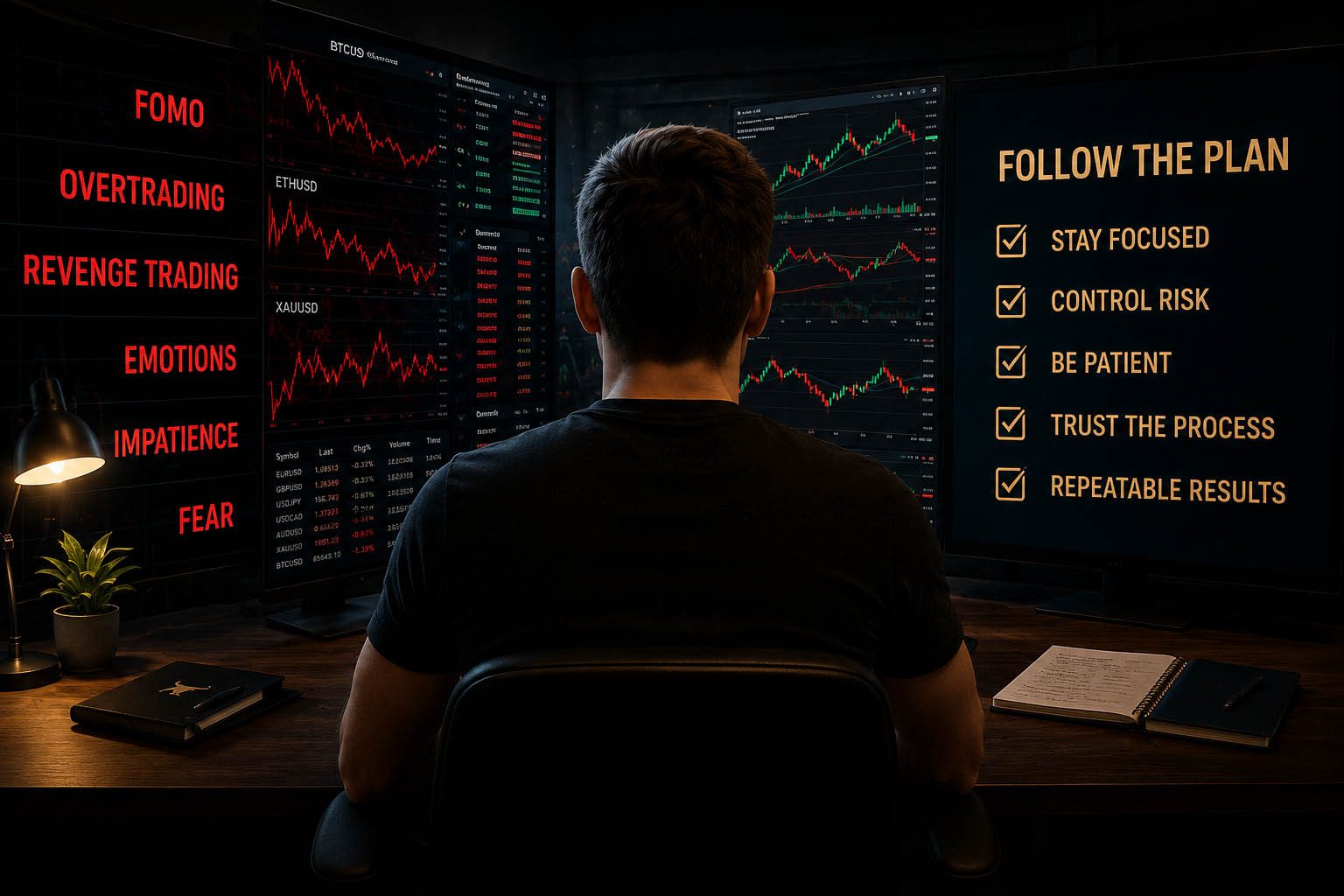
Without a trading plan, every decision becomes emotional. With a trading plan, your job becomes simple: follow the rules.
Why Most Traders Fail Without a Plan
Most traders do not fail because they cannot find trades. They fail because they have no structure. They enter randomly, increase risk after losses, chase price, trade during dangerous news, and keep trading after they should have stopped.
A prop firm challenge is not just testing whether you can make money. It is testing whether you can follow rules under pressure. A professional trading plan gives you the structure needed to survive that pressure.
| Without a Trading Plan | With a Trading Plan |
|---|---|
| Emotional entries | Rule-based entries |
| Overtrading | Controlled trade frequency |
| Random lot sizes | Predefined position sizing |
| Revenge trading | Daily stop rules |
| Inconsistent results | Repeatable process |
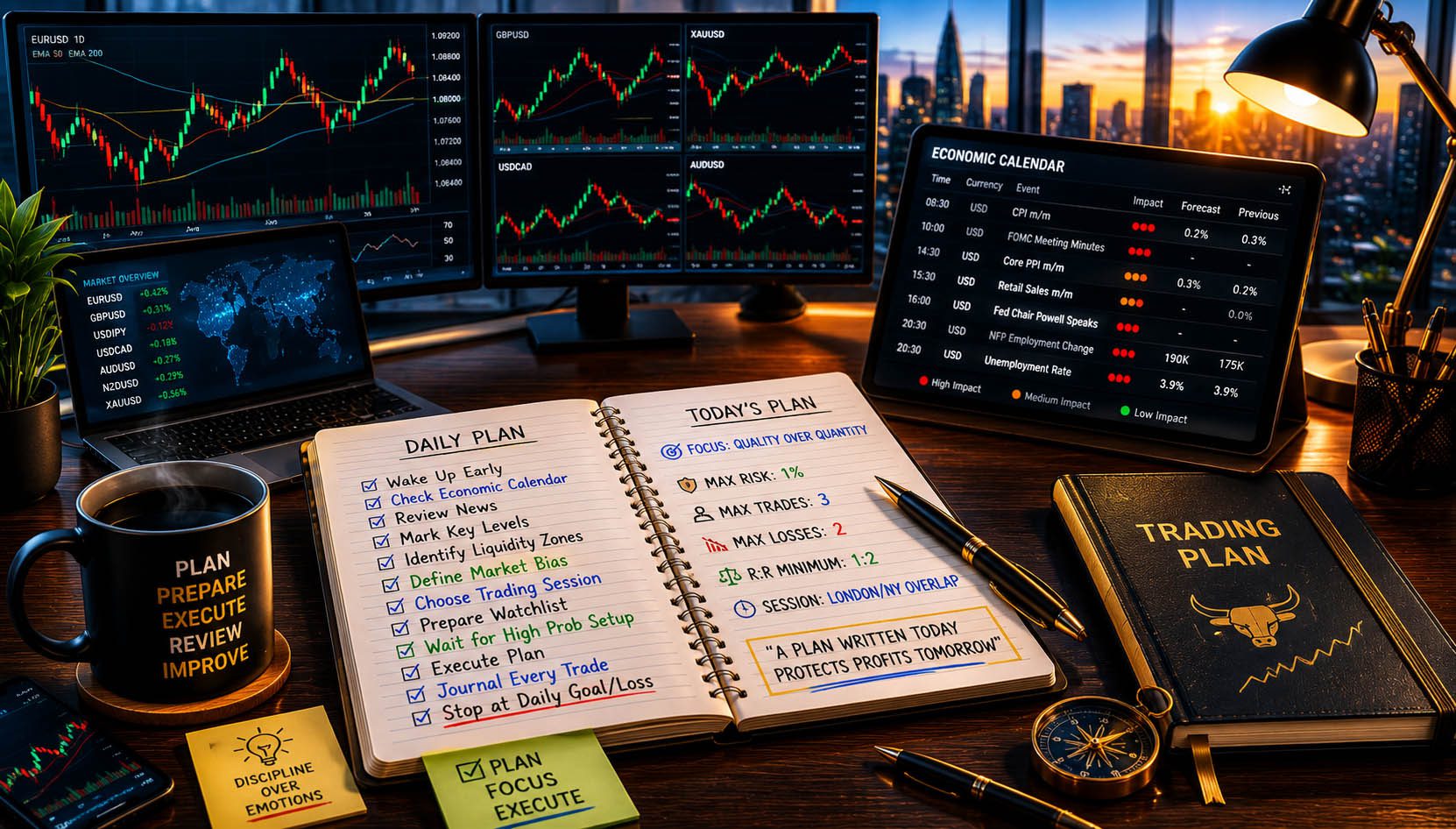
Your Daily Trading Routine
A serious trader does not wake up and immediately start clicking buttons. A professional trading routine begins before the first trade is ever placed. This routine prepares your mind, reviews the market environment, and helps you avoid low-quality decisions.
| Step | Professional Routine |
|---|---|
| 1 | Check the economic calendar for high-impact news. |
| 2 | Review overnight market movement and major headlines. |
| 3 | Mark important support, resistance, liquidity, and key levels. |
| 4 | Choose the trading session you will focus on. |
| 5 | Wait for your setup. Do not force trades. |
| 6 | Journal every trade after execution. |
This routine keeps you from trading out of boredom. It also helps you focus only on conditions that match your trading plan.
Set Daily Risk Limits
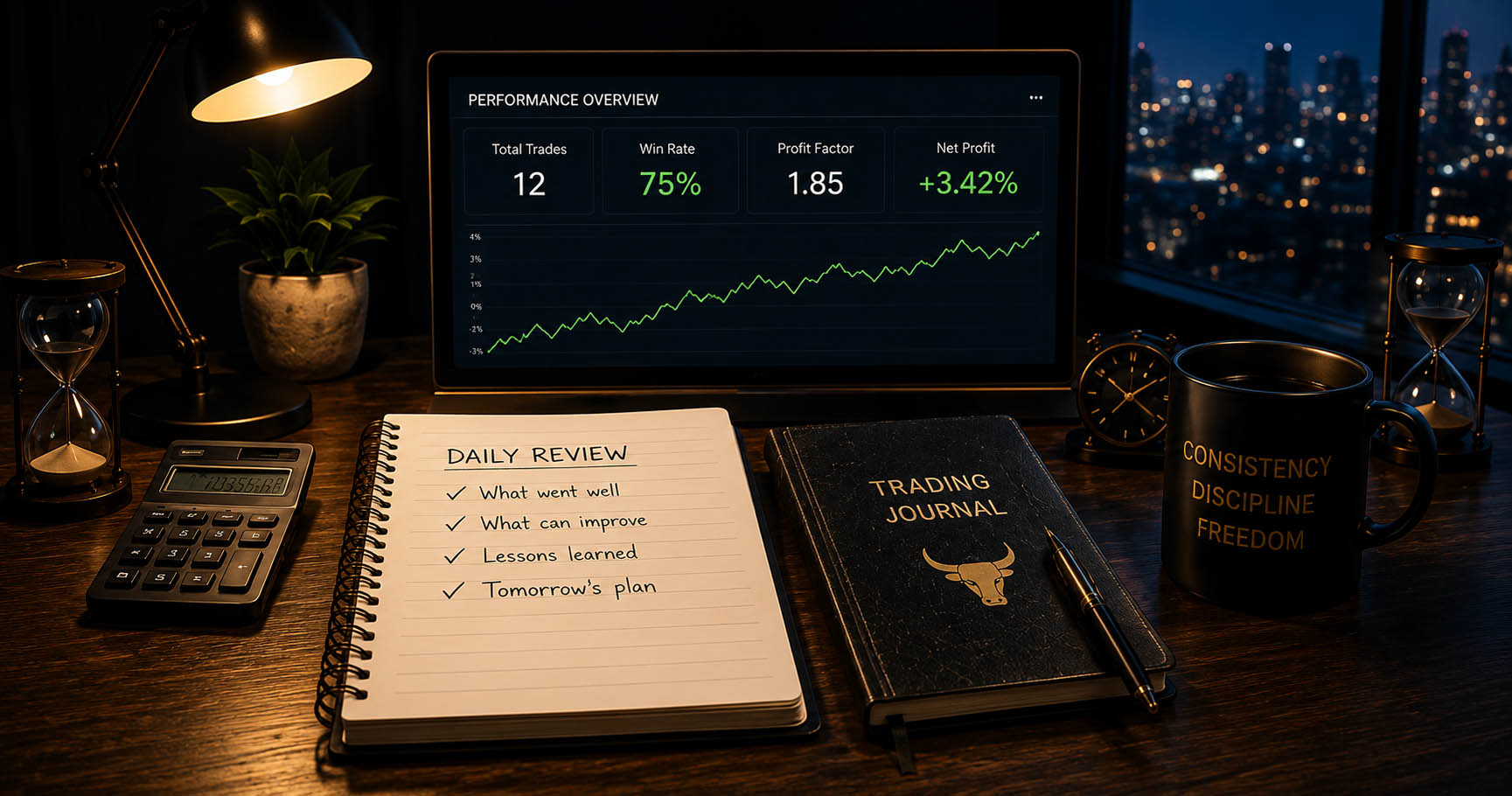
Daily risk limits are the backbone of a prop firm trading plan. If you do not know how much you are allowed to lose today, you are already trading emotionally. Professional traders define their maximum daily risk before entering the market.
This is especially important in funded trading because one bad day can violate the maximum daily loss rule and fail the account. Your personal risk limit should usually be smaller than the firm’s official limit.
| Risk Rule | Example |
|---|---|
| Maximum risk per trade | 1% |
| Maximum daily risk | 2% |
| Maximum trades per day | 3 trades |
| Maximum consecutive losses | 2 losses, then stop |
| Minimum risk-to-reward | 1:2 or better |
Professional Rule
Your goal is not to trade until you are forced to stop. Your goal is to stop early enough that your account is protected for the next high-quality opportunity.
This is where the 1% Rule becomes useful. Risking less gives your plan room to survive mistakes, losing streaks, and normal market randomness.
Choose the Right Trading Session
Your trading plan should clearly define when you trade. Not all market sessions behave the same way. Forex, indices, commodities, and crypto can move differently depending on liquidity, volatility, news, and institutional participation.
| Session | Common Characteristics |
|---|---|
| Asian Session | Usually slower for many major forex pairs, often lower volatility. |
| London Session | Strong liquidity, major forex movement, common session for prop traders. |
| New York Session | High volatility, strong USD movement, important for indices and forex. |
| London/New York Overlap | Often produces the cleanest opportunities due to strong liquidity. |
Many traders fail because they trade whenever they are bored. A professional trader waits for the session that best fits their strategy. If your edge appears during London or New York, then your trading plan should tell you to ignore random setups outside those sessions.
Use a News Filter
A professional trading plan must include a news filter. High-impact news can cause spreads to widen, price to spike, stop losses to slip, and accounts to breach drawdown rules faster than expected.
Some traders build strategies specifically for news trading, but most beginners and prop firm traders should avoid placing trades directly before major releases unless they fully understand the risk.
- Non-Farm Payrolls.
- CPI inflation reports.
- FOMC rate decisions.
- Central bank press conferences.
- Interest rate announcements.
- Major unemployment data.
- Unexpected geopolitical events.
Simple News Rule
If high-impact news is scheduled within the next 15 to 30 minutes, do not open a new trade unless your strategy is specifically designed for news conditions.
News filters help protect your maximum drawdown and daily loss limits from sudden volatility spikes.
Build a Pre-Trade Checklist
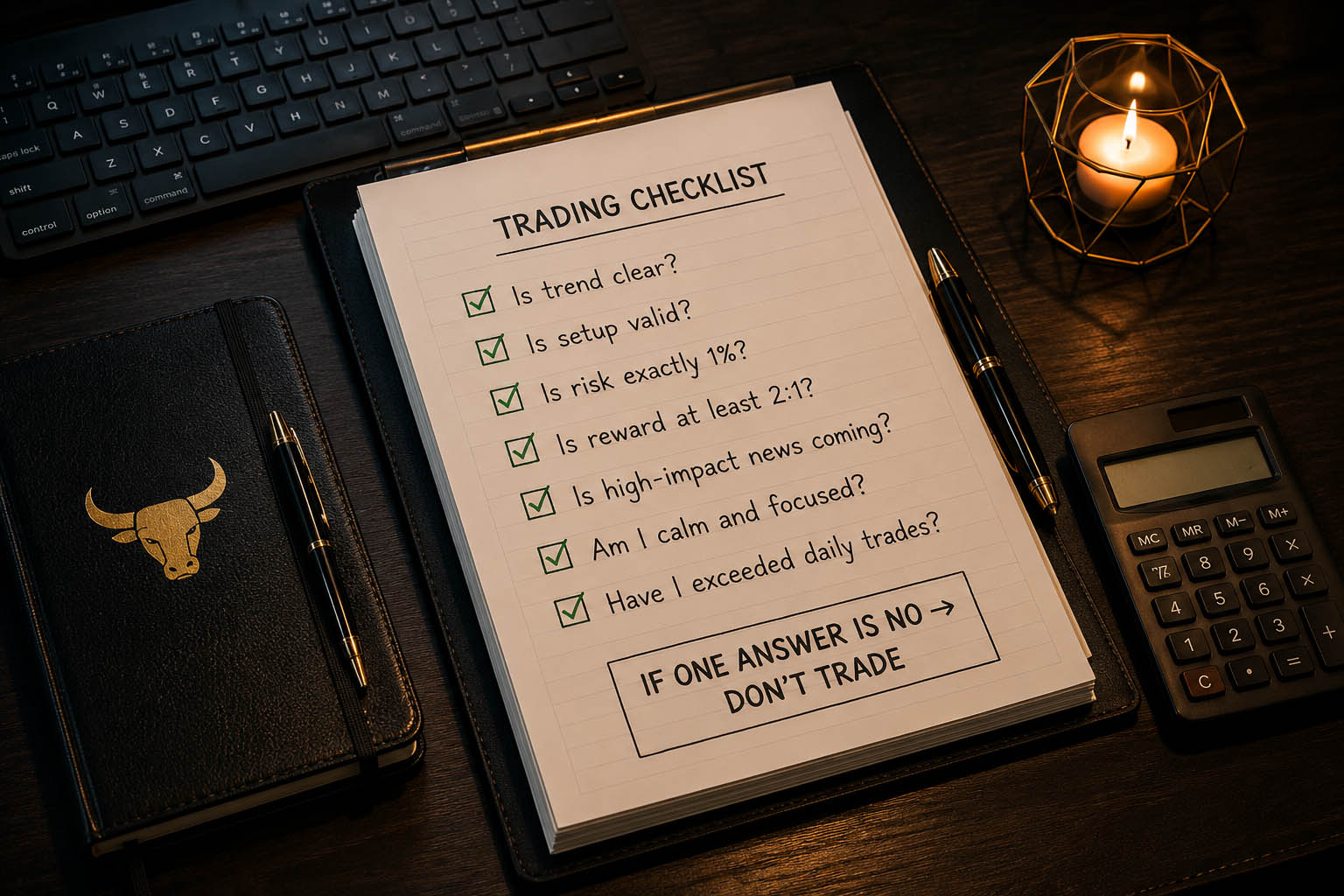
A pre-trade checklist is one of the easiest ways to reduce emotional decisions. Before every trade, you should answer a few simple questions. If the trade does not pass the checklist, you do not take the trade.
- Is this setup part of my trading plan?
- Is the trend or market structure clear?
- Is my stop loss already defined?
- Is my position size calculated correctly?
- Is the risk-to-reward at least 1:2?
- Is high-impact news coming soon?
- Have I already reached my maximum trades for the day?
- Am I calm, focused, and patient?
The checklist is not there to slow you down. It is there to protect you from your worst impulses.
Journal Every Trade
A trading journal turns experience into improvement. Without a journal, most traders repeat the same mistakes without realizing it. With a journal, you can track what is working, what is failing, and which emotional patterns are costing you money.
Your journal does not need to be complicated, but it does need to be honest. The goal is not to look good. The goal is to improve.
| Journal Field | Why It Matters |
|---|---|
| Date and session | Shows when your strategy performs best. |
| Pair or market | Helps identify which assets fit your style. |
| Entry, stop loss, and target | Confirms whether the trade was planned or random. |
| Risk-to-reward ratio | Tracks whether winners are large enough. |
| Emotion before entry | Reveals fear, greed, FOMO, or revenge trading. |
| Lesson learned | Turns every trade into training. |
Example Professional Prop Firm Trading Plan
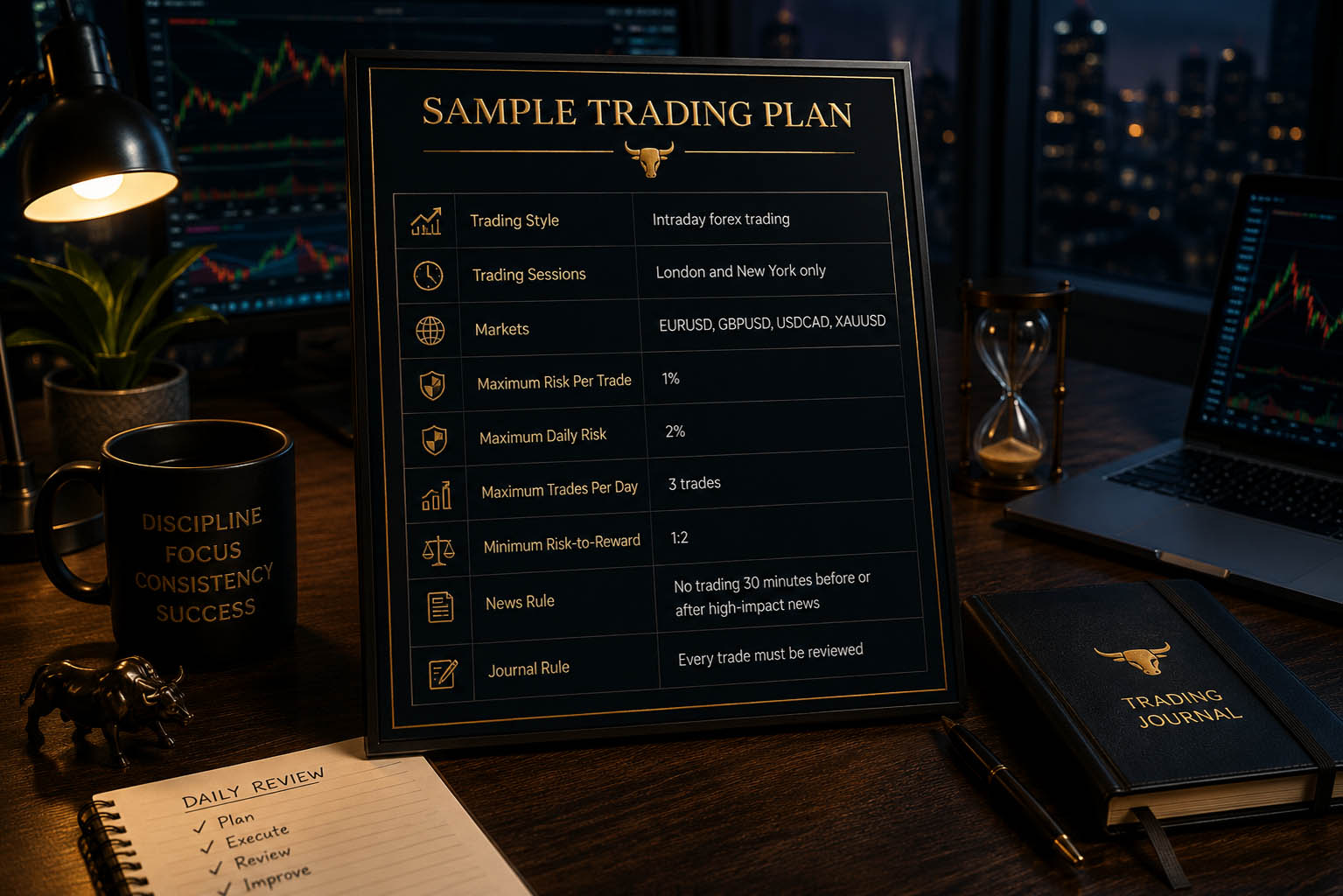
Below is a simple example of how a prop firm trading plan may look. This is not a signal service or financial advice. It is a framework showing how a disciplined trader can organize their rules before trading.
| Plan Area | Example Rule |
|---|---|
| Trading Style | Intraday forex trading |
| Trading Sessions | London and New York only |
| Markets | EURUSD, GBPUSD, USDCAD, XAUUSD |
| Maximum Risk Per Trade | 1% |
| Maximum Daily Risk | 2% |
| Maximum Trades Per Day | 3 trades |
| Minimum Risk-to-Reward | 1:2 |
| News Rule | No trading 30 minutes before or after high-impact news |
| Journal Rule | Every trade must be reviewed |
The Best Trading Plan Is Simple
Many traders make their trading plan too complicated. They include too many indicators, too many markets, too many sessions, and too many exceptions. Then when the market moves quickly, they abandon the plan because it is too difficult to follow.
A good professional trading plan should be simple enough to follow under pressure. The more emotional the market becomes, the more important simple rules become.
Our View
A trading plan is not about predicting every market move. It is about controlling your behavior when the market becomes unpredictable.
Build Your Trading Journal
A trading plan gives you rules. A trading journal shows whether you actually followed them. Use your journal to track setups, emotions, risk-to-reward, mistakes, and progress over time.
Open Trading Journal Guide → ✓ Track Trades ✓ Improve DisciplineProfessional Trading Plan Checklist
- Write down your trading sessions.
- Define your maximum risk per trade.
- Define your maximum daily loss limit.
- Limit your number of trades per day.
- Choose your minimum risk-to-reward ratio.
- Check the economic calendar before trading.
- Create a pre-trade checklist.
- Journal every trade without excuses.
- Review your performance weekly.
Key Takeaways
- A professional trading plan gives your trading structure. It turns random decisions into a repeatable process.
- Prop firm traders need clear risk rules before entering trades. Risk cannot be decided after the market moves.
- Your daily routine should include news review, chart preparation, and journaling. Preparation protects your account.
- Daily risk limits protect you from emotional trading. They help you stop before damage gets out of control.
- A pre-trade checklist helps prevent low-quality setups. It forces you to pause before entering.
- Trading journals turn mistakes into improvement. Honest review is how traders get better.
- The goal is not more trades. The goal is better decisions.
Frequently Asked Questions
What is a trading plan?
A trading plan is a written set of rules that explains when you trade, what you trade, how much you risk, which setups you take, when you stop, and how you review your results.
Do I need a trading plan for a prop firm challenge?
Yes. A trading plan is extremely important for prop firm challenges because you must manage daily loss, maximum drawdown, position sizing, news risk, and rule compliance.
How many trades should I take per day?
There is no perfect number, but many disciplined traders limit themselves to a small number of high-quality trades per day. For many beginners, 1 to 3 planned trades is better than constantly entering the market.
Should I trade every day?
No. Professional traders do not force trades every day. If market conditions are poor or your setup does not appear, not trading is often the best decision.
Should I trade during high-impact news?
Most beginner traders should avoid trading directly before or during high-impact news. News can create slippage, spread widening, unpredictable volatility, and drawdown breaches.
How often should I update my trading plan?
You should review your trading plan regularly, especially after a group of trades. Avoid changing rules after one emotional win or loss. Review patterns over time before making adjustments.
Lesson Quiz
- What is the main purpose of a trading plan?
- Why should prop firm traders set personal daily risk limits?
- What should you check before trading high-impact news?
- Why is a pre-trade checklist useful?
- How does a trading journal help improve consistency?
Lesson Summary
A professional trading plan turns trading from random decision-making into a structured process. It defines your markets, sessions, risk limits, news filter, trade checklist, and journaling routine. For prop firm traders, this structure is critical because the goal is not only to make profits, but also to protect the account, follow the rules, and stay consistent long enough to get funded and keep payouts coming.