Market Context
Understand the environment you are trading in so you stop forcing trades and start reading the market like a professional.
Learning Objectives
- Understand what market context actually means.
- Identify trending versus ranging environments.
- Recognize high-volatility and low-volatility conditions.
- Understand how sessions affect price behavior.
- Adapt your strategy to different market environments.
- Avoid forcing trades in poor conditions.
- Improve timing, patience, and decision-making.
- Use context to protect prop firm accounts from unnecessary drawdown.
What Is Market Context?
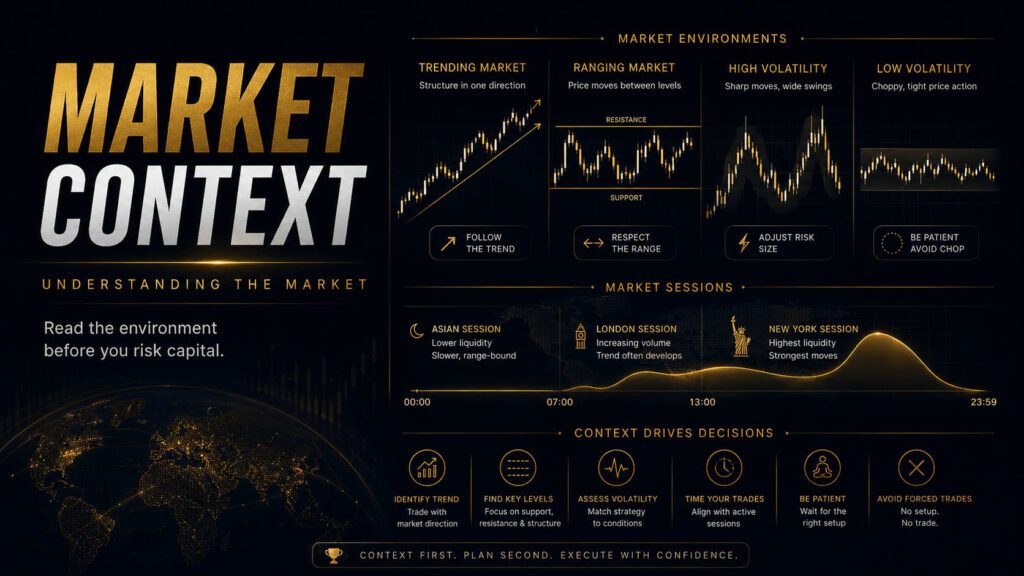
Market context is the overall environment the market is currently in. It tells you how price is behaving — not just where price is.
A setup can look strong in one environment and completely fail in another. For example, a breakout setup may work well during a strong London or New York trend, but fail repeatedly during a slow range. A reversal candle may matter at a major level, but mean very little in the middle of noisy price action.
If you do not understand context, you are trading blind. This is why market context must be combined with market structure, support and resistance, and multi-timeframe analysis.
Trending Markets
A trending market has a clear directional flow. Price is either making higher highs and higher lows in an uptrend, or lower highs and lower lows in a downtrend.
Trending Market Characteristics
- Clear direction up or down.
- Higher highs and higher lows in bullish trends.
- Lower highs and lower lows in bearish trends.
- Momentum candles in the direction of the trend.
- Pullbacks that hold structure.
How to Trade Trending Markets
- Trade with the trend whenever possible.
- Look for pullbacks into clean levels.
- Avoid guessing tops and bottoms.
- Use lower timeframes for confirmation.
- Plan stops around structure, not emotion.
Trend conditions are where tools like trendlines and channels can become useful. They help show the rhythm of price while the market is moving with direction.
Ranging Markets
A ranging market moves sideways between a clear support area and resistance area. It does not have strong directional conviction, and price often rejects both the top and bottom of the range.
Ranging Market Characteristics
- Sideways movement.
- Price stuck between support and resistance.
- Breakouts often fail.
- Momentum does not follow through clearly.
- The middle of the range is usually noisy.
How to Trade Ranging Markets
- Buy near support only with confirmation.
- Sell near resistance only with confirmation.
- Avoid trading the middle of the range.
- Reduce expectations and risk.
- Wait for a clear breakout before switching to trend mode.
This is where patience becomes a real trading edge. A range does not need to be traded from the middle. Sometimes the best decision is to wait for the edge or skip the session entirely.
Volatility Conditions
Volatility describes how fast and how aggressively price is moving. High volatility can create opportunity, but it can also create wider stops, fast reversals, slippage, and emotional decisions. Low volatility can create chop, fakeouts, and poor reward-to-risk.
| Condition | Behavior | Professional Approach |
|---|---|---|
| High Volatility | Fast, large moves with bigger candles and wider swings. | Reduce risk, wait for cleaner confirmation, and avoid chasing late entries. |
| Low Volatility | Slow, choppy movement with weak follow-through. | Be patient, reduce activity, or avoid trading until conditions improve. |
| News Volatility | Sudden spikes, spreads widening, and unpredictable movement. | Avoid trading directly before major news unless your plan specifically allows it. |
| Normal Session Volatility | Cleaner movement during active market hours. | Focus on planned setups during London and New York sessions. |
Volatility often increases during London and New York sessions and drops during off-hours. This is why market timing matters just as much as the setup itself.
Before trading volatile conditions, review daily drawdown and make sure your risk is reduced enough for the environment.
Session Behavior
Different sessions behave differently. A setup that works well during New York may not work the same during slow Asian session conditions. Professional traders understand session behavior before they commit risk.
London Session
- Strong directional moves often begin.
- Breakouts and trend continuation can appear.
- Forex pairs and gold can become more active.
- False moves can still happen near session open.
New York Session
- Continuation or reversal from London movement.
- High volatility around the open.
- Indices like NASDAQ and US30 become active.
- Major news releases can create sharp movement.
Asian Session
- Lower volatility for many major pairs.
- Range conditions are more common.
- Breakouts may lack follow-through.
- Often better for preparation than aggressive trading.
Off-Hours
- Lower liquidity.
- More random movement.
- Weak follow-through.
- Higher risk of boredom trading.
Session rules should be written into your professional trading plan so you are not deciding when to trade based on boredom or emotion.
When NOT to Trade
Knowing when not to trade is one of the most valuable skills for prop firm traders. You do not need to force every session. You need to protect the account until your edge appears.
- Low-volatility conditions with no follow-through.
- Choppy, unclear structure.
- Conflicting signals across timeframes.
- Right before major news events.
- After you already hit your daily target.
- After emotional losses or frustration.
- When your strategy does not match current conditions.
This connects directly to When Not to Trade. Market context tells you whether conditions deserve risk or whether patience is the professional move.
Practical Examples
XAUUSD Trending During London
Gold trends strongly during London session with clear higher highs and higher lows. The best approach is usually to look for pullbacks in the direction of the trend rather than guessing reversals.
A professional trader waits for price to return to structure, confirms with candles, and manages risk carefully.
EURUSD Range During Asian Session
EURUSD is stuck between support and resistance during Asian session. Breakout attempts are weak and price keeps returning to the middle.
A beginner keeps forcing trades. A professional waits for price to reach the range edge or avoids trading until London opens.
NASDAQ High Volatility at New York Open
NASDAQ becomes highly volatile during the New York open. Price moves fast and candles expand quickly.
A professional trader reduces risk, waits for structure, and avoids chasing the first spike.
US30 Choppy Midday Conditions
US30 moves sideways after the opening session. Momentum fades and price starts chopping around the same area.
This is a context warning. The best trade may be no trade.
Common Mistakes
- Forcing trades in bad conditions.
- Ignoring volatility changes.
- Trading every session the same way.
- Overtrading low-quality setups.
- Not adapting strategy to trend, range, or transition conditions.
- Trading directly before high-impact news without a plan.
- Assuming a setup works the same in every environment.
Many context mistakes turn into overtrading. When conditions are poor, traders often keep clicking because they want action, not because the market is offering quality.
Professional Checklist
- What type of market am I in?
- Is price trending, ranging, or transitioning?
- Is volatility high, low, or normal?
- Which session is active?
- Does my strategy fit this condition?
- Are timeframes aligned or conflicting?
- Is price near a meaningful level?
- Is it better to trade or wait?
This checklist fits into the full technical analysis summary framework because context is the first filter before any entry idea deserves attention.
FAQ
What is the best market condition?
Trending markets are often easier to trade because direction is clearer. But the best condition depends on your strategy. Some traders specialize in ranges, while others perform better in trends.
Should I trade all sessions?
No. Most traders should focus on the sessions where their strategy performs best. For many traders, London and New York offer cleaner volatility than off-hours.
Why do trades fail even when the setup looks good?
Often because the setup formed in poor market context. A clean pattern in the wrong environment can still fail.
Can I trade ranges?
Yes, but ranges require a different approach. Traders usually need to focus on support, resistance, confirmation, and avoiding the middle of the range.
How do I improve my market context reading?
Start each session by asking whether the market is trending, ranging, volatile, quiet, or unclear. Then decide whether your strategy fits that condition.
Knowledge Quiz
- What does a trending market usually have?
Answer: Clear direction. - What is a ranging market?
Answer: Sideways movement between support and resistance. - Which sessions usually offer the best trading activity?
Answer: London and New York. - What does high volatility mean?
Answer: Fast, larger market movement. - What is sometimes the best trade?
Answer: Waiting or not trading. - Why do many traders lose money in ranges?
Answer: They treat ranges like trends. - What should you check before trading volatile conditions?
Answer: Risk, stop placement, and daily drawdown exposure. - What does market context tell you?
Answer: The environment price is moving in. - Why does timing matter?
Answer: Different sessions create different volatility and behavior. - What should come before setup selection?
Answer: Market context.
Key Takeaways
- Market context determines trade quality.
- Trending and ranging markets require different strategies.
- Volatility changes risk, timing, and execution.
- Session behavior matters because markets do not move the same way all day.
- Patience is a competitive advantage in poor conditions.
- A setup can be strong in one environment and weak in another.
- Prop firm traders should protect capital when context is unclear.
Lesson Summary
Market context is the trading environment. It tells you whether price is trending, ranging, volatile, quiet, clear, or messy. Professional traders adapt to context instead of forcing the same setup in every condition. Trending markets, ranging markets, high volatility, low volatility, and different sessions all require different expectations. Inside prop firm challenges, understanding context helps traders avoid low-quality trades, protect drawdown, and wait for better conditions.