
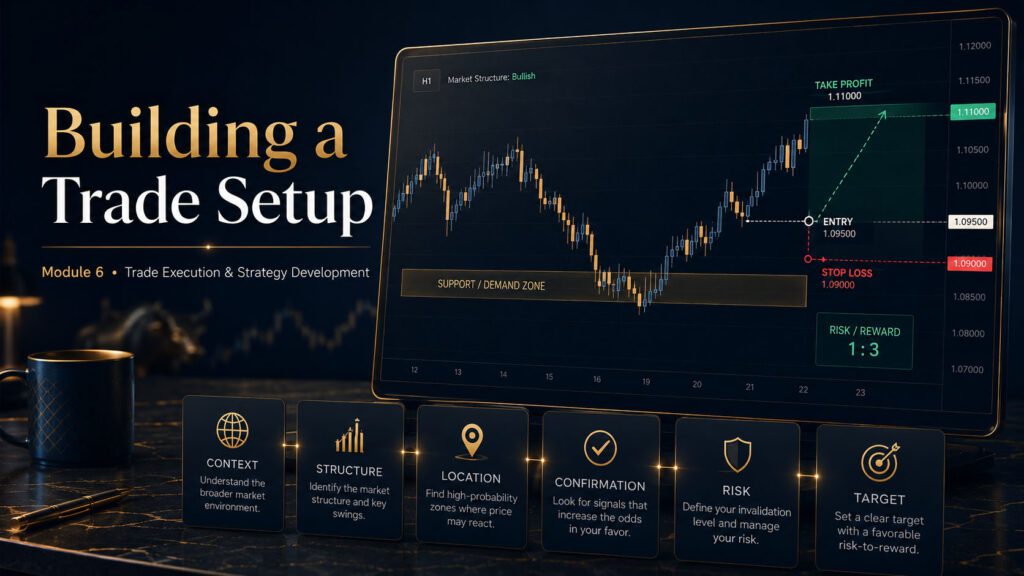
Module 6 · Trade Execution & Strategy Development · Lesson 1
Building a Trade Setup
Learn how to turn market analysis into a complete trade idea with entry criteria, stop loss, target, invalidation, risk, confirmation, and a clear reason for taking the trade.
🎯 Execution Builder
Learning Objectives
Technical analysis helps you understand the chart. Trade execution helps you decide whether that chart actually deserves your money. In this lesson, you will learn how to build a complete trade setup from start to finish.- Understand what a professional trade setup actually includes.
- Learn the difference between an idea, a setup, and an entry.
- Build a setup using context, structure, levels, confirmation, and risk.
- Define the exact reason for entering before risking capital.
- Identify stop loss, target, invalidation, and reward-to-risk before entry.
- Avoid random trades, emotional entries, and weak trade location.
- Use a repeatable process that fits prop firm challenge rules.
- Create a setup checklist you can use before every trade.
What Is a Trade Setup?
A trade setup is a complete trading idea that includes the reason for the trade, the location, the confirmation, the entry plan, the stop loss, the target, and the risk. It is not just “I think price will go up” or “gold looks like a sell.” Professional traders do not enter because they feel excited, bored, rushed, or confident. They enter because the market has met their conditions. A setup is the bridge between analysis and execution.Professional Truth: A trade setup is not a prediction. It is a structured plan for what you will do if the market gives you the right conditions.
This lesson builds directly on Technical Analysis Summary. In Module 5, you learned how to read the chart. In Module 6, you will learn how to turn that chart reading into real execution.
Idea vs Setup vs Entry
One of the biggest beginner mistakes is confusing a trade idea with a trade setup. A trade idea is only the beginning. A setup is the full plan. An entry is only the moment you execute.| Stage | Meaning | Example | Professional Question |
|---|---|---|---|
| Trade Idea | A possible direction or bias. | “EURUSD may continue higher.” | Why do I think this? |
| Trade Setup | A complete plan with conditions. | “If EURUSD pulls into support and confirms bullish rejection, I will look for a long.” | What exactly must happen first? |
| Entry | The actual execution point. | “Enter after the 15M bullish confirmation candle closes.” | Is risk defined before I click? |
Important: A trade idea without conditions is not a setup. It is just an opinion.
The 6-Part Trade Setup Blueprint
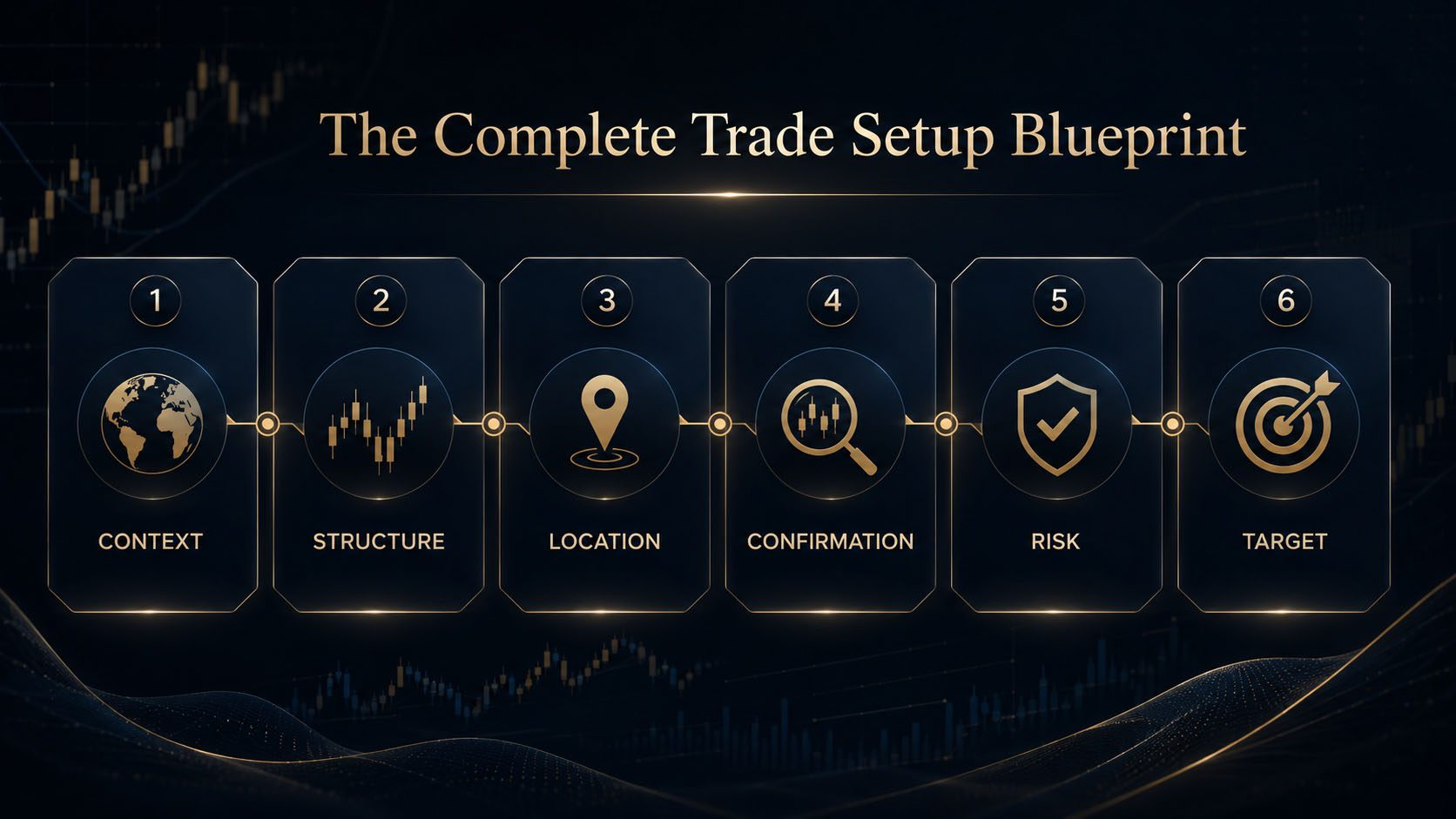
A professional trade setup should have six parts. When one part is missing, the trade becomes weaker. When several parts are missing, the trade is usually not worth taking.The Complete Setup Blueprint
1ContextWhat market environment are you trading?
2StructureWho is currently in control?
3LocationWhere is price reacting?
4ConfirmationHas price proven the idea?
5RiskWhere is the trade wrong?
6TargetIs the reward worth it?
Step 1 — Define Market Context
Before building a setup, you need to understand the environment. Is the market trending, ranging, volatile, slow, choppy, or unclear? The same entry pattern can produce very different results depending on the context. A breakout setup may work well in a strong trending market, but fail repeatedly inside a range. A reversal setup may work at a major support or resistance level, but fail badly if it fights strong momentum.Ask These Questions First
- Is the market trending or ranging?
- Is volatility high, low, or normal?
- Is the current session active enough to trade?
- Is price near major news or low-liquidity conditions?
- Does my strategy fit this market environment?
Execution Tip: Context decides whether your setup type makes sense. Do not use the same setup in every market condition.
Review Market Context if you are unsure how to identify the environment before planning a trade.
Step 2 — Identify Market Structure
Structure tells you who is currently controlling price. If the market is making higher highs and higher lows, buyers are in control. If the market is making lower lows and lower highs, sellers are in control. If price is moving sideways between levels, neither side has full control. Without structure, your trade has no foundation. You may end up buying into resistance, selling into support, or fighting the larger move because one small candle looked attractive.Structure Gives You Bias
- Bullish structure: look for buying opportunities after pullbacks.
- Bearish structure: look for selling opportunities after rallies.
- Range structure: wait for price to reach support or resistance.
- Transition structure: reduce risk and wait for clarity.
Professional Rule: If you cannot explain the structure, you are probably not ready to plan the entry.
This connects to Understanding Market Structure, which should be the foundation behind every setup you build.
Step 3 — Choose the Trade Location
Trade location is where the setup forms. A good setup needs a meaningful location. This could be support, resistance, a supply or demand zone, a trendline, a channel edge, a breakout retest, or a higher timeframe level. Location matters because it affects stop loss placement, target distance, and reward-to-risk. A trader who enters in the middle of nowhere usually has weaker risk control and less logical trade structure.Good Trade Locations Include
- Pullbacks into higher low areas during bullish structure.
- Rallies into lower high areas during bearish structure.
- Retests of broken support or resistance.
- Reactions from major higher timeframe levels.
- Channel edges or trendline reactions with confirmation.
- Range highs and range lows, not the middle.
Common Mistake: Entering because price is moving, instead of waiting for price to reach a meaningful location.
Use Support & Resistance and Trendlines & Channels to help define better trade locations.
Step 4 — Wait for Confirmation
Confirmation is what tells you price is reacting the way your setup expected. Without confirmation, you are guessing. With confirmation, you have evidence that buyers or sellers may actually be stepping in. Confirmation does not guarantee a winning trade, but it can help you avoid early entries, fakeouts, and emotional reactions.Common Confirmation Types
- Rejection candle at a key level.
- Engulfing candle in the direction of the setup.
- Break of lower timeframe structure.
- Retest that holds after breakout.
- Momentum candle in the planned direction.
- Failure to break a key level after multiple attempts.
Professional Reminder: Confirmation should happen at the right location. A candle pattern in the middle of nowhere is usually not enough.
Review Candlestick Patterns and Chart Patterns to improve your confirmation reading.
Step 5 — Define Invalidation and Stop Loss
Invalidation is the point where your trade idea is no longer valid. Your stop loss should be placed around invalidation, not around fear, hope, or a random number of pips. If you are buying because price is holding support, your trade is likely wrong if support fails. If you are shorting because price rejected resistance, your trade is likely wrong if price breaks and holds above resistance. The stop loss should match the logic of the setup.A Good Stop Loss Should Be
- Based on structure, not emotion.
- Placed where the trade idea is invalidated.
- Known before entry.
- Compatible with your position size.
- Small enough to respect prop firm drawdown rules.
- Large enough to avoid normal market noise.
Prop Firm Warning: A good setup can still fail your challenge if the lot size is too large or the stop loss threatens daily drawdown.
This is where position sizing, daily drawdown, and maximum drawdown must be checked before the trade is opened.
Step 6 — Define the Target and Reward-to-Risk
A trade setup is not complete until you know where price may realistically go. Many traders focus only on entry, then panic after entry because they never planned the exit. Your target should be based on structure, not fantasy. A good target may be the next support or resistance level, previous high or low, range boundary, liquidity area, or measured move. The target should also give enough reward compared to the risk.Simple Reward-to-Risk Visual
Risk
Stop loss below invalidation. This is the amount you are willing to lose if the setup is wrong.
Reward
Target at the next logical level. The reward should be worth the risk before the trade is entered.
Target Planning Questions
- Where is the next major support or resistance level?
- Is there enough room before price hits an opposing zone?
- Does the setup offer at least acceptable reward-to-risk?
- Will I take partials, move to breakeven, or hold for full target?
- Is the target realistic for current volatility and session behavior?
Professional Rule: Do not enter a trade if the target is unclear or the reward is not worth the risk.
This connects directly to Risk-to-Reward Trading. A setup is only worth taking when the potential reward justifies the risk.
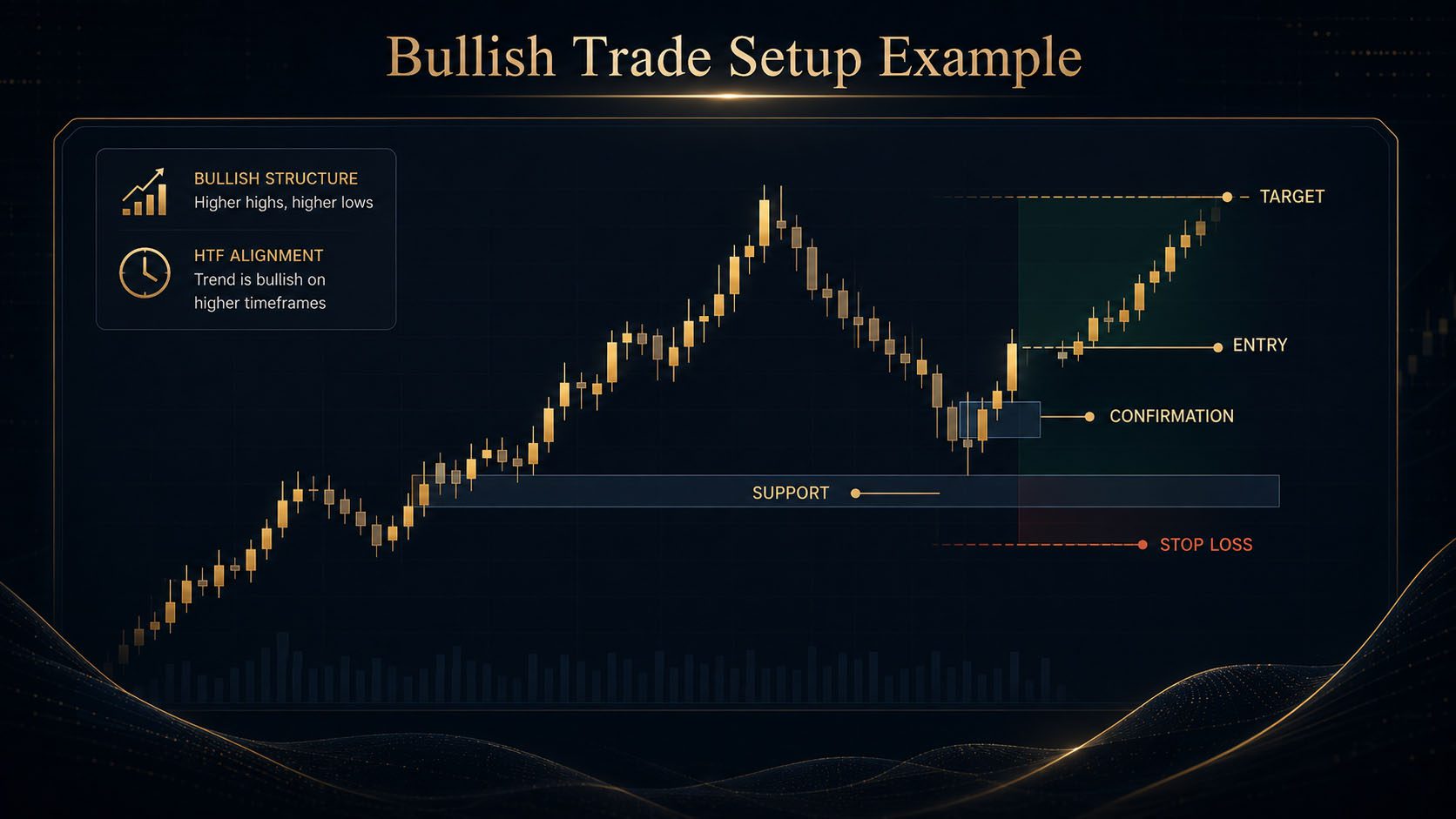
Visual Example: Building a Long Setup
Let’s walk through a bullish setup example using the full blueprint. This is not a signal. It is an example of how a professional trader thinks before entering.Bullish Setup Map
Higher Timeframe Context: Daily and 4H structure are bullish. Price is making higher highs and higher lows.
Trade Location: Price pulls back into a clean support zone that previously acted as resistance.
Confirmation: Lower timeframe forms bullish rejection and breaks minor structure upward.
Invalidation: If price breaks below support and closes under the higher low, the trade idea is wrong.
Target: The next resistance area or previous high becomes the first logical target.
Professional Thought Process
The trader does not buy simply because price is falling into support. They wait. They want to see whether buyers actually defend the area. If price confirms, the trader can plan a long with a stop below invalidation and a target near the next resistance level. The key difference is that the trader has a reason for every part of the setup. The entry, stop, and target are not random.
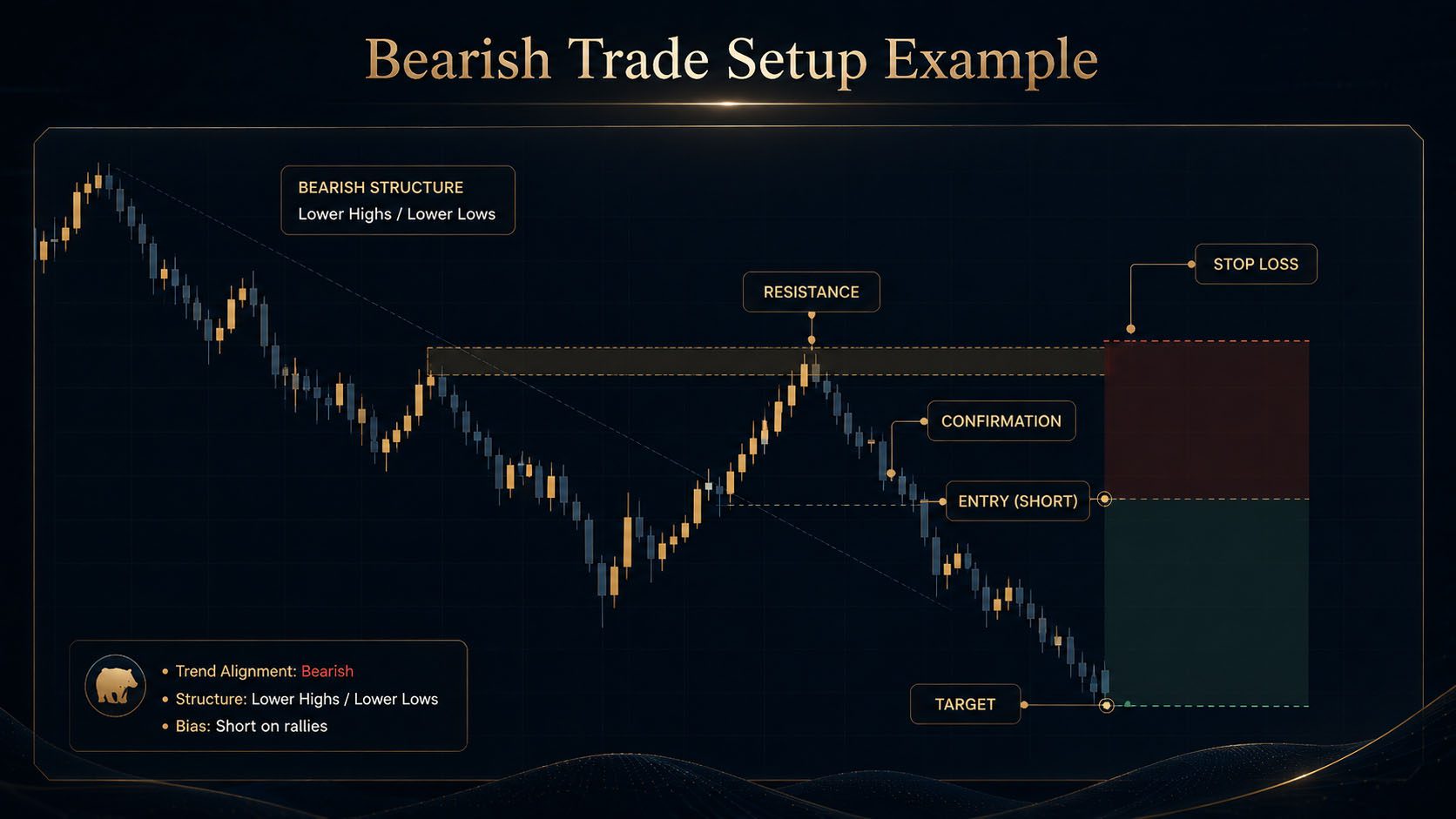
Visual Example: Building a Short Setup
Now let’s look at a bearish setup example. Again, the goal is not to predict. The goal is to build a logical plan.Bearish Setup Map
Higher Timeframe Context: 4H structure is bearish. Price is making lower lows and lower highs.
Trade Location: Price rallies into resistance or a broken support retest.
Confirmation: Lower timeframe shows bearish rejection, momentum shift, or break of minor bullish structure.
Invalidation: If price breaks above resistance and holds, the short idea is invalid.
Target: The next support level, prior low, or liquidity area becomes the logical target.
Professional Thought Process
The trader does not sell because price “looks high.” They sell only if the market context, structure, location, confirmation, and risk all make sense together. If price does not confirm, there is no trade.Trade Setup Quality Score
One simple way to improve your trading is to score your setup before entering. This forces you to slow down and check whether the trade actually has enough quality.| Setup Component | Question | Score |
|---|---|---|
| Context | Does the market environment support this setup? | 0 or 1 |
| Structure | Does structure support the direction? | 0 or 1 |
| Location | Is price reacting from a meaningful area? | 0 or 1 |
| Confirmation | Has price confirmed before entry? | 0 or 1 |
| Risk | Is invalidation clear and position size controlled? | 0 or 1 |
| Reward | Is the target realistic and worth the risk? | 0 or 1 |
Scoring Rule: A setup with 5 or 6 points may be worth considering. A setup with 3 or 4 points needs caution. A setup with 0 to 2 points should usually be skipped.
This scoring system should be added to your professional trading plan so you can repeat the same decision process every session.
Common Beginner Mistakes
Entering Before the Setup Is Complete
Many traders enter as soon as they see price approaching a level. But price reaching a level is not confirmation. A complete setup requires the market to react and prove the idea.Using a Random Stop Loss
A stop loss should not be placed based on a random pip amount. It should be placed where the setup is invalidated. If your stop is random, your risk plan is weak.Ignoring Reward-to-Risk
A trader may find a good entry but still take a poor trade because the target is too close. Reward-to-risk must be checked before entry, not after.Taking Trades in Bad Context
A clean setup in poor context can still fail. If the market is choppy, quiet, or conflicting across timeframes, the best decision may be to wait.Overtrading Weak Setups
Not every possible setup deserves capital. Weak setups often appear when traders are bored, frustrated, or trying to recover losses.Important: A trade setup should reduce emotional decision-making. If the setup creates more confusion, it is not clean enough.
Review Overtrading, Patience Pays, and When Not to Trade if you find yourself forcing low-quality setups.
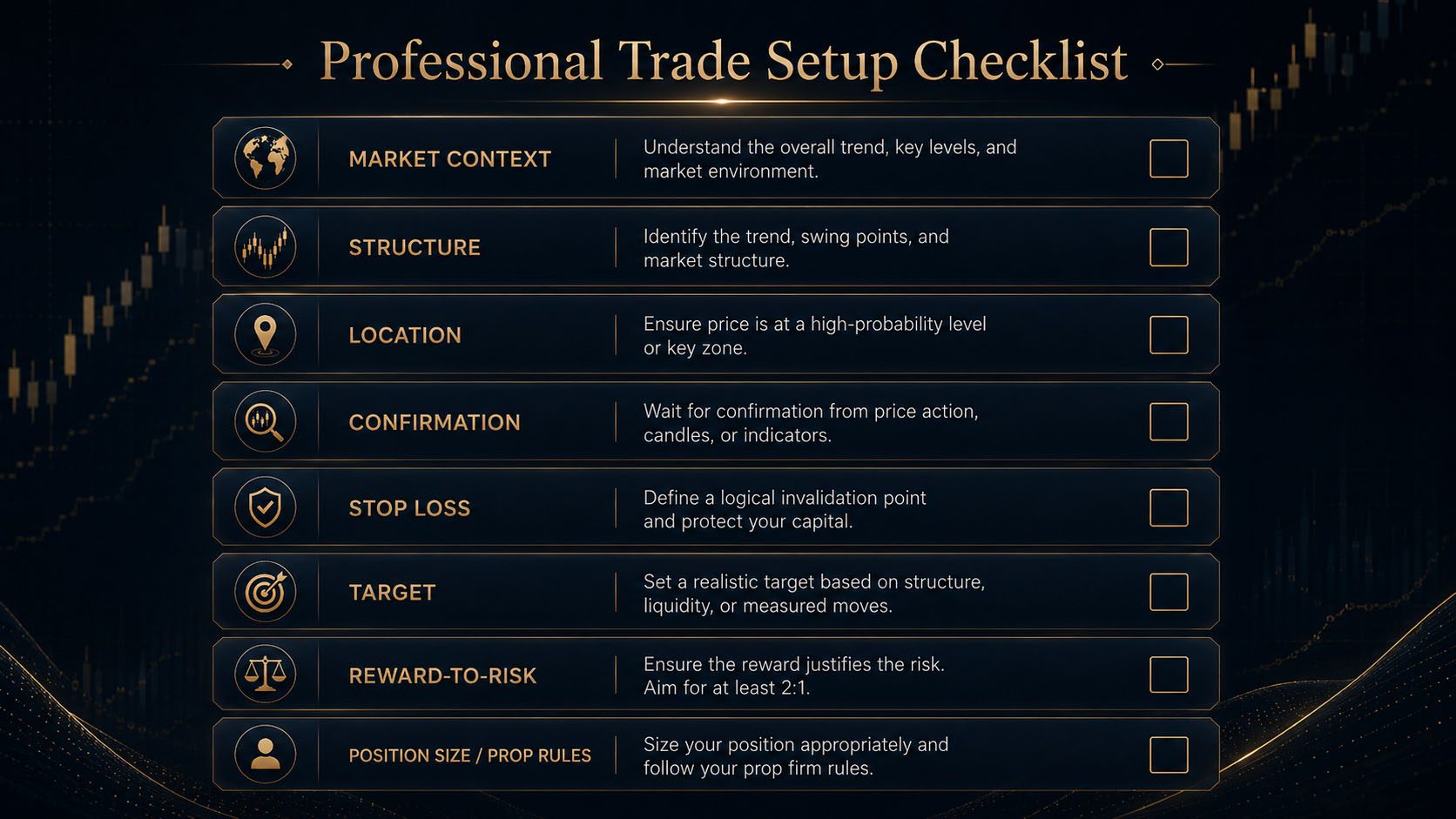
Professional Trade Setup Checklist
- What is the market context?
- Is price trending, ranging, or transitioning?
- Who is in control based on structure?
- Is price at a meaningful level?
- Does higher timeframe bias support the setup?
- Is there enough volatility for the trade to move?
- What exact confirmation am I waiting for?
- Where is the entry trigger?
- Where is the trade invalidated?
- Where is the stop loss?
- Where is the realistic target?
- Is reward-to-risk worth it?
Rule: If you cannot identify entry, stop, target, invalidation, and reason for entry before clicking, the setup is not ready.
How This Applies to Prop Firm Challenges
In a prop firm challenge, building a complete setup is even more important because every trade affects your drawdown, psychology, and ability to stay within the rules. You cannot afford to take random trades just because price moved.A Prop Firm Setup Must Respect
- Daily drawdown limits.
- Maximum drawdown limits.
- Position sizing rules.
- News restrictions if the firm has them.
- Consistency rules if the firm uses them.
- Lot size and risk exposure.
- Trading session quality.
Funded Trader Reality: The goal is not to take more trades. The goal is to take better trades that protect the account while giving profit enough room to develop.
Before taking any setup inside a challenge, review common prop firm disqualification rules and make sure the trade does not create unnecessary account risk.
FAQ
What is the difference between a setup and an entry?
A setup is the full plan. It includes context, structure, location, confirmation, risk, and target. The entry is only the moment you execute after the setup conditions are met.Can I take a trade without confirmation?
You can, but it usually increases risk because you are predicting instead of reacting to evidence. Professional traders usually wait for confirmation before entering.What makes a setup high quality?
A high-quality setup has clear market context, clean structure, meaningful location, confirmation, defined invalidation, controlled risk, and a realistic target.Should every setup have a stop loss?
Yes. Every professional setup should have an invalidation point and a stop loss. Trading without a stop is not professional risk management.How many setups should I trade?
Start with one or two clean setup types and master them. It is better to trade one setup well than to chase ten setups poorly.What should I do if the setup almost looks good?
Wait. Almost good is not good enough when real money or a prop firm challenge is on the line. Let the market either confirm or skip the trade.Knowledge Quiz
- What is a trade setup? Answer: A complete trading plan with context, structure, location, confirmation, risk, and target.
- Is a trade idea the same as a trade setup? Answer: No. A trade idea is only a possible direction. A setup is the complete plan.
- What should come before entry? Answer: Confirmation and a complete risk plan.
- Where should a stop loss be placed? Answer: Near the point where the trade idea is invalidated.
- Why does trade location matter? Answer: It affects stop placement, target distance, and reward-to-risk.
- What does confirmation help reduce? Answer: Guessing, early entries, and emotional trades.
- Why is reward-to-risk important? Answer: It helps determine whether the potential reward is worth the planned risk.
- What should a trader do if context is unclear? Answer: Wait or skip the trade.
- Why should prop firm traders be extra selective? Answer: Because every trade can affect drawdown, rule compliance, and account survival.
- What is the professional rule before entering? Answer: Know the entry, stop, target, invalidation, risk, and reason for entry before clicking.
Key Takeaways
- A trade setup is more than an entry signal.
- A complete setup includes context, structure, location, confirmation, risk, and target.
- Trade ideas are opinions until they become structured plans.
- Confirmation should happen at a meaningful location.
- Stop loss placement should be based on invalidation, not emotion.
- Reward-to-risk must be checked before entry.
- Prop firm traders must build setups that respect drawdown and account rules.
- The cleaner the setup, the easier it should be to explain.
Important Note: A setup does not need to be perfect. It needs to be clear, planned, controlled, and worth the risk.
Lesson Summary
Building a trade setup means turning analysis into a complete execution plan. A professional setup includes market context, structure, trade location, confirmation, stop loss, invalidation, target, and reward-to-risk. Beginners often enter because they have an idea. Professionals wait until the idea becomes a structured setup with clear risk. Inside prop firm challenges, this process is essential because every trade must protect drawdown, respect the rules, and give the trader a logical reason to risk capital.Professional Rule: Do not trade the idea. Trade the complete setup.