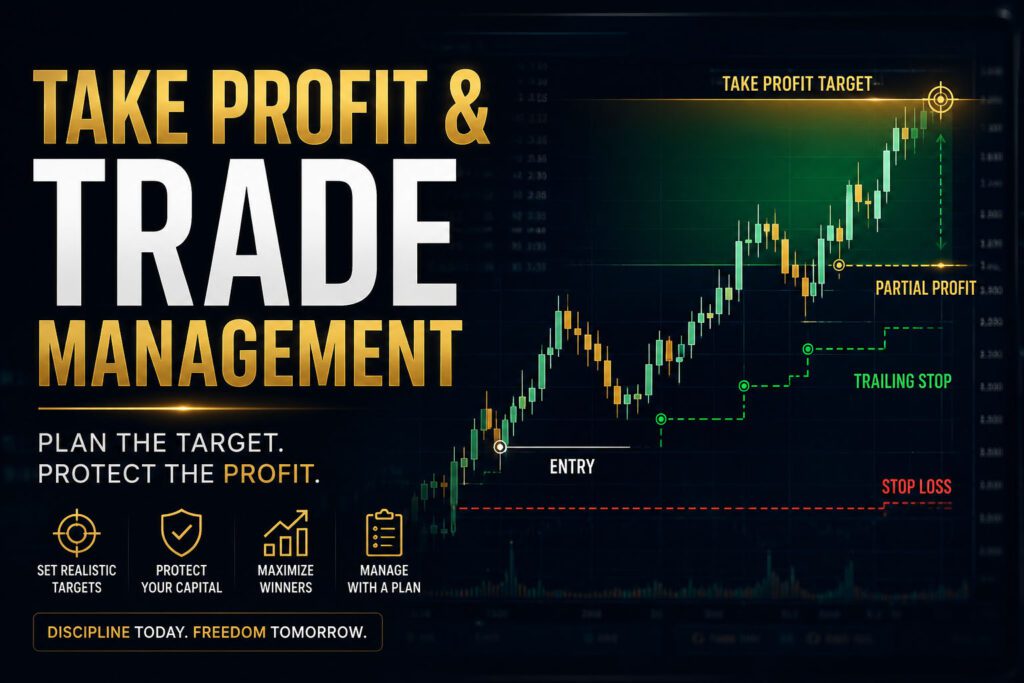
Take Profit & Trade Management
Learn how to select realistic profit targets, manage open positions, protect gains, and give strong trades enough room to reach their full potential.
Entering the Trade Is Only the Beginning
Many traders spend most of their time searching for entries but give very little attention to what happens after the order is opened. They enter with confidence, watch every price movement, become nervous when profit appears, and then make emotional decisions that were never part of the original plan.
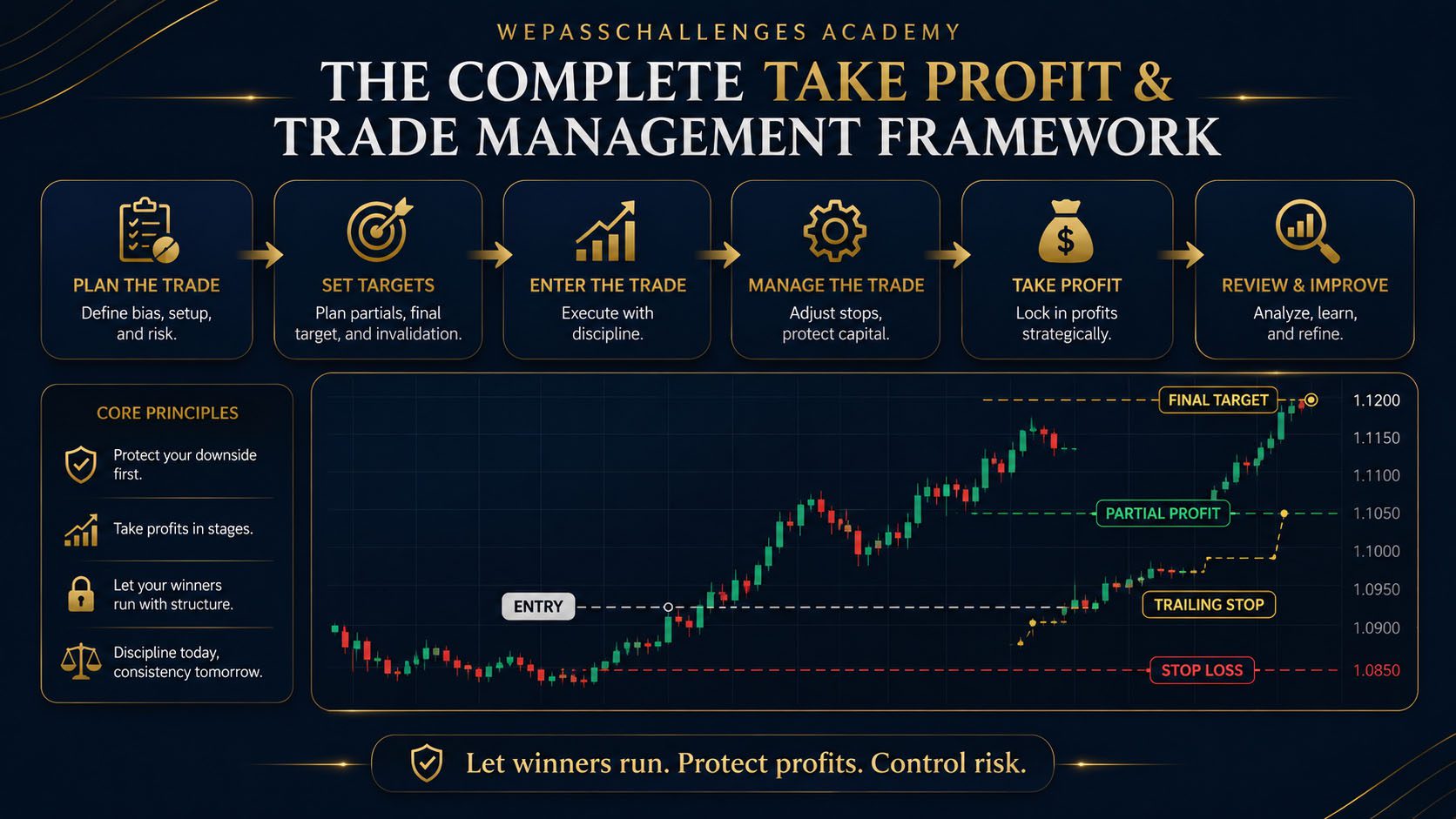
A complete trade requires more than an entry and stop loss. It also needs a realistic profit target and a clearly defined management plan. You should know where you intend to take profit, whether you will secure partial profits, when you may move the stop loss, and what evidence would justify closing the trade early.
This lesson builds directly on Building a Trade Setup, Entry Confirmation, and Stop Loss Placement.
Learning Objectives
- Understand the purpose of a take profit order.
- Identify realistic targets using market structure.
- Use support and resistance to plan exits.
- Compare fixed targets with active trade management.
- Understand partial profit-taking strategies.
- Know when moving a stop to break-even is appropriate.
- Trail stops behind developing market structure.
- Avoid closing winning trades too early.
- Protect prop firm accounts while managing open profit.
- Create a repeatable trade management plan.
1. What Is a Take Profit Order?
A take profit order is an instruction to automatically close a position when price reaches a predetermined profitable level. It allows the trader to define the intended exit before emotion begins influencing the decision.
For a long trade, the take profit is placed above the entry. For a short trade, it is placed below the entry. When price reaches the selected target, the platform closes the position and realizes the profit.
The Main Purposes of a Take Profit
- Define a realistic destination for the trade.
- Lock in profit without requiring constant chart monitoring.
- Prevent greed from turning a winning trade into a losing one.
- Allow risk-to-reward to be calculated before entry.
- Make trading results easier to review and test.
- Reduce emotional decision-making while the trade is active.
2. Where Should a Profit Target Be Placed?
The best target is normally placed near a price area where the market has a logical reason to slow down, reverse, consolidate, or attract opposing orders.
Previous Swing High or Low
A bullish trade may target a previous swing high. A bearish trade may target a previous swing low.
Support or Resistance
Major horizontal levels often become logical locations for profit-taking and opposing pressure.
Liquidity Area
Equal highs, equal lows, session extremes, and obvious price levels may attract price before a reversal.
Trendline or Channel Boundary
A respected channel edge may provide a realistic objective during an established trend.
Measured Move
Chart patterns and ranges can provide projected targets based on the size of the formation.
Risk Multiple
Targets may also be planned at one, two, three, or more times the original risk when structure supports them.
Review Understanding Market Structure, Support and Resistance Trading Strategy, and Chart Patterns before selecting targets from technical levels.
3. Market Structure Target Placement
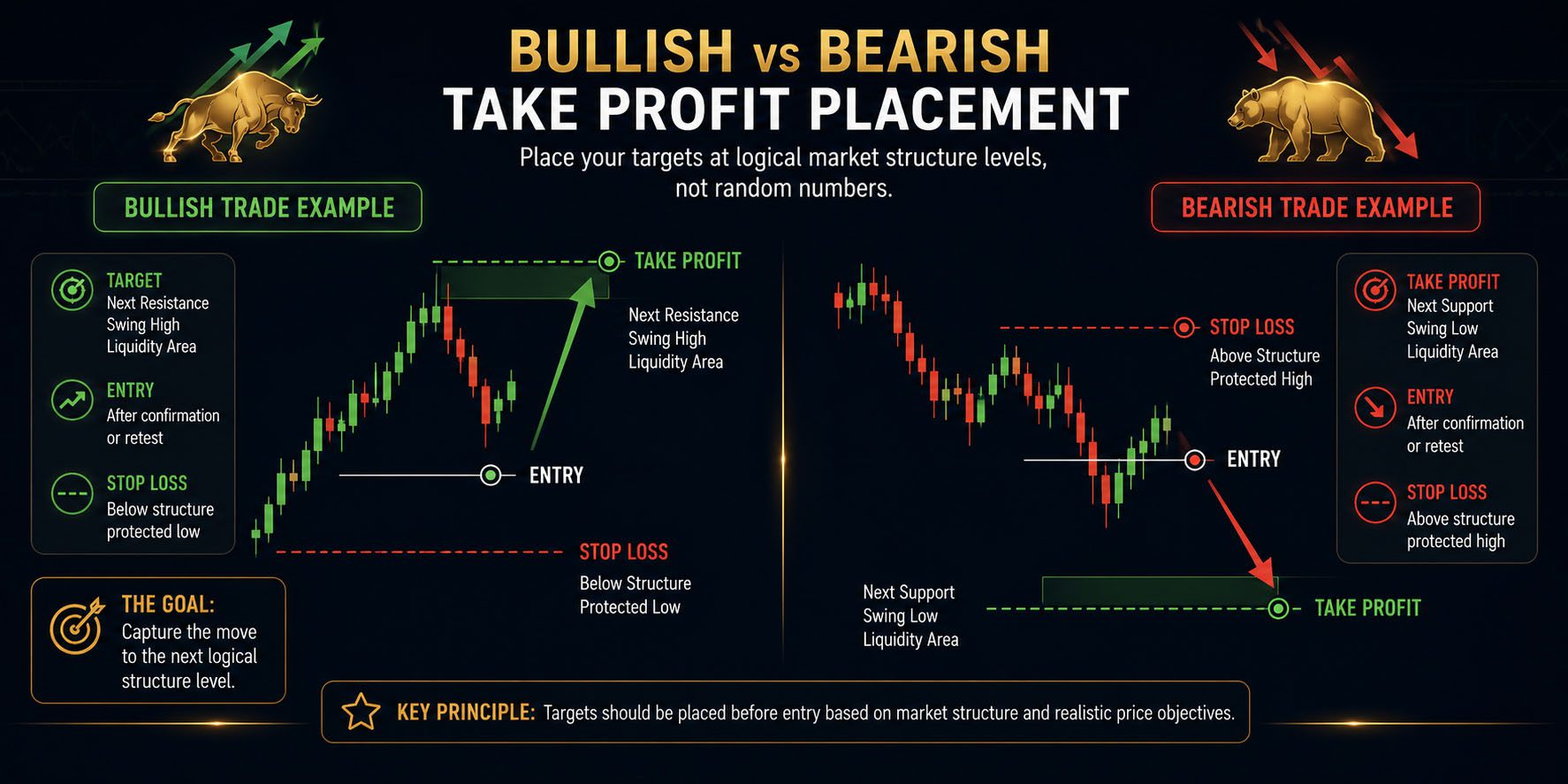
Targeting the Next Resistance Area
In a bullish setup, the first logical objective is commonly the previous swing high, the next major resistance level, an area of equal highs, or the upper boundary of a trading channel.
- Identify the next clear obstacle above the entry.
- Check whether the higher timeframe contains a stronger level nearby.
- Consider placing the target slightly before obvious resistance.
- Confirm that the reward justifies the stop loss risk.
Targeting the Next Support Area
In a bearish setup, the target is commonly placed near the previous swing low, the next support area, equal lows, or the lower boundary of a channel.
- Locate the nearest meaningful demand or support area.
- Look for previous lows where buyers may return.
- Place the target before the strongest opposing level.
- Avoid expecting price to break every level without resistance.
4. Risk-to-Reward Comes Before Trade Management
Before entering a trade, compare the distance from entry to stop loss with the distance from entry to the realistic target. This calculation produces the risk-to-reward ratio.
If your stop loss represents 20 pips of risk and your realistic target is 40 pips away, the setup offers approximately a 1:2 risk-to-reward ratio. If the target is 60 pips away, it offers approximately 1:3.
| Planned Risk | Profit Target | Risk-to-Reward | Meaning |
|---|---|---|---|
| $100 | $100 | 1:1 | Potential reward equals the planned loss. |
| $100 | $200 | 1:2 | Potential reward is twice the planned loss. |
| $100 | $300 | 1:3 | Potential reward is three times the planned loss. |
| $100 | $500 | 1:5 | Potential reward is five times the planned loss. |
Study Risk-to-Reward Trading for Prop Firm Challenges for a deeper explanation.
5. Fixed Take Profit vs Active Trade Management
Fixed Take Profit
A fixed target is selected before entry and remains unchanged unless the trade is manually closed for a valid reason.
Advantages
- Simple and easy to execute.
- Reduces emotional interference.
- Makes backtesting easier.
- Works well for traders who cannot watch the chart.
- Produces clear and consistent data.
Disadvantages
- May exit before a major trend continues.
- Cannot adapt to rapidly changing structure.
- May miss additional profit during strong momentum.
Active Trade Management
Active management allows the trader to adjust the stop loss, secure partial profits, extend a target, or close early when market evidence changes.
Advantages
- Can capture larger trending moves.
- Allows risk to be reduced as structure develops.
- Adapts to changing market conditions.
- Can protect profit before major events.
Disadvantages
- Creates more opportunities for emotional mistakes.
- Requires clear and tested rules.
- Can lead to early exits and inconsistent results.
6. The Three Main Trade Management Styles
Set and Forget
The entry, stop loss, and take profit are placed before the trade begins. No changes are made unless a major abnormal event occurs.
This is often the cleanest approach for beginners because it prevents constant interference.
Partial Profit Management
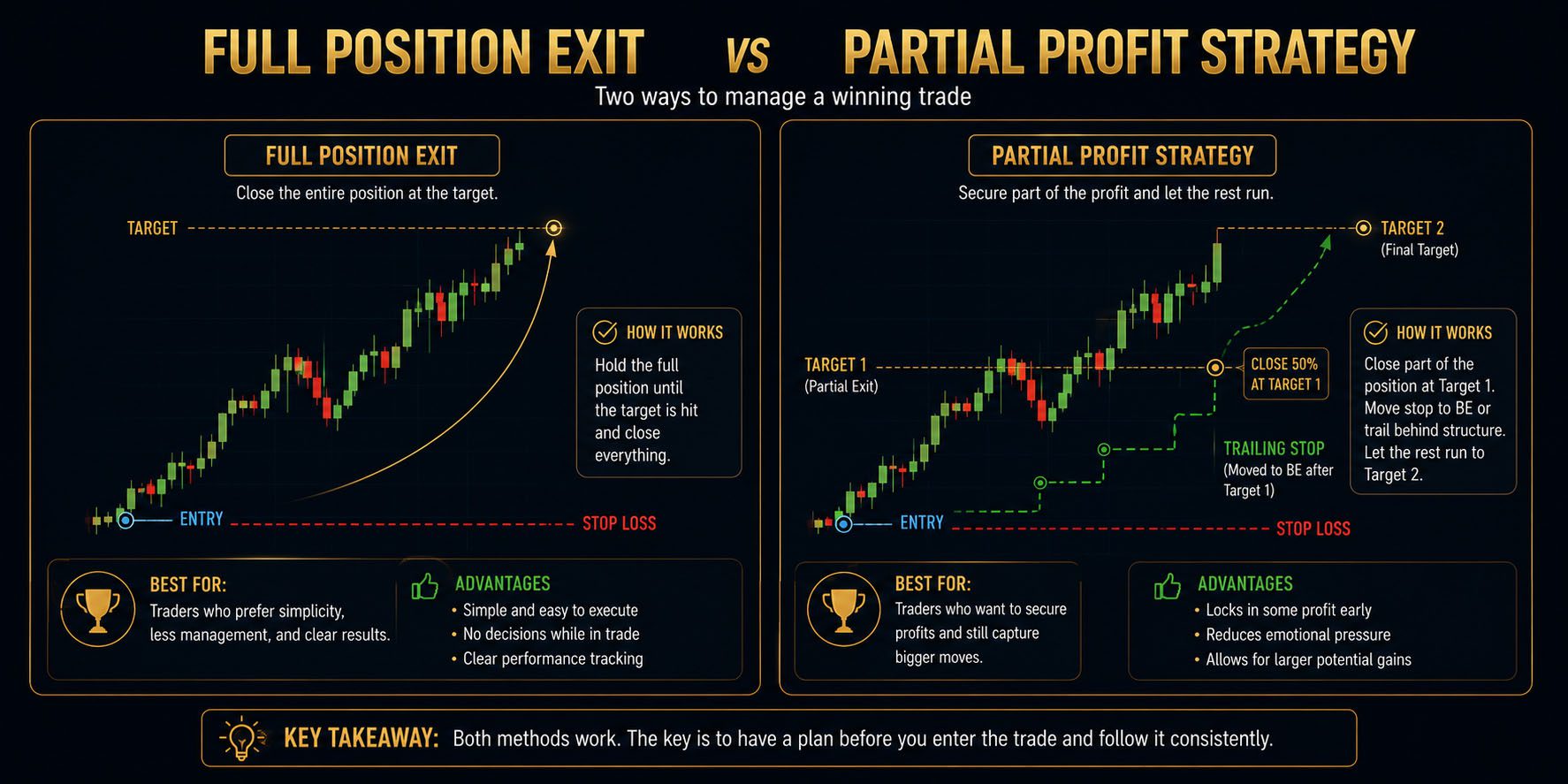
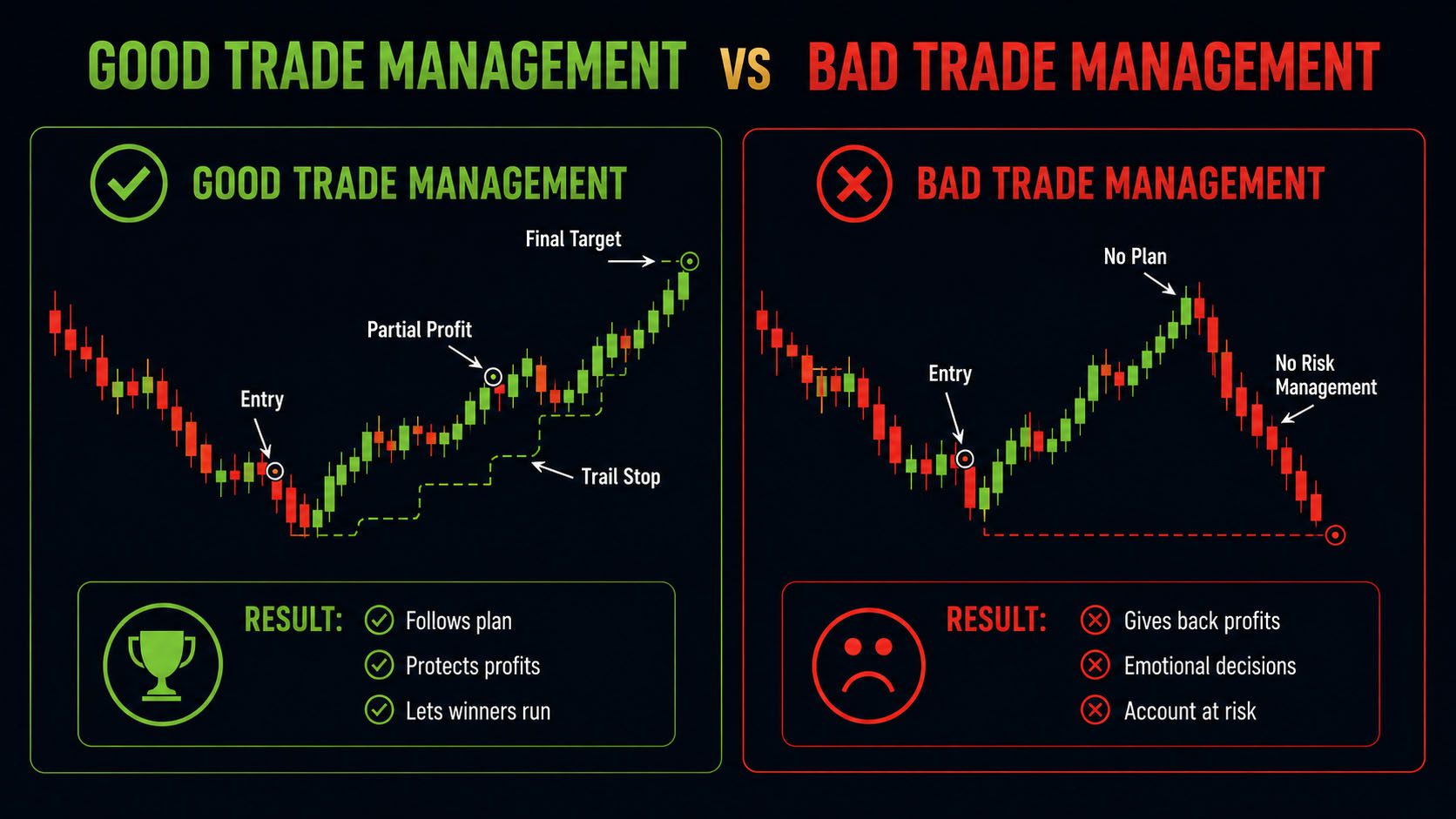
A portion of the trade is closed at the first objective while the remaining position is allowed to continue toward a larger target.
This can reduce emotional pressure while preserving the opportunity for a larger winner.
Structure-Based Trailing
The stop loss is moved behind new higher lows during a bullish trade or new lower highs during a bearish trade.
This approach is designed to remain in a trend until market structure begins to reverse.
7. Partial Profit-Taking
Partial profit-taking means closing part of an open position while allowing the remaining portion to continue. For example, a trader may close 50% of a position at the first target and leave the other 50% open for a larger objective.
Example Partial Profit Plan
Secure part of the profit at the first important structure level.
Avoid immediately moving to break-even simply because partial profit was taken.
This provides additional upside if momentum continues.
Advantages of Partial Profits
- Locks in realized profit.
- Reduces emotional pressure.
- Allows participation in a larger move.
- Can reduce the impact of a reversal.
Disadvantages of Partial Profits
- Reduces the total gain if price reaches the final target.
- Can make performance calculations more complex.
- May become inconsistent if percentages constantly change.
- Can encourage traders to take profit too early.
8. Moving the Stop Loss to Break-Even
Moving to break-even means adjusting the stop loss to the original entry price, or slightly beyond it to account for spread and commissions. If price reverses, the position closes with little or no loss.
Break-even sounds safe, but moving the stop too quickly is one of the most common trade management mistakes. Normal retracements often revisit the entry area before the market continues toward the target.
Possible Break-Even Rules
- Move to break-even only after price reaches 1:1 or 1:2.
- Move only after the first target is reached.
- Move only after a new higher low or lower high forms.
- Move only after price breaks an important structural level.
- Move before major scheduled news only if required by the strategy.
9. Structure-Based Trailing Stops
Trail Below Higher Lows
As a bullish trend continues, price may form a series of higher lows. The stop can be moved beneath confirmed higher lows after price resumes upward.
- Wait for the higher low to form and hold.
- Do not trail directly under every candle.
- Allow a reasonable volatility buffer.
- Keep the stop beneath meaningful structure.
Trail Above Lower Highs
During a bearish trend, the stop may be moved above confirmed lower highs as price continues downward.
- Wait for a clear lower high.
- Confirm that bearish momentum resumes.
- Keep the stop above the full structural area.
- Avoid tightening the stop during normal retracements.
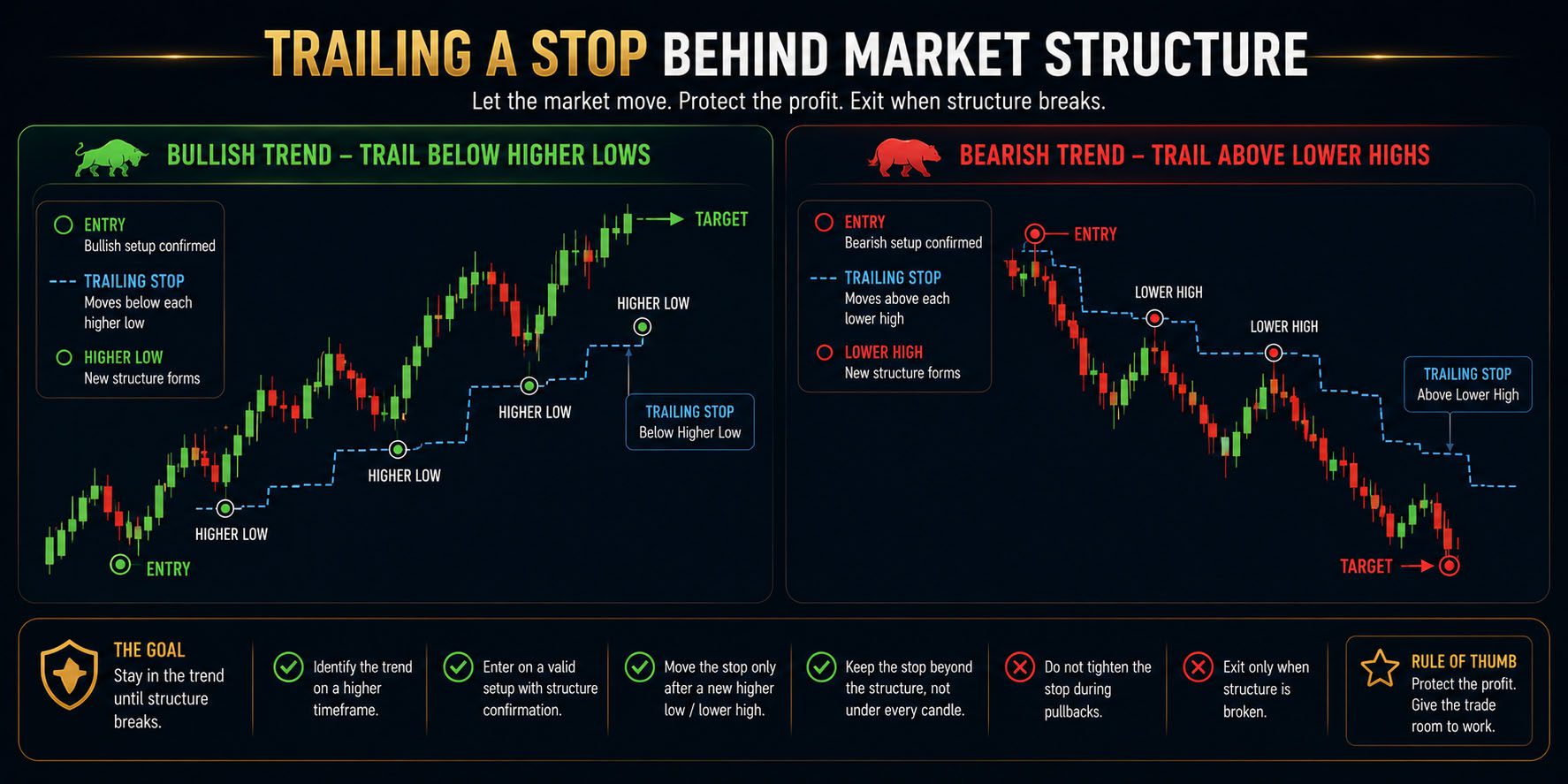
Structure-based trailing connects the management decision to the same market logic used for the original setup. Review Multi-Timeframe Analysis to avoid reacting to insignificant lower-timeframe movements.
10. When Should a Trade Be Closed Early?
Closing early may be justified when the conditions supporting the trade have materially changed. It should not happen merely because the position shows a temporary pullback.
| Situation | Possible Action | Reason |
|---|---|---|
| Clear opposite structure break | Reduce or close the position | The original direction may no longer be valid. |
| Strong rejection at a major target area | Secure partial or full profit | Opposing pressure is entering the market. |
| Unexpected high-impact news | Reduce exposure according to the plan | Volatility and slippage may increase dramatically. |
| Momentum disappears before target | Observe structure before acting | Slower movement alone does not always mean the setup failed. |
| Trade entered by mistake | Close immediately | An accidental order should not become an unplanned trade. |
| Daily drawdown risk becomes unacceptable | Reduce or close exposure | Account protection takes priority over one trade. |
11. Why Traders Exit Winning Trades Too Early
Early exits usually come from emotional discomfort rather than technical evidence. Once a position turns profitable, traders often become afraid of giving back even a small portion of the gain.
Common Psychological Causes
- Fear of losing unrealized profit.
- Lack of confidence in the trading plan.
- Watching every tick or candle movement.
- Recent losing trades creating excessive caution.
- Using an oversized position.
- Entering without a predetermined target.
- Trying to protect daily profit totals.
- Confusing normal pullbacks with full reversals.
The lessons Patience Pays and Overtrading explain why discipline is essential during both winning and losing trades.
12. Why Traders Hold Winning Trades Too Long
The opposite problem occurs when greed causes a trader to ignore a planned target. Price reaches the intended objective, but the trader keeps holding because the profit feels exciting. The market then reverses and returns a large portion of the gain.
Warning Signs of Greedy Trade Management
- Moving the take profit farther away without new analysis.
- Ignoring major resistance or support.
- Refusing to secure profit after the planned target is reached.
- Expecting every trade to become an unusually large winner.
- Changing the target because of a daily or challenge profit goal.
- Holding through major news without a tested rule.
13. Bullish Trade Management Example
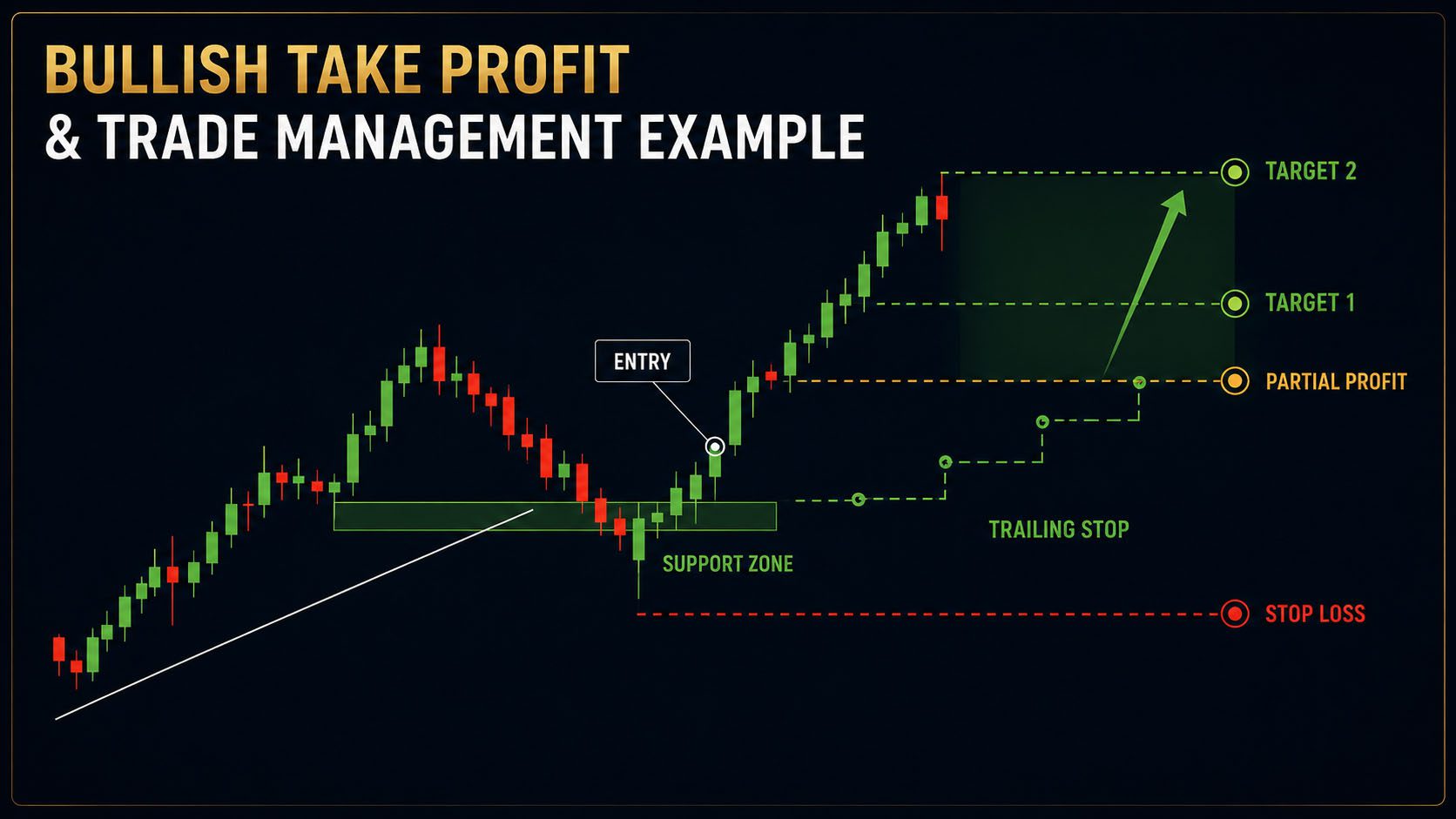
Example: Managing a Bullish Pullback Trade
Assume price is trending higher on the one-hour chart. It pulls back into support and forms a bullish rejection followed by a lower-timeframe structure break.
- Entry: After the bullish confirmation or retest.
- Stop loss: Below the protected higher low.
- First target: Previous swing high.
- Second target: Higher-timeframe resistance above the swing high.
- Management option: Close part of the position at the first target.
- Trailing option: Move the stop below a newly confirmed higher low.
- Exit condition: Bearish structure break or rejection from the final target area.
The trader does not move the stop simply because the position becomes profitable. The stop is adjusted only after the market creates new protective structure.
14. Bearish Trade Management Example
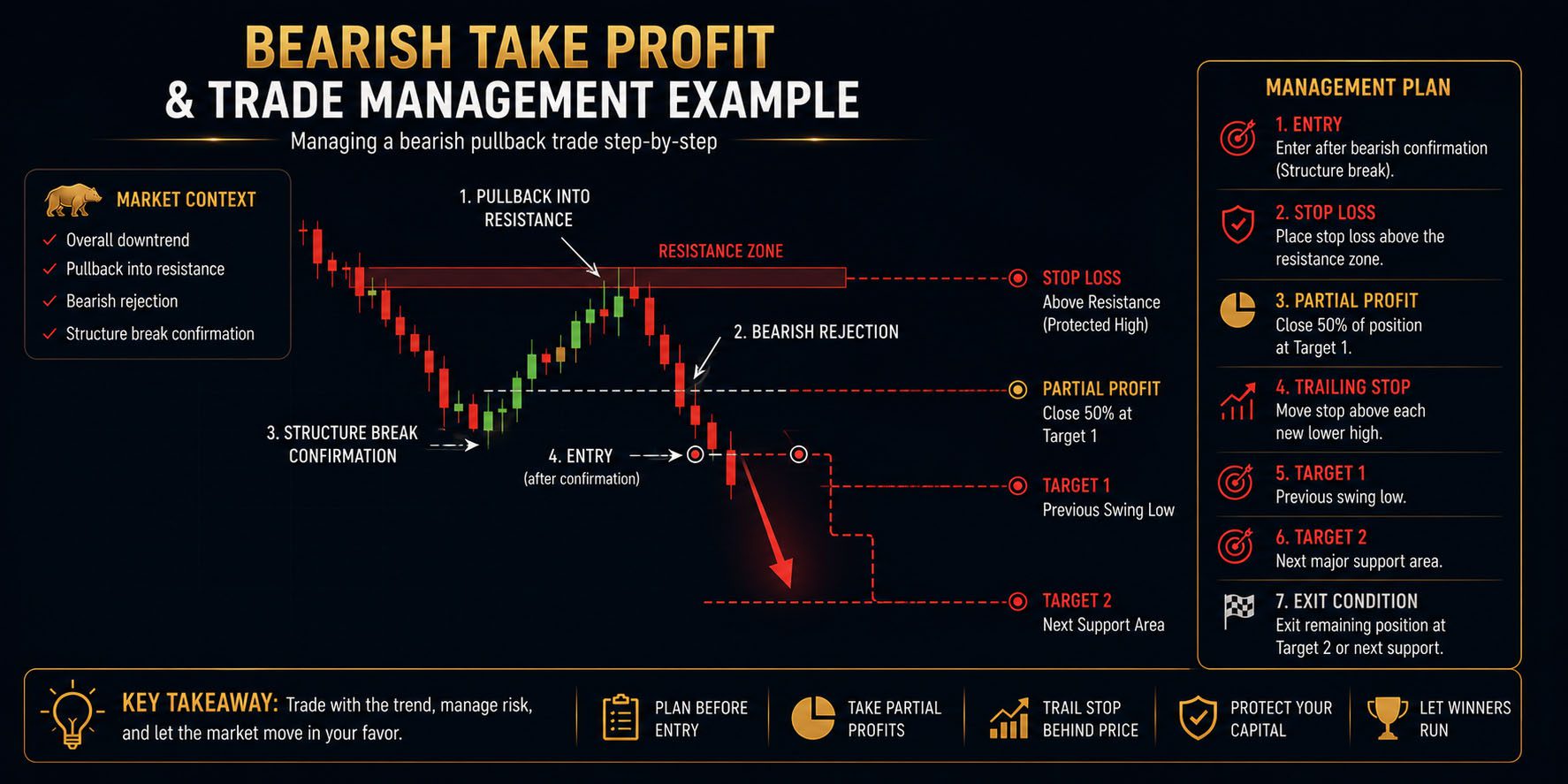
Example: Managing a Bearish Resistance Trade
Assume the higher timeframe is bearish. Price retraces into former support that now acts as resistance. A bearish engulfing candle forms, followed by a break beneath short-term structure.
- Entry: After bearish confirmation.
- Stop loss: Above the protected lower high.
- First target: Previous swing low.
- Second target: Lower support or equal lows.
- Management option: Secure partial profit at the first low.
- Trailing option: Move the stop above confirmed lower highs.
- Exit condition: Bullish structure break or strong rejection from support.
The target is placed slightly before the strongest support area rather than directly on the most obvious level.
15. Trade Management During News and Session Changes
Open trades can behave differently when liquidity and volatility change. A position opened during London may remain active into New York. A quiet trade may suddenly become volatile near an economic release.
Before High-Impact News
- Know whether your trading plan permits holding through the release.
- Consider whether the trade has already reached a meaningful objective.
- Account for spread expansion and slippage.
- Do not move the stop excessively close simply because news is approaching.
- Do not widen the stop to survive volatility.
- Close or reduce exposure if required by your tested rules.
Review When Not to Trade before holding positions through unstable market conditions.
16. Prop Firm Trade Management
Trade management becomes especially important inside a prop firm challenge or funded account. Unrealized profit may temporarily protect an account, but it can disappear quickly if the market reverses.
Prop Firm Management Rules
- Know whether drawdown is calculated from balance or equity.
- Understand whether the account uses static or trailing drawdown.
- Monitor total risk across all open positions.
- Avoid allowing several profitable trades to reverse into full losses.
- Do not increase risk after a winning trade.
- Protect the account before attempting to reach a profit target quickly.
- Stop trading after reaching the planned daily objective.
- Do not manage trades emotionally because the challenge is close to completion.
Study Understanding Daily Drawdown, Maximum Drawdown Explained, and Common Rules That Get Traders Disqualified.
17. Common Take Profit and Management Mistakes
| Mistake | Why It Hurts Performance | Professional Correction |
|---|---|---|
| Entering without a target | Profit decisions become emotional. | Define the target before entering. |
| Targeting a random cash amount | The target may conflict with market structure. | Use technical levels and realistic price objectives. |
| Moving to break-even too early | Normal retracements repeatedly close valid trades. | Wait for structural confirmation or a tested threshold. |
| Closing after one opposite candle | Normal pullbacks are mistaken for reversals. | Evaluate structure, not one candle. |
| Moving the target farther away | Greed overrides the original plan. | Extend only when new evidence supports it. |
| Taking partial profit randomly | Results become impossible to test consistently. | Use fixed percentages and clear target rules. |
| Watching every market tick | Small movements create unnecessary fear. | Manage on the timeframe used in the strategy. |
| Ignoring correlated positions | Multiple trades may reverse simultaneously. | Manage total exposure across the account. |
18. The Professional Trade Management Process
Define the Target
Choose the realistic destination before entering the market.
Confirm the Reward
Make sure the potential gain justifies the planned loss.
Select a Management Style
Choose fixed target, partial profits, or structure-based trailing.
Define Adjustment Rules
Know exactly when the stop can move or profit can be secured.
Follow Market Evidence
React only to meaningful structural changes.
Record the Outcome
Review whether management improved or reduced the result.
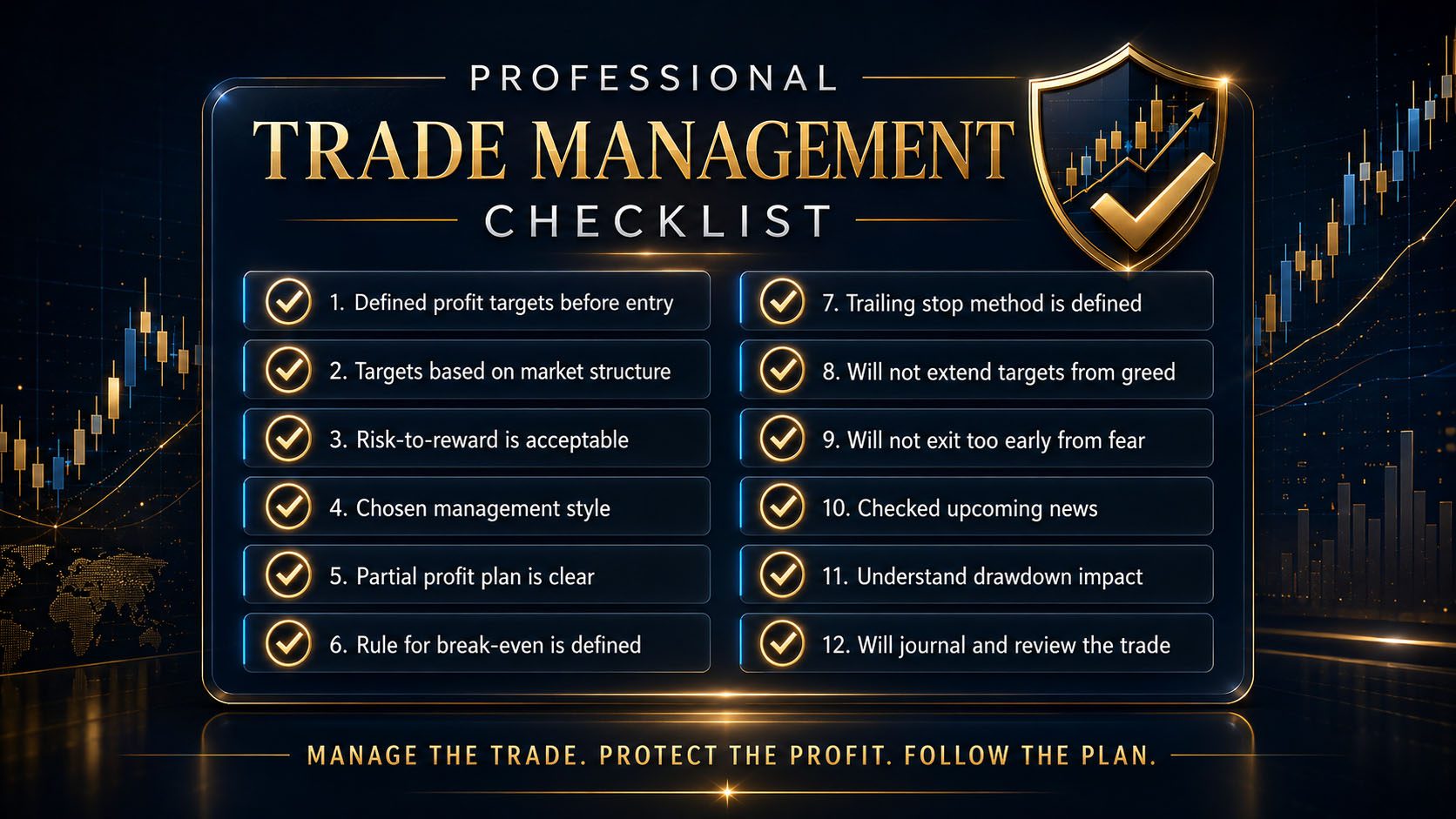
19. Take Profit and Trade Management Checklist
- I selected the profit target before entering.
- The target is based on market structure.
- I checked higher-timeframe support or resistance.
- The target offers acceptable risk-to-reward.
- I know whether I am using a fixed or actively managed exit.
- I defined my partial profit percentages in advance.
- I know the exact condition for moving to break-even.
- I know how I will trail the stop if the trend continues.
- I will not extend the target because of greed.
- I will not close early because of one temporary pullback.
- I checked for upcoming high-impact news.
- I understand the effect on daily and maximum drawdown.
- I will record every management decision in my journal.
Frequently Asked Questions
Should I always use a take profit order?
Most traders benefit from having a predefined target. Some tested strategies use trailing stops instead, but the exit process must still be clearly defined before entry.
Is a 1:2 risk-to-reward ratio always required?
No. The appropriate ratio depends on the strategy’s win rate, market structure, and tested performance. A high win-rate strategy may operate differently from a lower win-rate trend-following strategy.
Should I take partial profits?
Partial profits can reduce pressure and secure gains, but they also reduce the total reward if price reaches the final target. Test the method rather than assuming it is automatically better.
When should I move my stop to break-even?
Use a specific rule, such as after reaching a risk multiple, breaking structure, reaching the first target, or forming a new protective swing.
Should I close a trade when momentum slows down?
Not automatically. Markets frequently pause and consolidate. Look for structural evidence that the original trade idea is failing.
Can I extend my profit target?
Yes, but only when new market evidence supports a larger objective. Do not extend it simply because the open profit feels exciting.
What is the safest trade management method for beginners?
A fixed entry, stop loss, and take profit often provide the clearest starting point. It reduces emotional decisions and produces easier-to-review trading data.
Knowledge Check Quiz
1. What should primarily determine a profit target?
2. Why can moving to break-even too early be harmful?
3. What does partial profit-taking mean?
4. What is a structure-based trailing stop?
5. When is extending a target reasonable?
6. Why should trade management rules be defined before entry?
Quiz Answer Key
Question 1 Answer
B. Profit targets should be selected from realistic market structure and technical objectives.
Question 2 Answer
C. Price may revisit the entry during a normal pullback before continuing toward the target.
Question 3 Answer
B. Partial profit-taking closes part of the position while allowing the remaining portion to continue.
Question 4 Answer
C. Structure-based trailing moves the stop behind meaningful higher lows or lower highs.
Question 5 Answer
B. A target should only be extended when new market evidence provides a logical larger objective.
Question 6 Answer
C. Defining management rules before entry prevents fear and greed from controlling the open trade.
What You Must Remember
- Choose the profit target before entering the market.
- Use market structure rather than random monetary goals.
- Confirm that the realistic target offers acceptable reward.
- Choose a consistent trade management method.
- Partial profits reduce exposure but also reduce maximum reward.
- Moving to break-even too early can damage performance.
- Trail stops behind confirmed structure, not every candle.
- Close early only when meaningful market evidence changes.
- Do not extend targets because of greed.
- Record and review every management decision.
Lesson Summary
Take profit placement and trade management determine how much of a good setup you actually convert into realized profit. A strong entry is not enough if the target is unrealistic, the trade is closed from fear, or the stop is moved without a clear rule.
A professional trader selects a target from market structure, confirms the potential reward, and decides how the position will be managed before entering. The trader may use a fixed target, partial profits, or a trailing stop, but the method must be consistent and testable.
The goal is not to capture every possible pip. The goal is to repeatedly execute a management plan that protects the account, respects market structure, and produces measurable long-term results.
In the next lesson, you will learn how trading sessions, liquidity, volatility, and economic timing affect entry quality and trade execution.