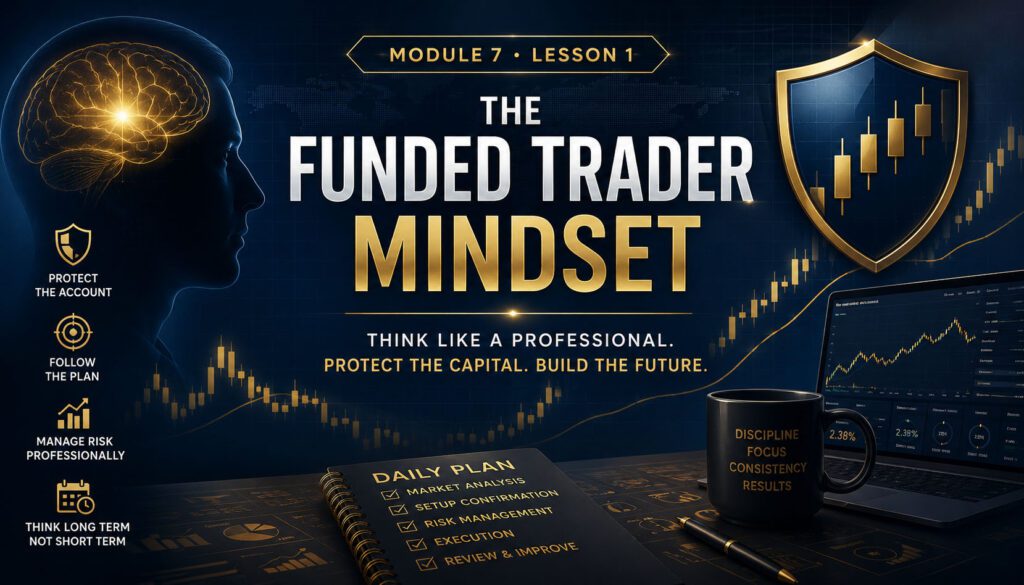
The Funded Trader Mindset
Learn how to shift from chasing an evaluation target to protecting capital, building consistency, and operating like a professional funded trader.
Getting Funded Changes the Objective
Many traders believe that receiving a funded account is the finish line. In reality, it is the beginning of a more demanding stage of development.
During a prop firm evaluation, the trader usually has one clearly defined objective: reach the profit target without violating the rules. Once the evaluation has been passed, the objective changes. The trader must now protect access to capital, remain eligible for payouts, control drawdown, and produce results that can be repeated over many weeks and months.
This change sounds simple, but it requires a completely different way of thinking. A trader who continues using a high-pressure, target-chasing evaluation mindset after becoming funded may quickly return the account to the prop firm.
Professional funded trading is not about proving how much money you can make in one day. It is about proving that you can follow a stable process while protecting the opportunity you have earned.
Before continuing, it is helpful to review the earlier lessons on common prop firm disqualification rules, daily drawdown, and maximum drawdown. Those rules now become part of your daily operating environment.
What You Will Learn
Recognize why evaluation trading and funded-account trading require different priorities.
Measure performance by longevity, discipline, payout consistency, and account protection.
Stop treating every session as an opportunity that must produce profit.
Manage performance across weeks and months instead of reacting emotionally to single trades.
Understand why preserving the funded account is more important than maximizing short-term return.
Approach trading as a controlled professional operation rather than an excitement-driven activity.
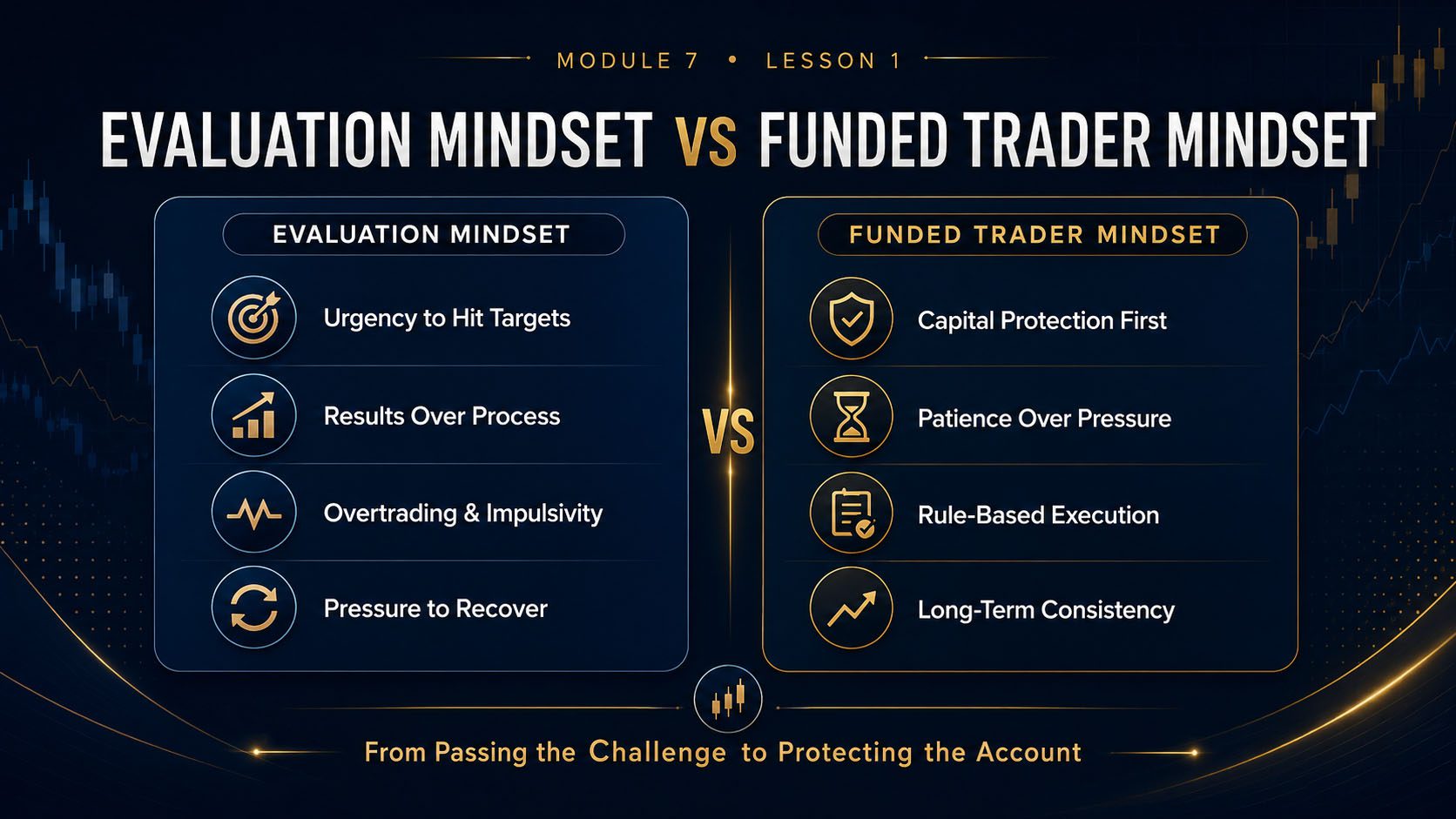
Evaluation Mindset vs Funded Trader Mindset
The evaluation stage often creates urgency. There is a visible profit target, traders want to pass quickly, and every day can feel like a race against time. Even when the evaluation has no formal deadline, the trader may create an artificial deadline through impatience.
A funded account should remove that urgency. There is no prize for reaching the next payout target in the fewest number of trades. There is no benefit to creating unnecessary exposure simply because the account is available.
Evaluation-Trader Thinking
- I need to reach the target as quickly as possible.
- I should trade whenever the market is moving.
- A larger position can help me finish sooner.
- A losing day must be recovered immediately.
- Passing is more important than process quality.
- Every missed trade is a missed opportunity.
- One large winning day can solve everything.
Funded-Trader Thinking
- I must protect the account before pursuing profit.
- I only trade when my complete setup is present.
- Risk must remain stable and intentional.
- Losses are reviewed, not chased.
- Process quality determines long-term results.
- Missing a weak trade protects capital.
- Consistent smaller gains can build reliable payouts.
The funded trader does not become less ambitious. The ambition becomes more intelligent. Instead of trying to make the most money possible today, the trader tries to remain in position to make money repeatedly.
Your First Responsibility Is Capital Preservation
A funded account gives you permission to operate with capital under a strict set of rules. That permission can be removed as soon as a drawdown limit, consistency rule, prohibited strategy rule, or account condition is violated.
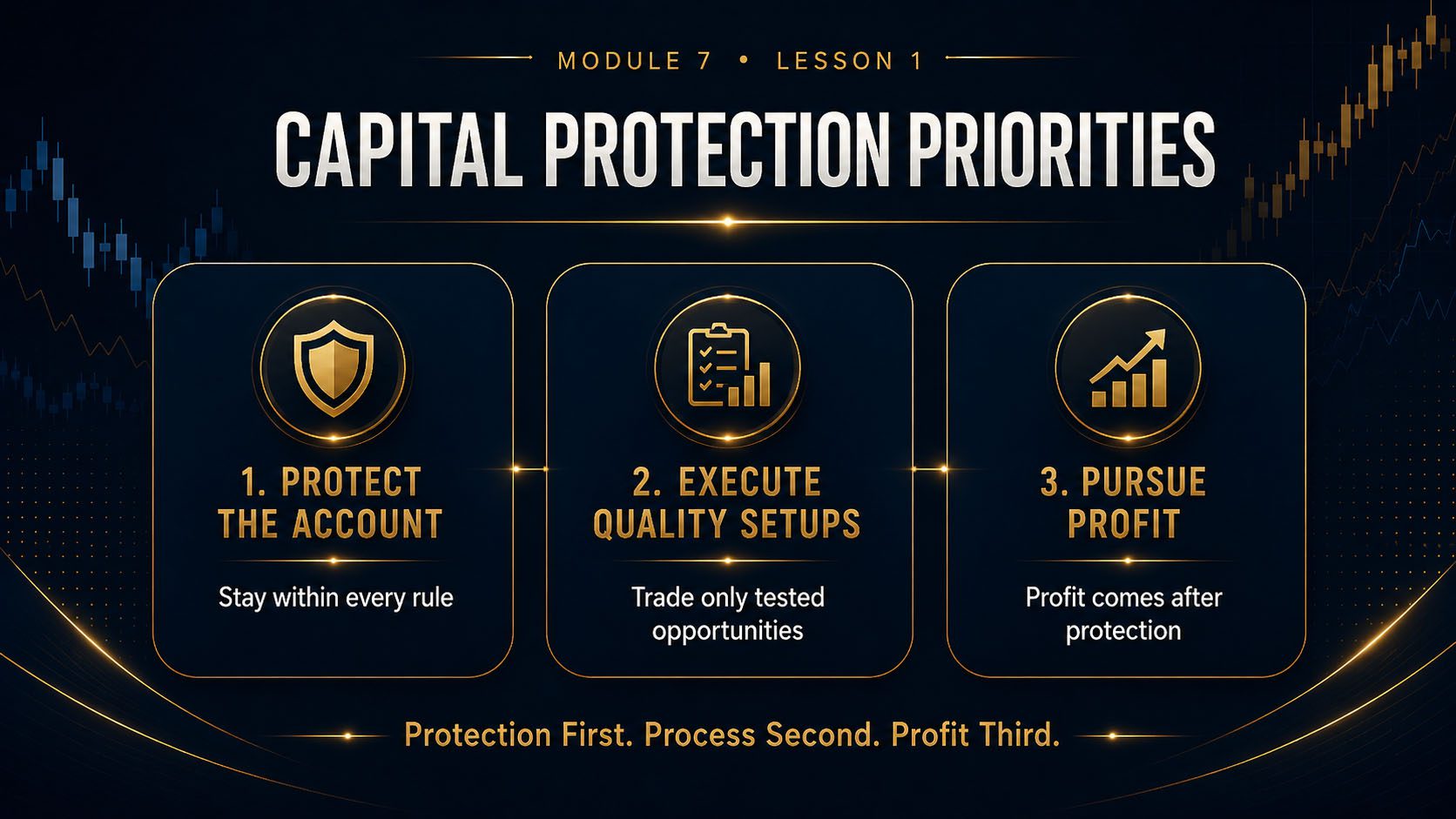
This means that every funded trader must understand a basic professional hierarchy:
Many struggling traders reverse this order. They place profit first, then strategy quality, and only think about account protection after losses have already accumulated.
Capital preservation does not mean being afraid to trade. It means knowing exactly when risk is justified and refusing to take risk when the conditions are not strong enough.
The principles taught in Position Sizing Made Simple and Risk-to-Reward Trading become even more important after funding. A funded account should never cause a trader to abandon the risk structure that helped them pass.
Success Is More Than Daily Profit
A trader can make money while trading badly. A trader can also lose money while executing perfectly. One day of profit or loss does not provide enough information to judge professional performance.
Funded traders should evaluate success using a wider group of measurements.
| Measurement | Weak Interpretation | Professional Interpretation |
|---|---|---|
| Daily result | I made money, so I traded well. | Did I follow the correct process regardless of the outcome? |
| Trade frequency | More trades create more opportunity. | Only high-quality trades deserve funded capital. |
| Winning streak | I should increase risk because I am trading well. | I should keep risk stable until the data supports a change. |
| Losing streak | I need to recover quickly. | I need to protect capital and verify execution quality. |
| Payout size | A larger payout always means better performance. | A repeatable payout with controlled drawdown is more valuable. |
| Account age | Time does not matter if profit is strong. | Longevity demonstrates discipline and account protection. |
Think in Months and Payout Cycles
Unprofessional traders often judge themselves minute by minute. A losing trade creates panic. A winning trade creates overconfidence. A missed setup creates regret. This short-term emotional cycle makes consistent performance almost impossible.
A funded trader should think across a much longer timeframe.
One Trade
A single trade is only one outcome within a larger strategy sample. It should not change your identity, confidence, or rules.
One Trading Day
A day is successful when the trading plan is followed, even when the result is a small controlled loss.
One Trading Week
A week reveals whether risk, frequency, patience, and execution remained stable across multiple opportunities.
One Payout Cycle
A payout cycle measures whether the trader can protect profit, avoid late-stage mistakes, and reach withdrawal eligibility.
Several Months
Multiple months provide more meaningful evidence about strategy expectancy, discipline, and account durability.
A Trading Career
The true objective is not one payout. It is the ability to maintain access to capital and produce income repeatedly.
This long-term perspective reduces pressure. You no longer need one trade to fix the week, one day to create the payout, or one oversized position to prove your ability.
Stop Treating Every Session Like It Must Produce Profit
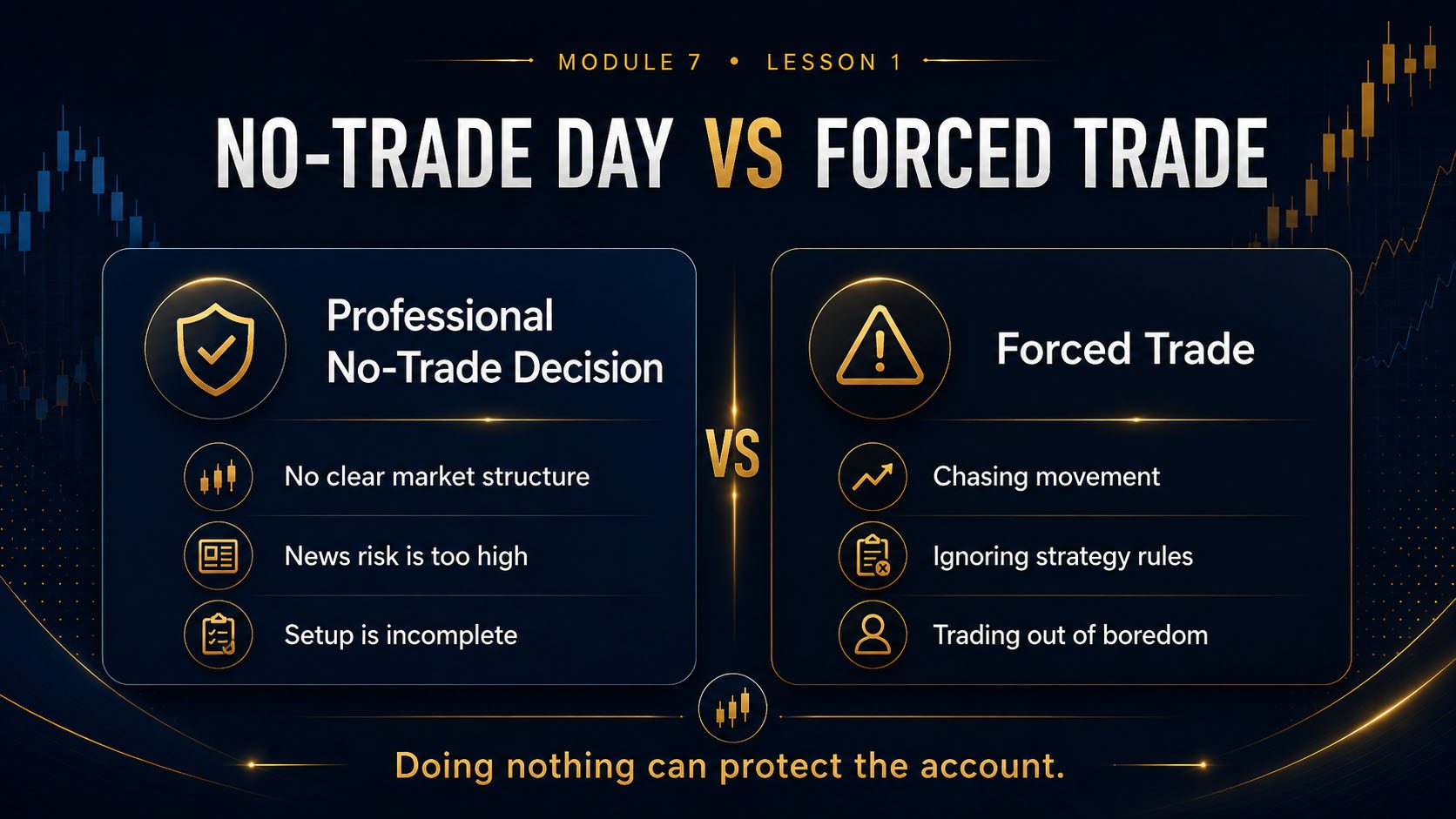
The market does not owe you a setup because you opened your trading platform. Some sessions will offer several strong opportunities. Other sessions will offer nothing worth risking capital on.
A funded trader must become comfortable with inactive days.
This principle connects directly with the earlier lessons on trading patience, overtrading, and when not to trade.
Reasons a Funded Trader May Correctly Finish the Day Without Trading
- The market structure is unclear or inconsistent.
- Price is trading in the middle of a range with poor location.
- The expected reward does not justify the required risk.
- High-impact economic news creates unpredictable conditions.
- The trader missed the planned entry and would now be chasing price.
- The setup does not meet the strategy rules developed in Module 6.
- The trader is tired, distracted, emotionally reactive, or technically unprepared.
- The account has reached its personal daily profit or loss boundary.
Doing nothing can be a professional decision. In funded trading, inactivity is often cheaper than low-quality activity.
Separate Confidence From Position Size
One of the most dangerous moments for a newly funded trader occurs immediately after passing the evaluation. The trader feels confident, relieved, and validated. That emotional high may encourage larger positions, more trades, or a belief that the difficult part is over.
Confidence is valuable when it helps you follow your process. Confidence becomes dangerous when it convinces you that your rules no longer apply.
Emotional Confidence
- I passed, so I can handle more risk.
- My last few trades worked, so the next one should work.
- I understand the market better now.
- I should increase lot size to make the funded account worthwhile.
- I do not want to waste time with small gains.
Professional Confidence
- I trust myself to follow the plan.
- I accept that the next trade can lose.
- I will keep position size consistent.
- I will scale only after sufficient live data.
- I value repeatability more than excitement.
Your funded account should begin with the most controlled version of your trading process, not the most aggressive version.
Trade the Plan, Not the Account Size
A large advertised account size can distort decision-making. A trader may see a $100,000 or $200,000 funded account and begin mentally calculating how much money can be made from every market movement.
However, the displayed account balance is not the same as personal risk capital. The true operational capital is the distance between the current account equity and the account’s drawdown boundary.
This is why a funded trader should not think:
A more accurate way to think is:
Your strategy rules, setup requirements, stop placement, and position sizing should determine the trade. The size printed at the top of the platform should not emotionally pressure you into larger exposure.
Review Building a Trade Setup, Entry Confirmation, and Stop Loss Placement whenever account size begins to influence your decisions more than market structure.
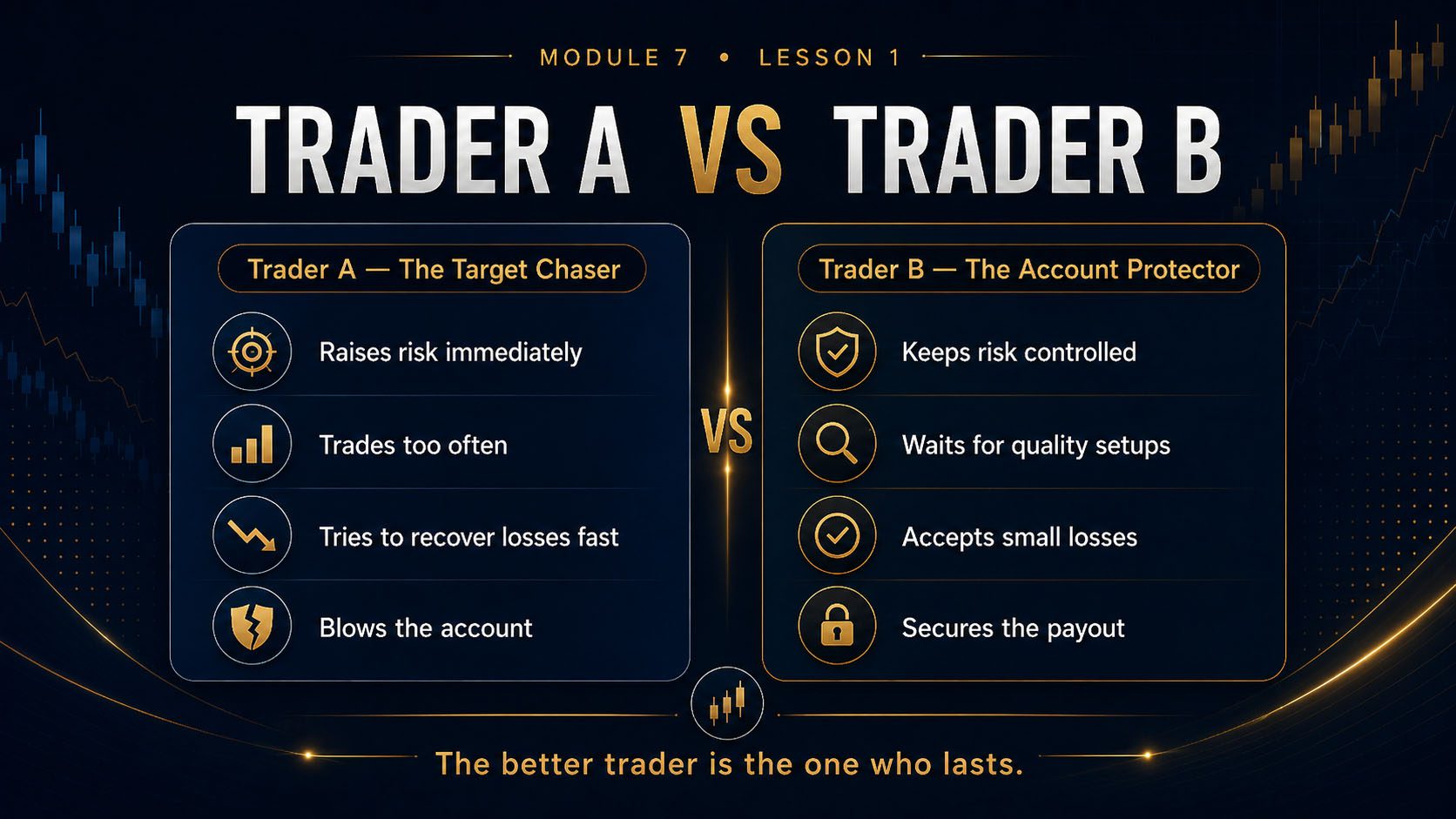
Two Traders With the Same Funded Account
Scenario
Trader A and Trader B both receive a $100,000 funded account. Both traders use the same basic strategy and both have demonstrated enough skill to pass the evaluation.
Trader A: The Target Chaser
- Immediately increases risk because the evaluation is complete.
- Attempts to make 5% during the first payout cycle.
- Takes additional trades after the planned session ends.
- Moves a stop loss because the trade “should reverse.”
- Loses 2.5% over two days and increases risk to recover.
- Violates the maximum drawdown rule before receiving a payout.
Trader B: The Account Protector
- Begins with the same conservative risk used during testing.
- Only trades the highest-quality setup during approved sessions.
- Stops trading after reaching the daily limit.
- Accepts several small losses without changing the strategy.
- Finishes the payout cycle with a controlled 2.2% gain.
- Requests a payout while preserving an account buffer.
Result: Trader A temporarily produced larger daily gains but never converted them into a payout. Trader B produced less excitement but completed the professional objective.
The Funded Trader’s Daily Decision Process
Check Account Condition
Know the current balance, equity, drawdown allowance, recent results, and whether risk should be normal, reduced, or paused.
Check Personal Condition
Confirm that you are focused, rested, emotionally stable, and prepared to follow the plan without forcing action.
Check Market Conditions
Review structure, session timing, volatility, economic news, and whether the market environment suits the strategy.
Wait for the Complete Setup
Use the trade execution model from Module 6 rather than entering because of fear of missing out.
Control Risk Before Entry
Calculate position size, define the stop, confirm the target, and know the exact financial exposure before placing the trade.
Review the Process
After the session, evaluate rule adherence and decision quality instead of judging yourself only by profit or loss.
Funded Trader Mindset Checklist
Use this checklist before every funded-account trading session.
Funded Trader Mindset FAQ
Should I reduce my risk after becoming funded?
In many cases, beginning conservatively is sensible. A newly funded trader has not yet proven that their performance can remain stable under the psychological pressure of real payout eligibility. Risk should only be increased after a meaningful sample of disciplined live trading supports the decision.
Is a funded account the same as trading my own capital?
No. A funded account normally includes strict drawdown, payout, consistency, strategy, and platform rules. The advertised account size does not represent unrestricted personal capital. Your usable operating room is limited by the firm’s risk rules.
How much should I try to make each month?
There is no universal percentage that fits every trader, strategy, or prop firm. The correct target should be based on strategy expectancy, acceptable drawdown, trading frequency, payout rules, and current market conditions. A modest repeatable return is more valuable than an aggressive target that repeatedly destroys accounts.
Is it bad to finish a week without trading?
No. If the market does not provide valid setups, avoiding low-quality trades is professional. The purpose of a funded account is not to remain constantly active. It is to deploy risk only when the strategy provides a justified opportunity.
What should I do after several winning trades?
Continue following the same process. Do not automatically increase position size or trading frequency. Winning streaks can create overconfidence, which often causes traders to return profits through unnecessary risk.
What should I do after several losing trades?
Stop treating recovery as an emergency. Review whether the losses were valid strategy outcomes or execution mistakes. If necessary, reduce risk or pause trading. Module 7 will cover a complete drawdown-recovery framework in a later lesson.
Should I trade differently before a payout date?
You should not abandon your strategy, but you may choose to become more defensive as withdrawable profit increases. Many traders lose payouts by becoming aggressive immediately before eligibility. A complete payout-planning framework will be covered later in this module.
What is the biggest mindset mistake after passing?
The biggest mistake is believing that passing proves the trader can now ignore the process and focus only on money. Passing earns an opportunity. Discipline is what keeps it.
Lesson Quiz
Quiz Answers
What Professional Funded Traders Understand
From Challenge Passer to Funded Professional
Passing a prop firm evaluation demonstrates that you can produce a required result under a defined set of rules. It does not automatically prove that you can protect an account, manage payout pressure, survive drawdowns, or produce consistent long-term returns.
The funded trader mindset begins with a new priority: preserve access to capital. Profit remains important, but it must be pursued through controlled risk, patient execution, and a process that can be repeated.
A professional funded trader does not need every session to produce money. They do not chase missed entries, increase risk after emotional wins, or attempt to recover losses immediately. They think in weeks, months, and payout cycles.
In the next lesson, you will build the practical protection framework required to manage a funded account safely, including personal drawdown limits, safety zones, daily boundaries, and conditions that require trading to stop.