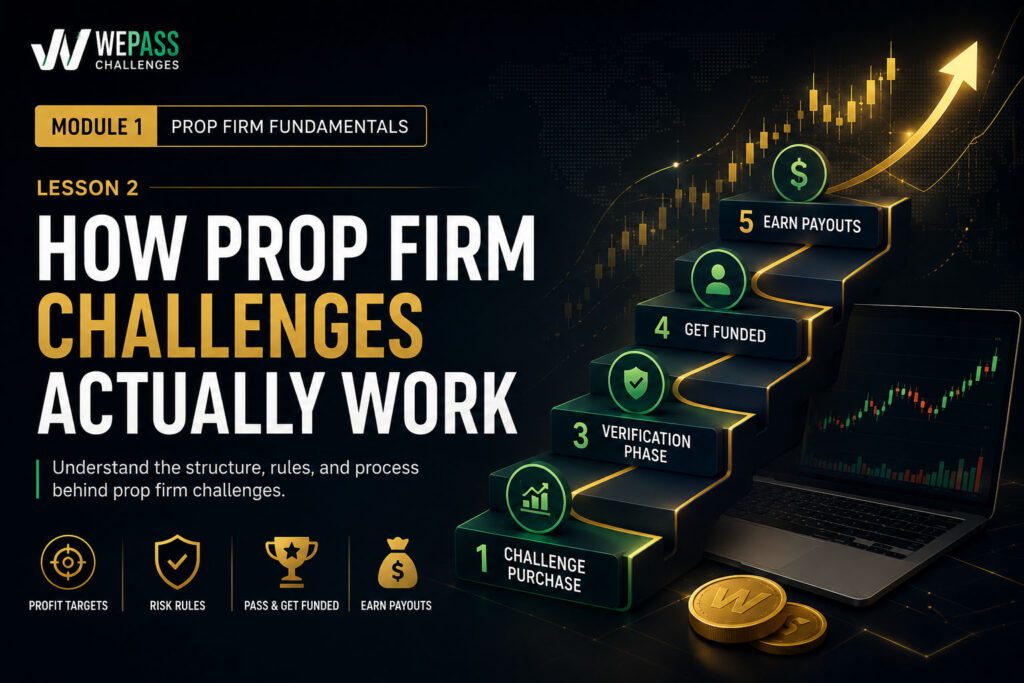
How Prop Firm Challenges Work
Learn how prop firm challenges work from evaluation purchase to profit targets, drawdown rules, verification phases, funded account access, and payout eligibility.
Learning Objectives
- Understand how prop firm challenges work from purchase to payout.
- Learn what a prop firm evaluation is designed to test.
- Understand profit targets, drawdown rules, and minimum trading days.
- Learn the difference between one-step and two-step challenges.
- Understand what happens after passing phase one.
- Learn why verification phases matter.
- Understand funded account access and payout eligibility.
- Avoid common challenge-killing mistakes.
How Prop Firm Challenges Work
How prop firm challenges work is one of the first things every trader should understand before paying for an evaluation. A prop firm challenge is designed to test whether you can generate profit while following strict risk management rules.
Now that you understand what a prop firm is, the next step is understanding the actual challenge process. This is where most new traders get caught slipping. They buy an account because the headline looks attractive, but they do not fully understand the phases, rules, restrictions, or what happens after they pass.
A prop firm challenge is an evaluation. The firm is testing whether you can trade profitably while staying inside strict risk limits. You usually need to hit a profit target, avoid breaking drawdown rules, follow trading restrictions, and complete minimum trading day requirements.
What Is a Prop Firm Challenge?
A prop firm challenge is a trading evaluation. The goal is not just to make money. The goal is to make money while proving you can follow the firm’s rulebook.
This is the part beginners underestimate. They think the challenge is only about hitting the profit target. It is not. You can reach the target and still fail if you break the daily drawdown rule, maximum drawdown rule, consistency rule, lot size rule, news rule, or platform rule.
This is why understanding common prop firm rules that get traders disqualified matters before you ever place the first trade.
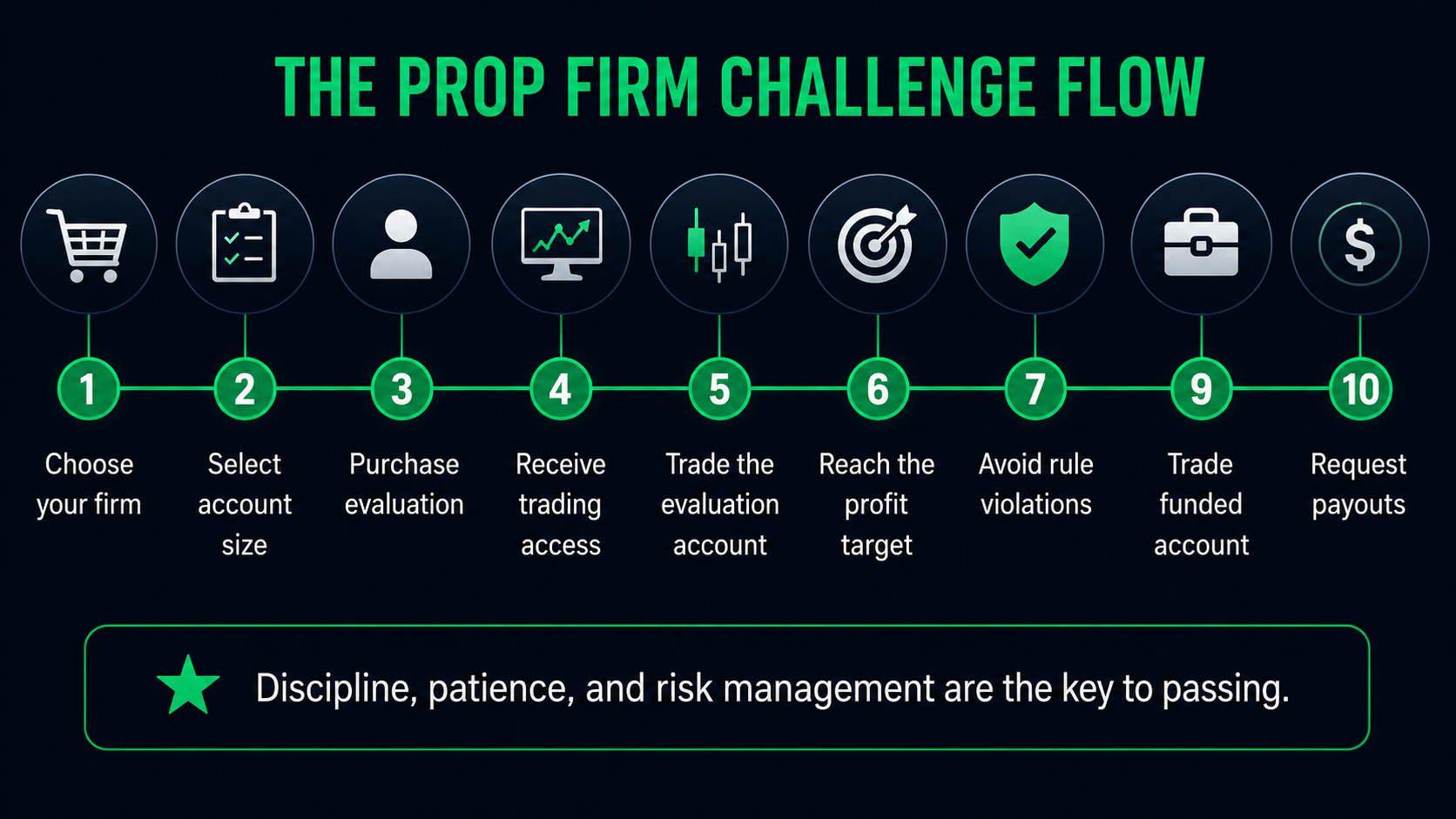
The Basic Prop Firm Challenge Flow
Most prop firm challenges follow a similar structure. The exact rules change from firm to firm, but the general process is usually the same. You choose an account size, pay the evaluation fee, receive login credentials, trade the account, hit the target, and move into the next stage.
Typical Challenge Flow
- Choose your prop firm.
- Select an account size.
- Purchase the evaluation.
- Receive trading platform credentials.
- Trade the evaluation account.
- Reach the profit target.
- Avoid all rule violations.
- Move to verification or funded stage.
- Trade the funded account.
- Request payouts based on firm rules.
That is how prop firm challenges work in a clean step-by-step format. The hard part is not understanding the steps. The hard part is staying disciplined through every step.
Step 1: Purchase a Challenge
The first decision is choosing the prop firm, account size, and challenge model. Prop firms may offer accounts such as $10,000, $25,000, $50,000, $100,000, $200,000, or higher depending on the firm.
Bigger accounts look better, but bigger does not always mean easier. What matters is the relationship between account size, profit target, maximum loss, daily drawdown, allowed lot size, and payout rules.
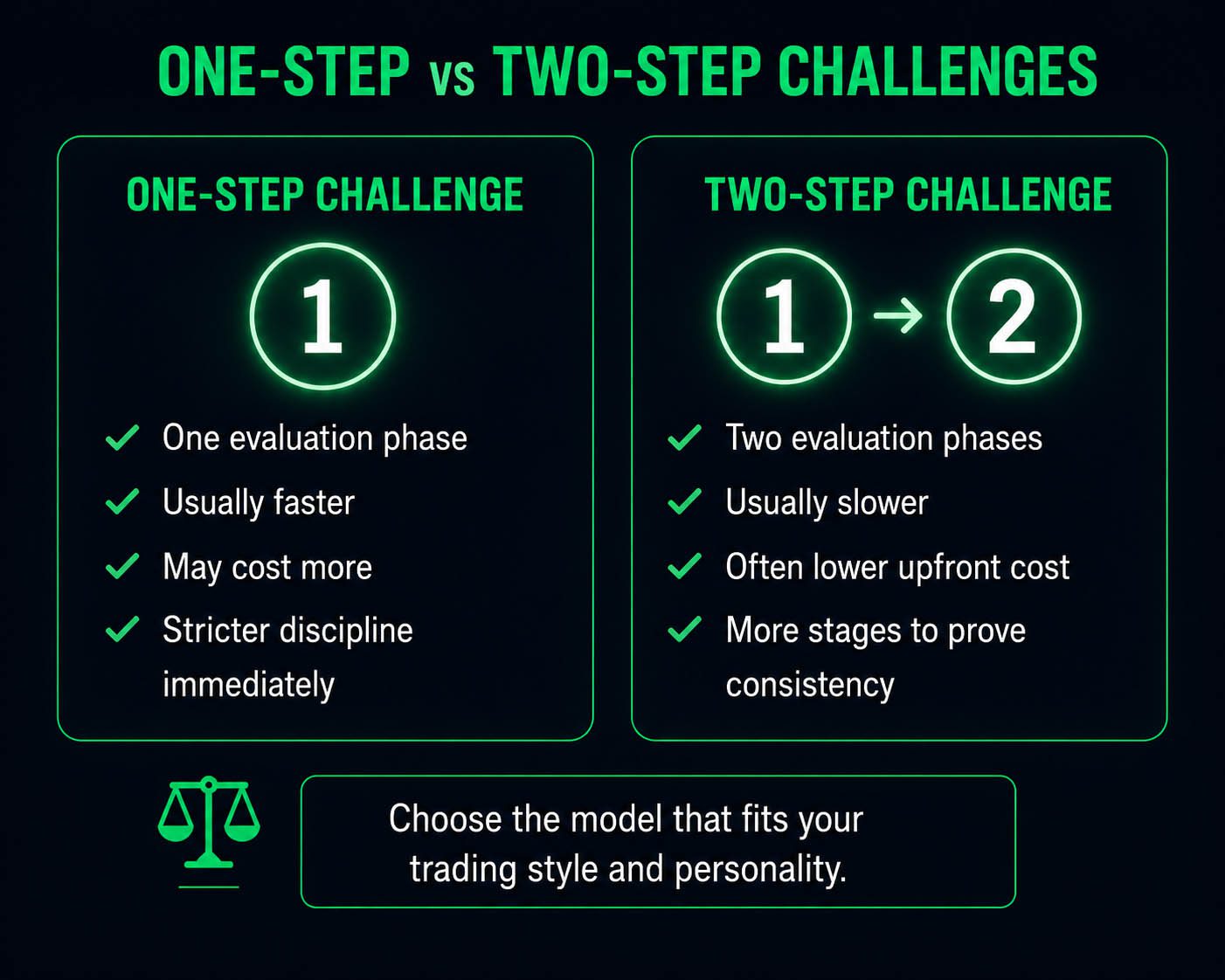
Before choosing an account, study the difference between one-step vs two-step challenges so the challenge model fits your trading style.
Step 2: Understand the Evaluation Fee
Once you choose the account, you purchase the evaluation. This fee gives you access to the challenge. It does not guarantee that you will pass. It does not guarantee payouts. It simply gives you the right to attempt the evaluation under that firm’s rules.
Some firms charge a one-time evaluation fee. Others may charge monthly fees, platform fees, data fees, activation fees, reset fees, or funded account fees. Always read the full fee structure before purchasing.
Step 3: Receive Your Trading Account
After purchasing the challenge, the prop firm usually sends your trading credentials. Depending on the firm, you may trade on platforms like MetaTrader 4, MetaTrader 5, cTrader, TradeLocker, Match-Trader, NinjaTrader, Tradovate, Rithmic, or another platform.
Before placing a single trade, confirm that your account size, platform, leverage, symbols, commission structure, and rules match what you purchased. Do not assume everything is correct. Check it.
Before Your First Trade, Check:
- Account size.
- Trading platform.
- Allowed instruments.
- Maximum daily loss.
- Maximum total loss.
- Profit target.
- Minimum trading days.
- News and weekend rules.
Step 4: Trade the Evaluation Account
This is where the real test begins. Your job is to reach the profit target without breaking the rules. That sounds obvious, but most traders fail because they focus too much on the target and not enough on survival.
The evaluation account is usually simulated, but the rules are very real. If you break maximum daily loss, maximum drawdown, consistency rules, lot size limits, or restricted trading policies, the account can fail immediately.
Your Evaluation Mission
- Make steady progress toward the profit target.
- Protect drawdown at all costs.
- Avoid revenge trading.
- Follow the exact rulebook.
- Skip bad market conditions.
- Trade smaller than your emotions want you to.
This mission becomes much easier when you build a professional trading plan before the challenge begins.
Step 5: Meet the Profit Target
The profit target is the amount you need to make to pass the evaluation stage. For example, a firm may require 8%, 10%, or a fixed dollar amount depending on the account size.
This is where traders get impatient. They see a $100,000 account with a $10,000 target and try to make the full target in a few trades. That is usually how accounts get destroyed. The better approach is to break the target into smaller daily and weekly goals.
Understanding profit targets helps you pace the challenge instead of trying to force the full target too quickly.
Step 6: Respect Drawdown Rules
Drawdown rules are usually the most important part of how prop firm challenges work. Most failed challenges do not fail because the trader never found a winning trade. They fail because the trader violated daily drawdown or maximum drawdown limits.
Daily drawdown limits control how much you can lose in one day. Maximum drawdown rules control how much you can lose overall before the account fails. Some firms also use trailing drawdown, which can move as your account balance grows.
For a deeper breakdown, study daily drawdown, maximum daily loss, and maximum drawdown.
Step 7: Avoid Rule Violations
You can hit the profit target and still fail if you break a rule. This is brutal, but it happens all the time. A trader reaches the target, feels like they passed, then realizes they violated a consistency rule, traded during restricted news, exceeded lot size, or breached drawdown intraday.
That is why rule compliance has to be part of the strategy from day one. You cannot treat the rules like fine print. The rules are the game.
Rules like consistency rules, news restrictions, lot limits, and payout requirements should be reviewed before you buy the account.
Step 8: Complete the Verification Phase
Some prop firms use a two-step model. In that case, passing the first phase does not immediately make you funded. You move into a second phase, often called verification, confirmation, or phase two.
The second phase may have a lower profit target, but the risk rules still matter. Do not relax just because you passed phase one. A lot of traders pass the first phase and then fail phase two because they get careless.
Step 9: Receive a Funded Account
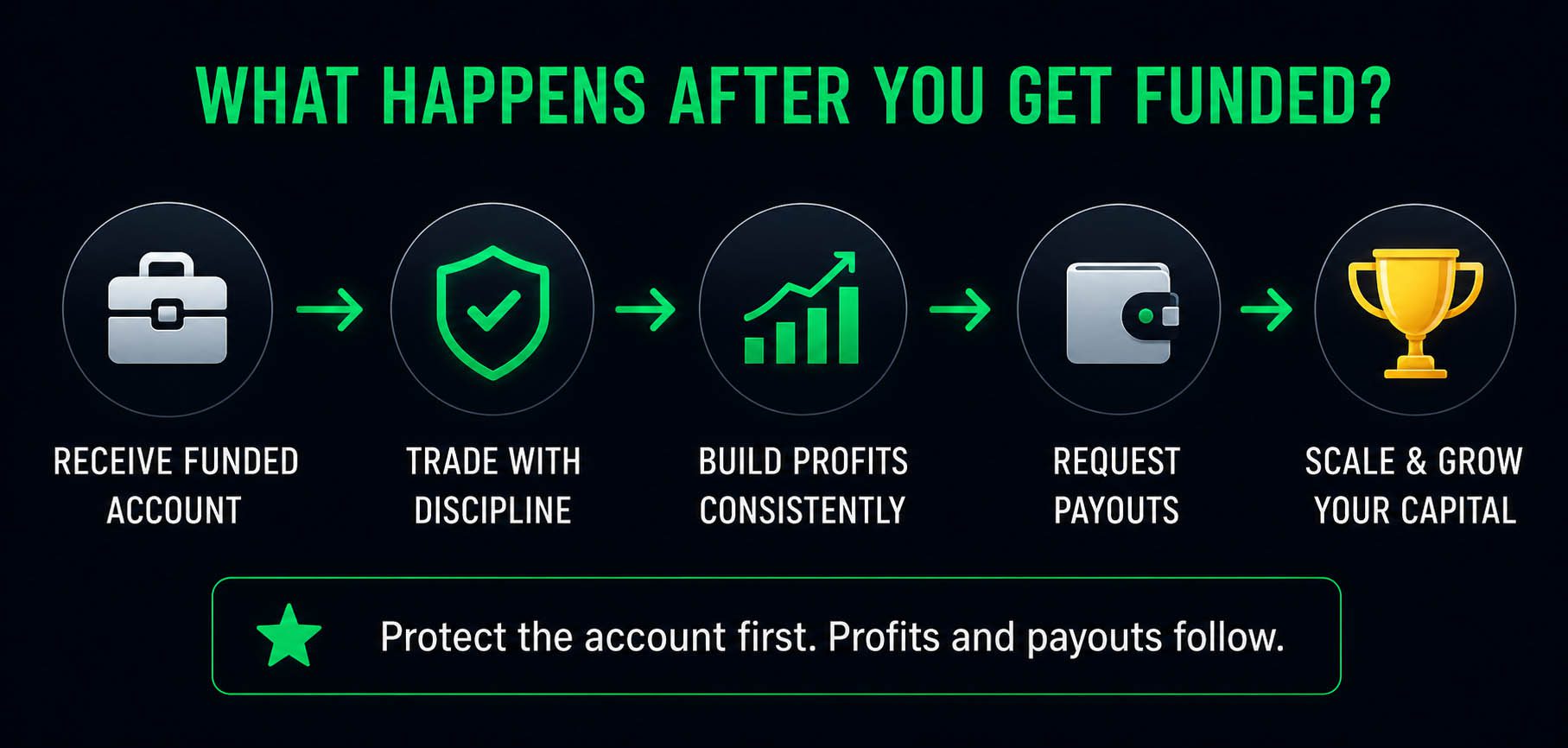
After completing the required evaluation stages, the firm may approve you for a funded account or payout-eligible account. This is the stage everyone wants, but it is not the finish line. It is a new stage with new responsibilities.
The funded stage may include different rules from the evaluation. There may be payout minimums, minimum trading days before withdrawal, consistency rules, scaling plans, lot limits, trailing drawdown, inactivity rules, or required profit buffers.
Before Trading the Funded Account, Confirm:
- Payout rules.
- Minimum payout amount.
- Minimum trading days.
- Profit split.
- Maximum loss rules.
- Consistency requirements.
- Scaling plan rules.
- Any activation or monthly fees.
Step 10: Request Your First Payout
The payout stage is where the business side becomes real. Each firm has its own payout schedule and requirements. Some allow payouts after a certain number of trading days. Others require a minimum profit buffer, minimum withdrawal amount, or consistency threshold.
This is another place where traders fail because they rush. They pass the challenge, get funded, make some profit, and immediately overtrade trying to increase the payout. The smartest move is usually to protect the account first and build payout eligibility with controlled trading.
One-Step vs Two-Step Challenges
Most challenges are either one-step or two-step. A one-step challenge usually has one evaluation phase before funded access. A two-step challenge requires phase one and phase two before funded access.
One-step challenges can be faster, but they may have stricter rules or higher fees. Two-step challenges may take longer, but they are often more structured and may be better for traders who prefer a slower pace.
| One-Step Challenge | Two-Step Challenge |
|---|---|
| One evaluation phase. | Two evaluation phases. |
| Usually faster. | Usually slower. |
| May cost more. | Often lower upfront cost. |
| Can require tighter discipline immediately. | Gives more stages to prove consistency. |
Minimum Trading Days
Many prop firms require a minimum number of trading days before you can pass or request a payout. This prevents traders from taking one lucky oversized trade and immediately qualifying.
If a firm requires five minimum trading days, you may need to place trades across at least five separate days even if you already hit the profit target earlier. This rule matters because it affects your pacing.
The Difference Between Passing and Getting Paid
Passing the evaluation and getting paid are not the same thing. Some traders think once they pass, the money is automatic. It is not.
After passing, you still need to follow funded account rules. You may need to trade a certain number of days, maintain a profit buffer, meet payout thresholds, avoid consistency violations, and request the payout during the correct window.
Why Most Traders Fail Prop Firm Challenges
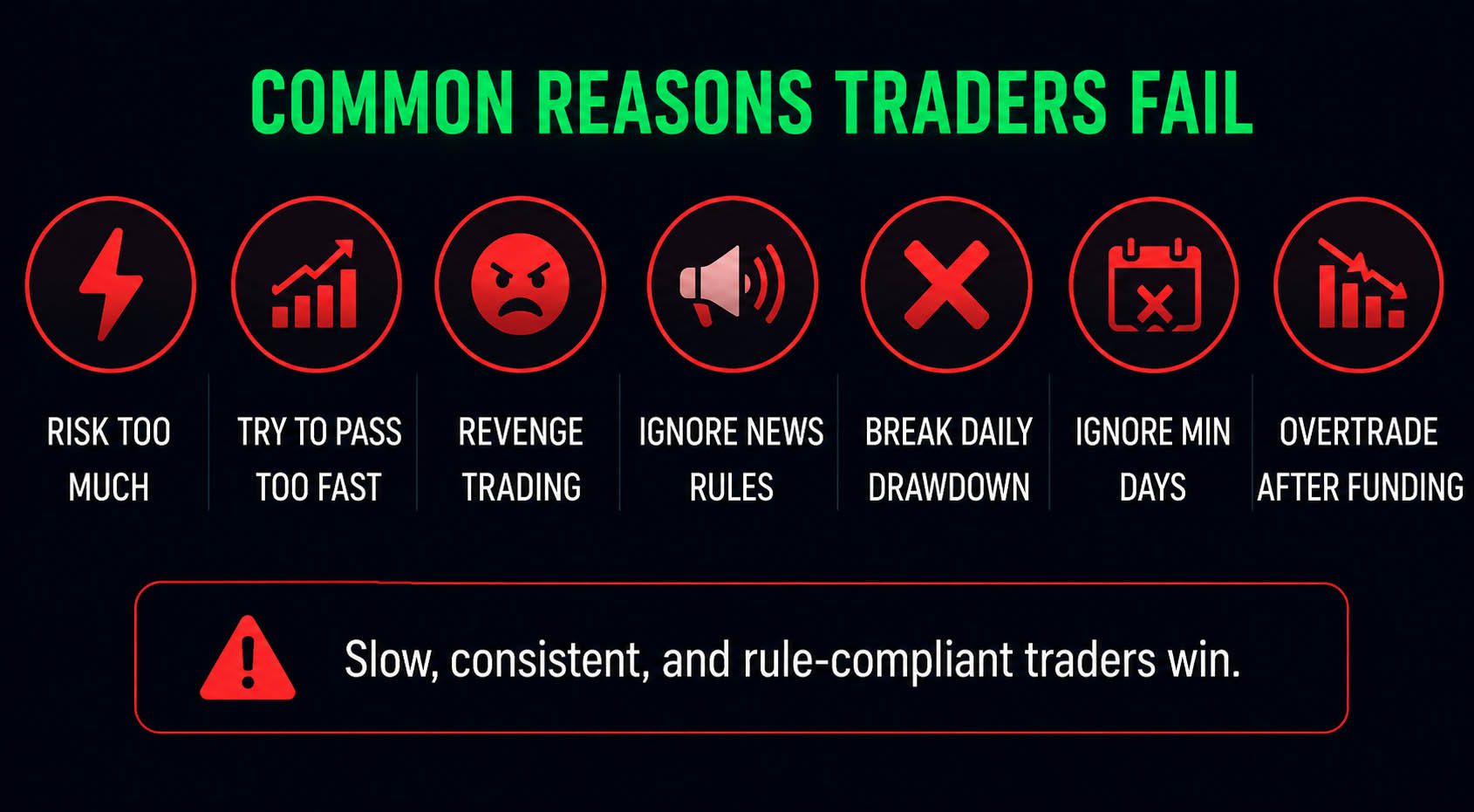
Most challenge failures are not mysterious. Traders usually fail for the same reasons over and over again. They risk too much, trade too often, ignore the daily loss limit, hold into restricted news, or try to pass too quickly.
Challenge-Killing Mistakes
- Buying the wrong account size.
- Not reading the rules before trading.
- Risking too much on the first few trades.
- Trying to pass in one day.
- Trading during restricted news.
- Ignoring daily drawdown.
- Revenge trading after a loss.
- Celebrating phase one too early.
- Overtrading after getting funded.
Tips to Pass a Prop Firm Challenge
- Read the full rulebook before buying.
- Trade the challenge slowly and professionally.
- Risk less than the maximum allowed.
- Break the profit target into smaller milestones.
- Stop trading after emotional losses.
- Avoid restricted news events.
- Track daily drawdown before every trade.
- Use a fixed trade checklist.
- Do not increase risk after a win streak.
- Treat funded access as the beginning, not the finish line.
FAQ
1. How do prop firm challenges work?
Prop firm challenges work by testing whether a trader can hit a profit target while following strict rules around drawdown, trading days, risk limits, and account behavior.
2. How long does a prop firm challenge take?
It depends on the firm, the rules, and the trader’s strategy. Some traders pass quickly, but slower and controlled trading is usually safer than rushing.
3. What happens if I fail a prop firm challenge?
If you fail, the account is usually closed or marked as failed. Some firms offer resets or discounts, but this depends on the company’s rules.
4. What is the verification phase?
The verification phase is a second evaluation stage used by some firms. It usually has a lower profit target but still requires strict rule compliance.
5. Can beginners pass a prop firm challenge?
Beginners can pass, but only if they understand risk management, drawdown, position sizing, and the firm’s rulebook before trading.
Knowledge Quiz
- What is the main purpose of a prop firm challenge?
A. To guarantee a payout
B. To test whether a trader can profit while following rules
C. To remove all trading risk
D. To let traders ignore drawdown - What can happen if you hit the profit target but break a rule?
A. You still always pass
B. The firm ignores it
C. You may fail the challenge
D. You automatically get paid - What is a verification phase?
A. A second stage used by some firms before funded access
B. A guaranteed payout request
C. A personal bank account review
D. A way to avoid trading rules - Why do minimum trading days matter?
A. They control the color of the dashboard
B. They may be required before passing or payout eligibility
C. They remove the need for risk management
D. They guarantee profit - What is the smartest mindset after getting funded?
A. Trade bigger immediately
B. Protect the account and follow payout rules
C. Ignore consistency requirements
D. Take random trades to increase profit fast - What matters most besides the profit target?
A. Daily and maximum drawdown rules
B. The platform color
C. The trader’s mood
D. Social media signals - What should you do before placing the first trade?
A. Ignore the dashboard
B. Confirm account size, rules, symbols, and drawdown
C. Increase lot size
D. Trade immediately - What is a common reason traders fail?
A. Reading the rules
B. Trading slowly
C. Overtrading and risking too much
D. Waiting for quality setups - What is the funded account stage?
A. A new stage with payout eligibility and continued rules
B. A rule-free account
C. Guaranteed income
D. The end of all risk - What is the best way to approach a challenge?
A. Like a controlled business process
B. Like a lottery ticket
C. Like a race
D. Like free money
Answer Key
1. B · 2. C · 3. A · 4. B · 5. B · 6. A · 7. B · 8. C · 9. A · 10. A
Key Takeaways
- How prop firm challenges work comes down to profit, risk control, and rule compliance.
- A prop firm challenge is an evaluation, not a guarantee.
- Your job is to hit the profit target without breaking rules.
- Account size matters less than drawdown, target, and payout rules.
- Passing the evaluation and getting paid are two different stages.
- Verification phases require the same discipline as phase one.
- Most failures come from rushing, overtrading, or ignoring rules.
- Funded account access is the beginning of the business stage, not the finish line.