
What Is a Prop Firm?
Learn what a prop firm is, how prop firm challenges work, and why traders must understand drawdown, rules, risk, and discipline before buying an evaluation.
Learning Objectives
- Understand what a prop firm is and how it works.
- Learn why prop firm challenges exist.
- Understand the difference between account size and real risk.
- Learn how prop firms make money.
- Compare retail trading vs prop firm trading.
- Understand who should and should not buy a challenge.
- Learn common beginner mistakes.
- Prepare for the next lesson on prop firm challenges.
What Is a Prop Firm?
What is a prop firm? A proprietary trading firm, commonly called a prop firm, gives traders access to trading capital or a funded-style account after they prove they can follow rules and manage risk.
Before you ever buy a prop firm challenge, you need to understand what you are actually getting into. A lot of traders see phrases like funded account, profit split, and six-figure trading account, then immediately get excited. The opportunity is real. The misunderstanding is also real.
A prop firm challenge is not free money. It is a structured evaluation. You usually pay a fee, trade an evaluation account, follow strict rules, and try to hit a profit target without violating drawdown limits.
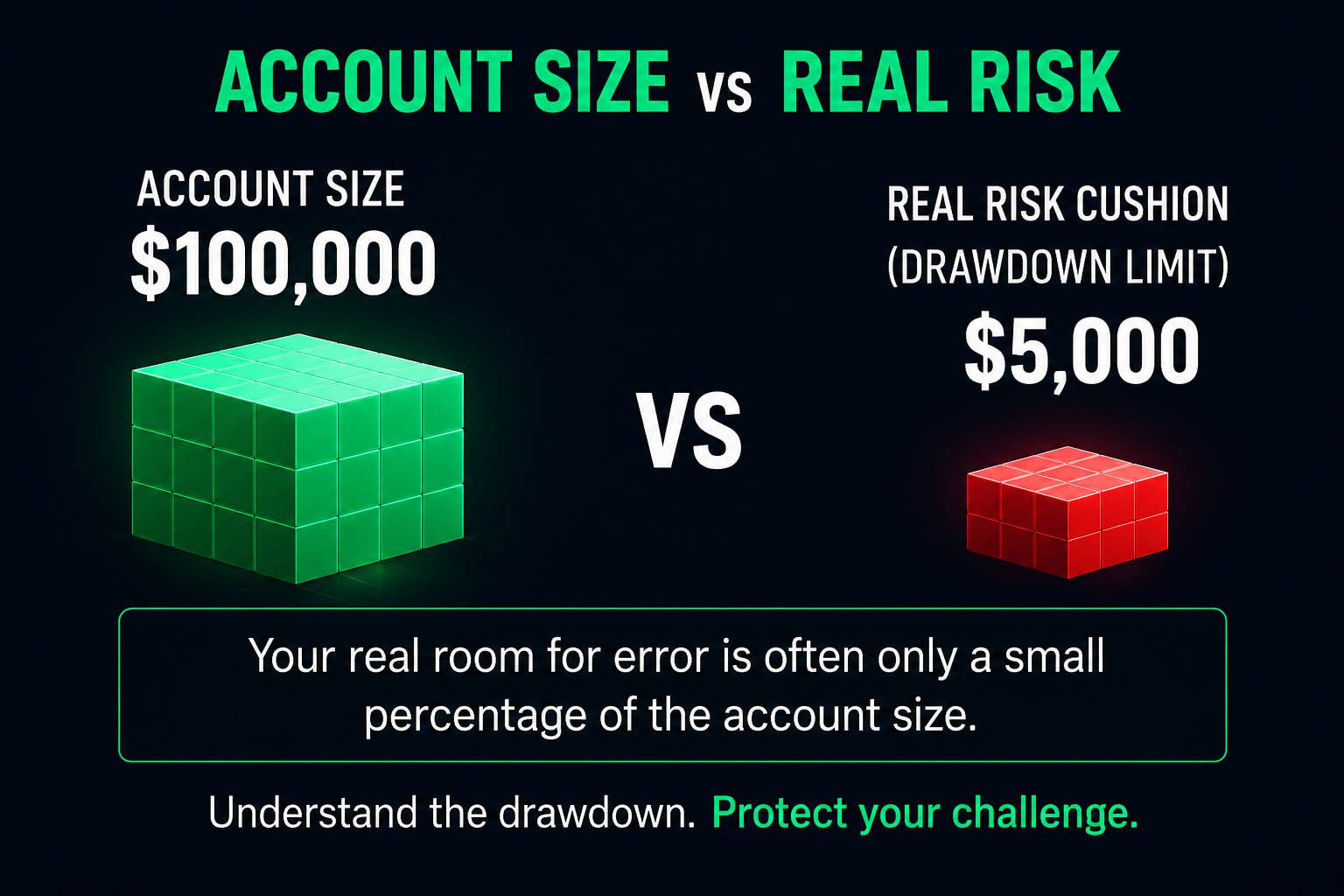
Sounds simple, but this is where most traders mess up. They focus only on the account size and ignore the rulebook. A $100,000 challenge does not mean you can lose $100,000. In many cases, your real usable risk is only a small percentage of that account.
What Does Prop Firm Mean?
A proprietary trading firm is a company that allows traders to trade using the firm’s capital or a firm-backed account structure. In traditional finance, prop firms hired professional traders directly. Those traders worked inside the firm, followed internal risk limits, and traded company money.
Modern online prop firms are different. Instead of hiring only in-house traders, they allow independent traders to prove themselves through an evaluation. If the trader passes the challenge, the firm may offer access to a funded account model where the trader can earn a percentage of profits.
This model became popular because it gives skilled traders a way to access larger account sizes without depositing large personal capital.
How Does a Prop Firm Work?
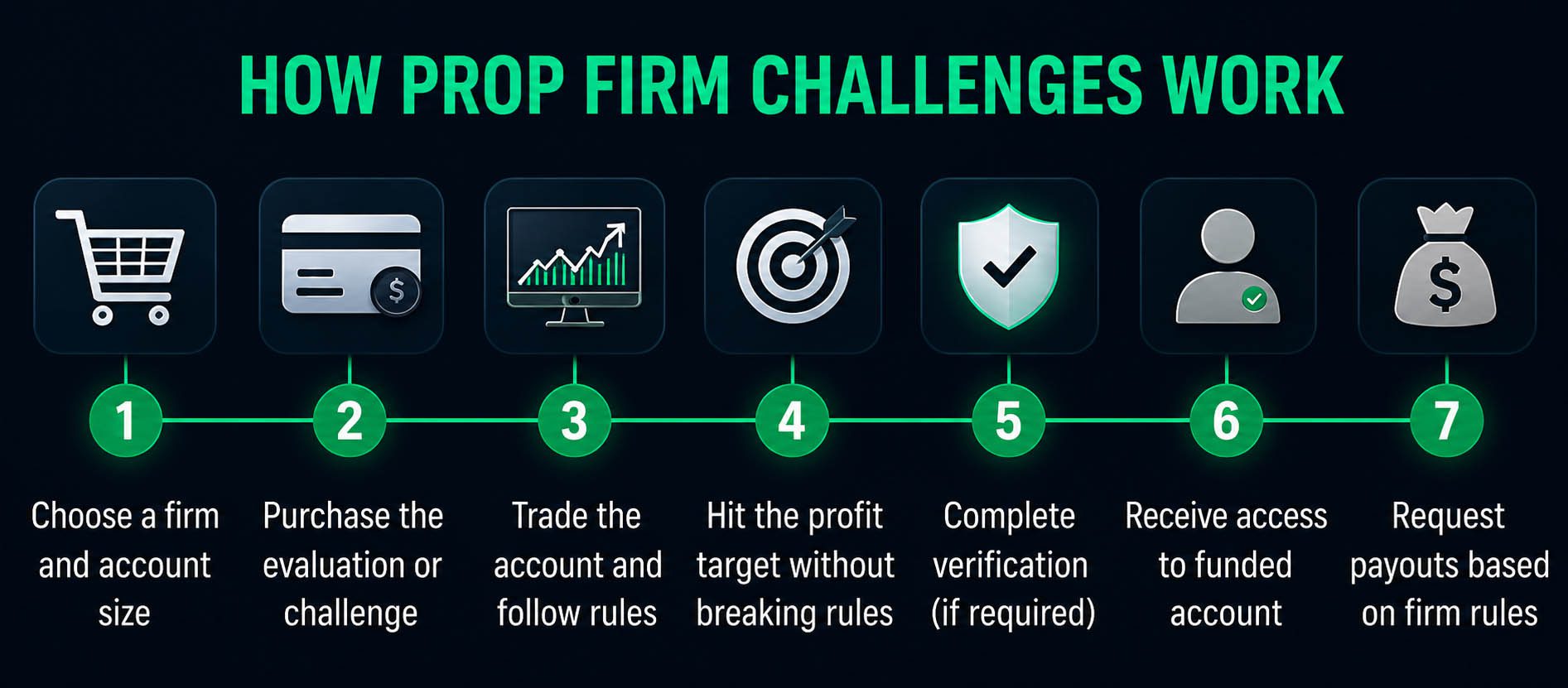
Most online prop firms use a challenge system. The trader purchases an evaluation account and must hit a profit target without breaking any rules. These rules usually include daily drawdown limits, maximum loss limits, minimum trading days, consistency rules, and restrictions around news trading, copy trading, or holding trades overnight.
The evaluation is designed to test whether the trader can make money while controlling risk. Prop firms do not want traders who get lucky once and then blow the account. They want traders who can follow structure.
Typical Prop Firm Process
- Choose a prop firm and account size.
- Purchase the evaluation or challenge.
- Trade the account while following all rules.
- Hit the profit target without violating drawdown limits.
- Complete any verification phase if required.
- Receive access to a funded or payout-eligible account.
- Request payouts based on the firm’s payout rules.
If you want a deeper breakdown of the evaluation process, the next lesson covers how prop firm challenges actually work.
Why Do Traders Use Prop Firms?
The biggest reason traders use prop firms is leverage of opportunity. A trader may have skill but not enough personal capital to make trading worthwhile. Prop firms offer a path to access larger account sizes without the trader needing to deposit the full account amount.
For example, a trader with only $1,000 may not be able to trade full-time from personal capital. But if that trader can qualify for a $50,000, $100,000, or $200,000 funded account, the profit potential becomes more meaningful.
Why Traders Like Prop Firms
- Access to larger trading accounts.
- Lower upfront cost compared to funding a personal account.
- Potential to earn payouts from trading profits.
- Structured rules that force discipline.
- Opportunity to scale into larger accounts over time.
The Catch
Prop firms are not free money. If you trade emotionally, over-leverage, ignore drawdown, or chase profit targets too aggressively, you can fail fast.
How Do Prop Firms Make Money?
Prop firms are businesses. Most firms make money from evaluation fees, reset fees, monthly platform fees, data fees, profit splits, and sometimes from trader performance depending on the business model.
The evaluation fee is the price traders pay to attempt the challenge. If the trader fails, they may need to buy another challenge or pay for a reset. This is why traders should not rush into a challenge without preparation.
Prop Firm Account Size vs Real Risk
One of the biggest beginner mistakes is misunderstanding account size. A trader sees a $100,000 account and thinks they have $100,000 to trade with. That is not how prop firm trading works.
The account size is the notional account size. The real limit that matters is the drawdown. If a $100,000 challenge has a maximum loss limit of $5,000, then your real room for error is $5,000, not $100,000.
This changes everything. It affects your lot size, your daily risk, your trade frequency, your stop loss placement, and your entire strategy.
Retail Trading vs Prop Firm Trading
Retail trading and prop firm trading are not the same. In a personal account, you set your own rules. In a prop firm account, the firm sets the rules.
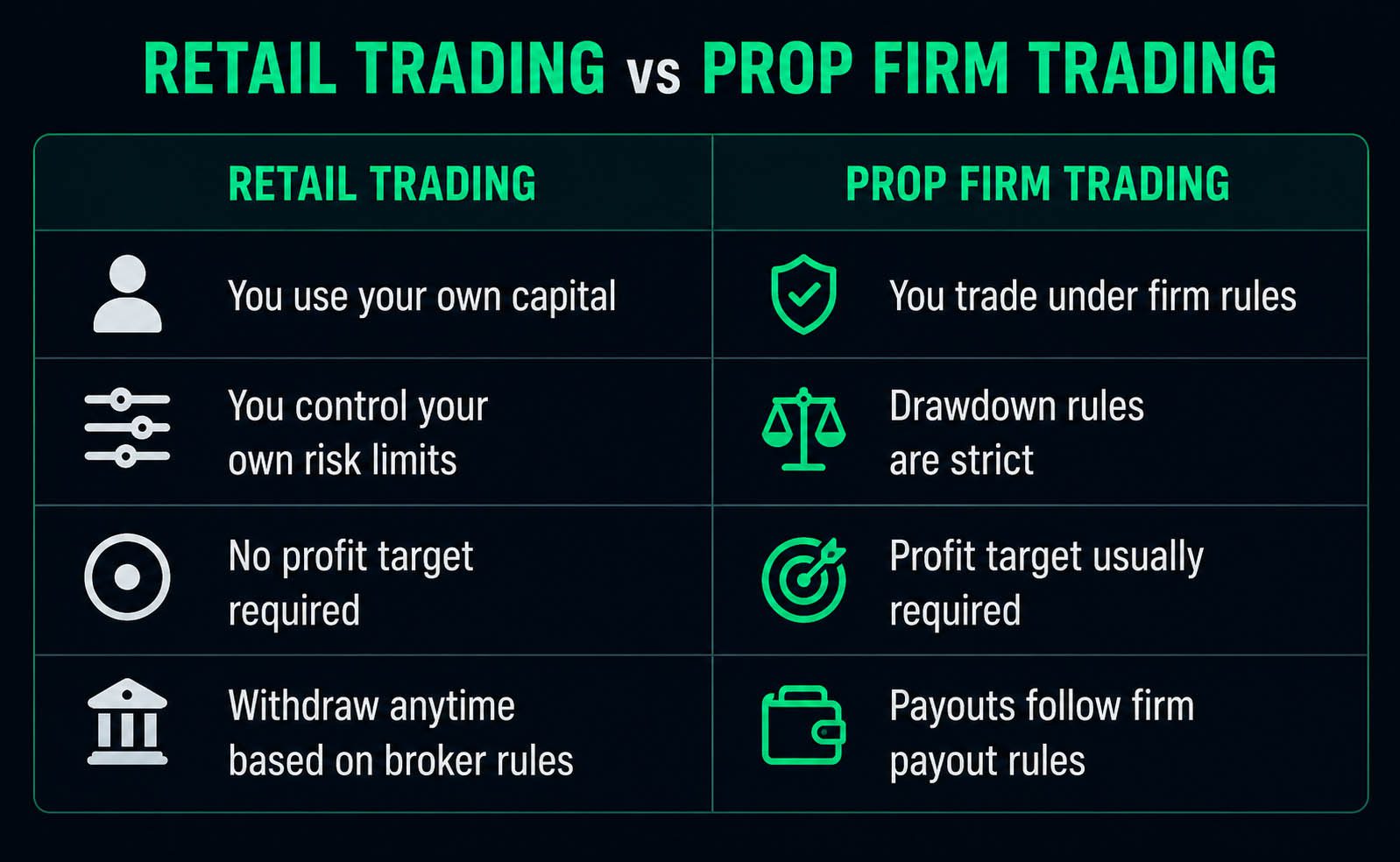
| Retail Trading | Prop Firm Trading |
|---|---|
| You use your own capital. | You trade under firm rules. |
| You control your own risk limits. | Drawdown rules are strict. |
| No profit target is required. | A profit target is usually required. |
| You can usually withdraw based on broker rules. | Payouts follow the firm’s payout schedule. |
| You can choose your own trading style. | Your strategy must fit the firm’s rulebook. |
Who Should Consider a Prop Firm?
A prop firm may be a good fit for traders who already have a strategy, understand risk, and can follow rules. A prop firm is not a magic fix for poor discipline.
A Prop Firm May Be Right For You If:
- You already have a tested trading strategy.
- You understand drawdown and position sizing.
- You can follow rules without emotional decision-making.
- You are patient enough to wait for quality setups.
- You want access to larger trading capital.
If you are consistent on demo, understand basic market structure, know how to calculate risk, and can trade without revenge trading after a loss, a prop firm challenge may make sense.
Who Should Avoid Buying a Prop Firm Challenge?
Some traders should not buy a challenge yet. If you do not understand lot sizing, if you do not use stop losses, if you revenge trade after a loss, or if you are hoping one lucky trade will pass the account, you are not ready.

Before buying a challenge, you should understand maximum daily loss, maximum drawdown, and basic risk control.
Common Myths About Prop Firms
Prop firm trading has become extremely popular, and with popularity comes misinformation. New traders often get sold a fantasy version of prop firms. They hear about big account sizes and fast payouts, but not enough about the rulebook.
Myth 1: A Bigger Account Means More Safety
Not always. A bigger account with tight drawdown can still be dangerous if you trade too aggressively. The drawdown limit matters more than the headline account size.
Myth 2: Passing Fast Is Always Better
Fast passing often comes from oversized risk. Slow, controlled progress is usually more sustainable, especially if the goal is payouts after passing.
Myth 3: The Challenge Is the Hardest Part
Passing is only step one. Keeping the account and reaching payouts requires even more discipline.
Myth 4: Prop Firms Guarantee Success
No prop firm guarantees payouts. You still need risk control, patience, discipline, and a strategy that fits the rules.
The Real Skill Prop Firms Test
Most beginners think prop firms test whether you can make money. That is only partly true. What they really test is whether you can make money without losing control.
Anyone can have a lucky trade. Anyone can catch one big move. But can you follow rules for multiple days? Can you avoid overtrading after a win? Can you stop trading when the market is messy? Can you take a loss without trying to win it back immediately?

The Skills That Matter Most
- Risk management.
- Position sizing.
- Patience.
- Rule compliance.
- Emotional control.
- Market selection.
- Consistency.
That is why knowing when not to trade matters just as much as knowing when to enter.
Practical Example
The $100,000 Challenge Mistake
A beginner buys a $100,000 challenge and assumes the account gives them massive room to trade. The trader risks $1,000 per trade because the account looks large.
But the challenge has a $5,000 maximum drawdown. After four bad trades and some commission or spread costs, the trader is already dangerously close to failure.
A professional sees the same $100,000 challenge differently. They understand the real account is not the headline size. The real game is protecting the $5,000 drawdown cushion while slowly working toward the profit target.
Professional Checklist Before Buying a Prop Firm Challenge
- Read the full rulebook before buying.
- Confirm the daily drawdown rule.
- Confirm the maximum drawdown rule.
- Understand the profit target.
- Check minimum trading day requirements.
- Confirm news trading restrictions.
- Confirm weekend holding rules.
- Know the payout schedule.
- Calculate your true risk cushion.
- Trade only if your strategy fits the rules.
FAQ
1. What is a prop firm?
A prop firm is a company that gives traders the opportunity to trade larger accounts after they prove they can follow rules, manage risk, and trade with discipline.
2. How does a prop firm work?
Most online prop firms use evaluations. Traders pay for a challenge, hit a profit target, avoid rule violations, and may receive access to a funded or payout-eligible account.
3. Do prop firms give traders real money?
It depends on the firm and account model. Some use simulated accounts with payout eligibility, while others may connect successful traders to live capital or copy-trading structures.
4. Can beginners join a prop firm?
Beginners can join, but they should not rush. If a trader does not understand risk management, drawdown, and position sizing, they should study and practice before buying a challenge.
5. Are prop firms worth it?
Prop firms can be worth it for disciplined traders who understand the rules and have a tested strategy. They are usually not worth it for emotional traders who are looking for fast money.
Knowledge Quiz
- What does a prop firm allow traders to access?
A. Guaranteed profits
B. Larger trading opportunities under firm rules
C. Free personal money
D. Unlimited losses - What is usually more important than the headline account size?
A. The logo of the firm
B. The trader’s favorite pair
C. The drawdown limit
D. The color of the dashboard - Why do prop firms use evaluations?
A. To test whether traders can follow rules and manage risk
B. To guarantee every trader gets paid
C. To remove all trading risk
D. To avoid having rules - What is one common beginner mistake?
A. Reading the rulebook
B. Using smaller risk
C. Treating the account size like usable loss room
D. Waiting patiently - What type of trader is usually best suited for a prop firm?
A. A revenge trader
B. A trader with no plan
C. A disciplined trader with risk management
D. A trader who ignores rules - What does maximum drawdown measure?
A. The maximum profit target
B. The largest allowed loss before failure
C. The broker spread
D. The number of trades allowed - Why should traders read the rulebook first?
A. To avoid accidental violations
B. To make trading more confusing
C. To increase leverage automatically
D. To skip risk management - What is a funded account?
A. An account where the trader may qualify for payouts after meeting firm requirements
B. A guaranteed income account
C. A personal bank account
D. An account with no rules - What do prop firms reward?
A. Random gambling
B. Oversized risk
C. Discipline and consistency
D. Revenge trading - What should come before buying a challenge?
A. Hype
B. Rule understanding and risk planning
C. Random lot sizing
D. Social media opinions
Answer Key
1. B · 2. C · 3. A · 4. C · 5. C · 6. B · 7. A · 8. A · 9. C · 10. B
Key Takeaways
- A prop firm gives traders the opportunity to qualify for larger trading accounts.
- Most modern prop firms use challenges or evaluations.
- The account size is not the same as your real risk cushion.
- Drawdown rules are often more important than profit targets.
- Prop firm trading rewards discipline and punishes emotional trading.
- Before buying a challenge, you need to understand the rulebook.
- Passing is only step one. Keeping the account requires even more discipline.
- The best traders treat prop firm challenges like business evaluations, not lottery tickets.