
Maximum Drawdown Explained: The Rule Every Funded Trader Must Respect
Learn how maximum drawdown works, why it is the real survival line in funded trading, and how professional traders protect accounts before chasing profits.
Lesson Goal
Maximum drawdown is one of the most important rules in prop firm trading. Many traders focus on profit targets, payouts, and account size, but the real survival line is drawdown. Once your account crosses that line, the challenge or funded account can be permanently failed.
Professional traders respect drawdown before they think about profit. They know that protecting the account is what keeps them in the game long enough to reach funding, payouts, and long-term consistency.
What Is Maximum Drawdown?
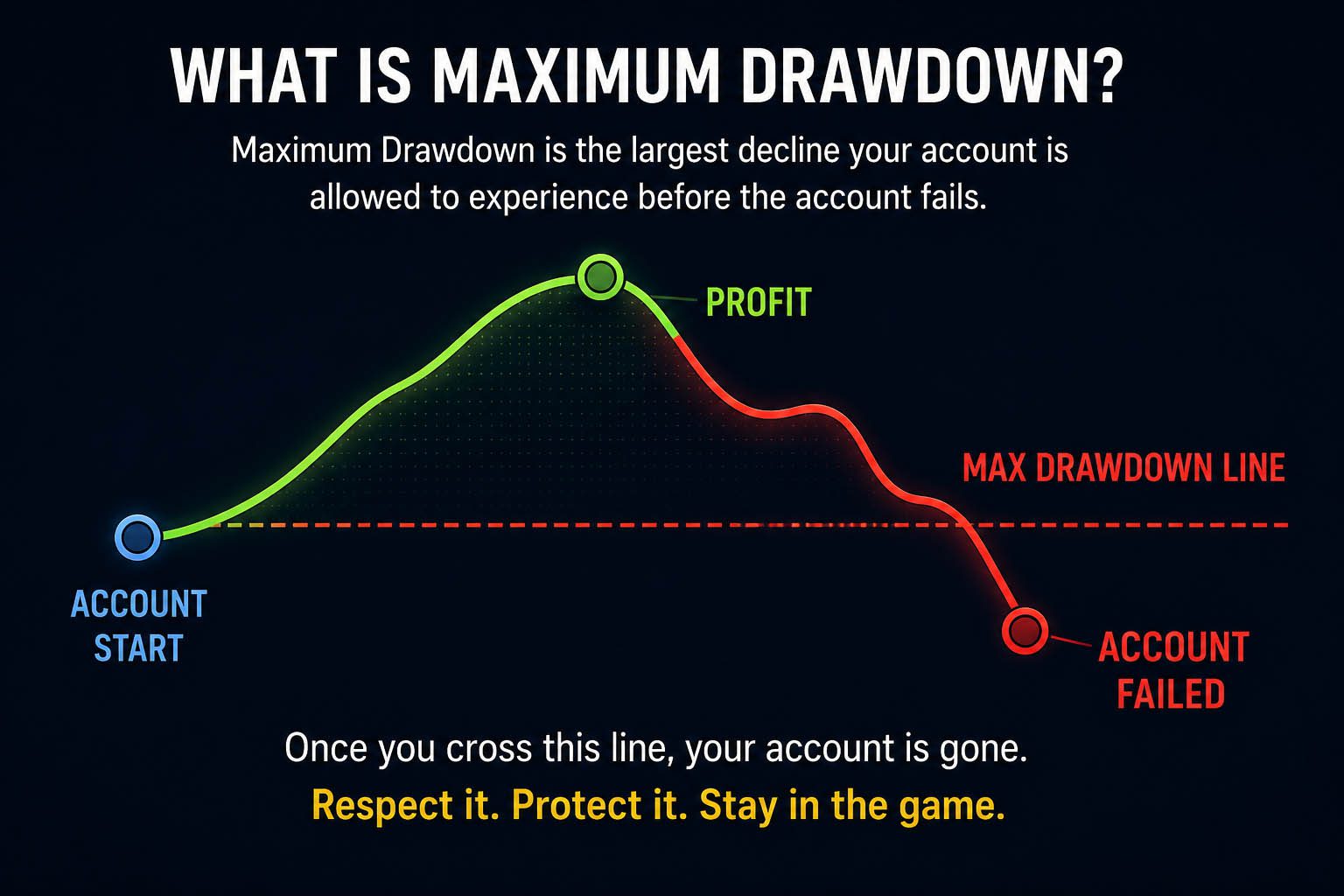
Maximum drawdown is the largest total decline your account is allowed to experience before the account is considered failed. It is different from maximum daily loss because daily loss usually applies to one trading day, while maximum drawdown applies across the life of the account.
Think of maximum drawdown as your account’s survival line. If your balance or equity falls below that line, the prop firm may close the account, even if you believe your next trade would have recovered the loss.
| Account Size | Max Drawdown | Failure Level |
|---|---|---|
| $100,000 | 10% | $90,000 |
Maximum Drawdown vs Daily Loss
Daily loss protects the firm from one bad trading day. Maximum drawdown protects the account from total damage over time. A trader can stay within the daily loss rule and still eventually fail from maximum drawdown if they keep taking small losses over several days.
| Daily Loss | Maximum Drawdown |
|---|---|
| Applies to one trading day | Applies to the account overall |
| Usually resets daily | Usually does not reset |
| Protects against emotional bad days | Protects total account capital |
Static vs Trailing Drawdown
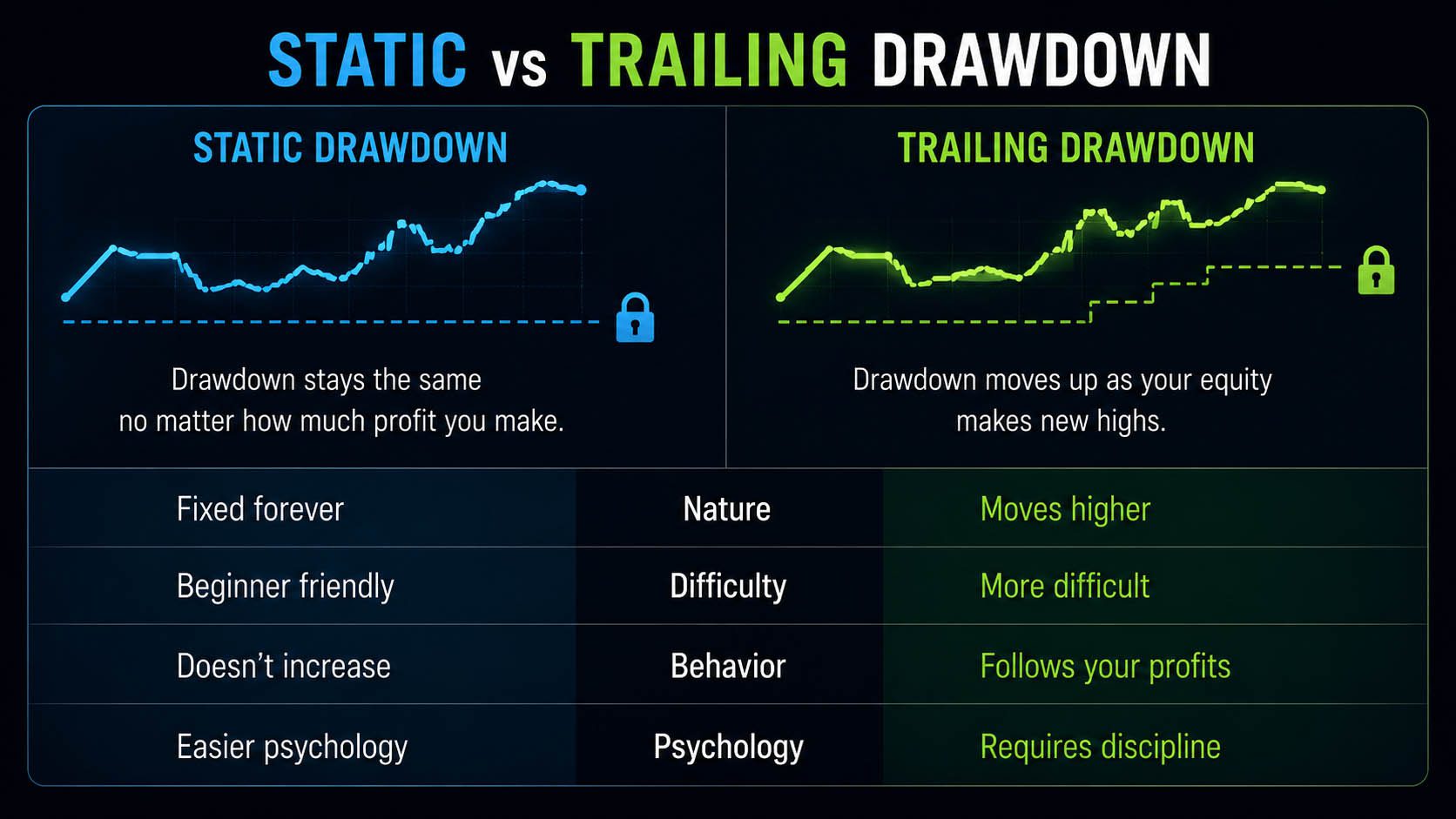
Not all prop firms calculate maximum drawdown the same way. Two of the most common models are static drawdown and trailing drawdown. Understanding the difference can completely change how you manage risk.
| Static Drawdown | Trailing Drawdown |
|---|---|
| Failure line stays fixed | Failure line may move up as profits grow |
| Usually easier to manage | Requires tighter discipline |
| More beginner friendly | Can punish aggressive profit swings |
| More room after profits grow | Less forgiving after equity rises |
Why Traders Fail After Making Money
One of the most painful ways to fail a challenge is to make money first, then give it all back. This happens when traders become overconfident after a strong day or a big winning trade. They increase lot size, take lower-quality setups, or keep trading when they should stop.
The market does not care that you were in profit earlier. If your account drops below the maximum drawdown line, the account can still fail.
Common Pattern
Trader makes +$8,000, feels confident, increases risk, takes emotional trades, gives back profits, then breaches maximum drawdown. The problem was not the winning trade. The problem was what happened after it.
This is why professional traders connect drawdown management with position sizing. Once confidence starts changing your lot size, risk is no longer controlled.
Know Exactly Where Your Drawdown Limit Is
Never guess how close your account is to failing. Our free Drawdown Calculator helps you estimate your remaining drawdown, account buffer, and risk room before placing another trade.
Open Free Drawdown Calculator → ✓ Free to Use ✓ No Login Required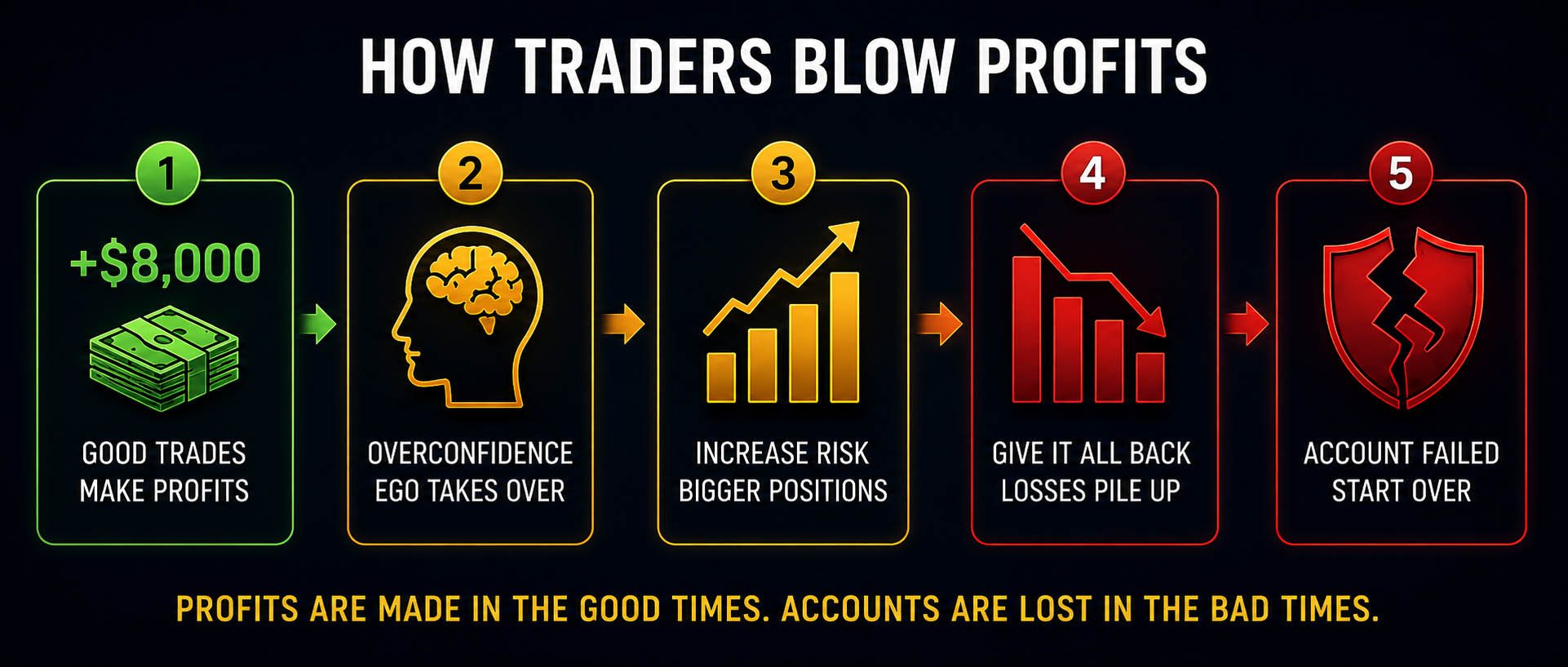
The Safety Buffer Strategy
Professional traders rarely trade all the way down to the maximum drawdown line. They create a personal safety buffer before the firm forces them out. This buffer protects against spread widening, slippage, floating losses, and emotional decision-making.
| Firm Max Drawdown | Professional Stop Point | Safety Buffer |
|---|---|---|
| $10,000 | $7,500 | $2,500 |
This does not mean you are afraid to trade. It means you are protecting the opportunity. A trader who stops early can come back tomorrow. A trader who breaches drawdown has to start over.
Recovery Gets Harder as Losses Grow
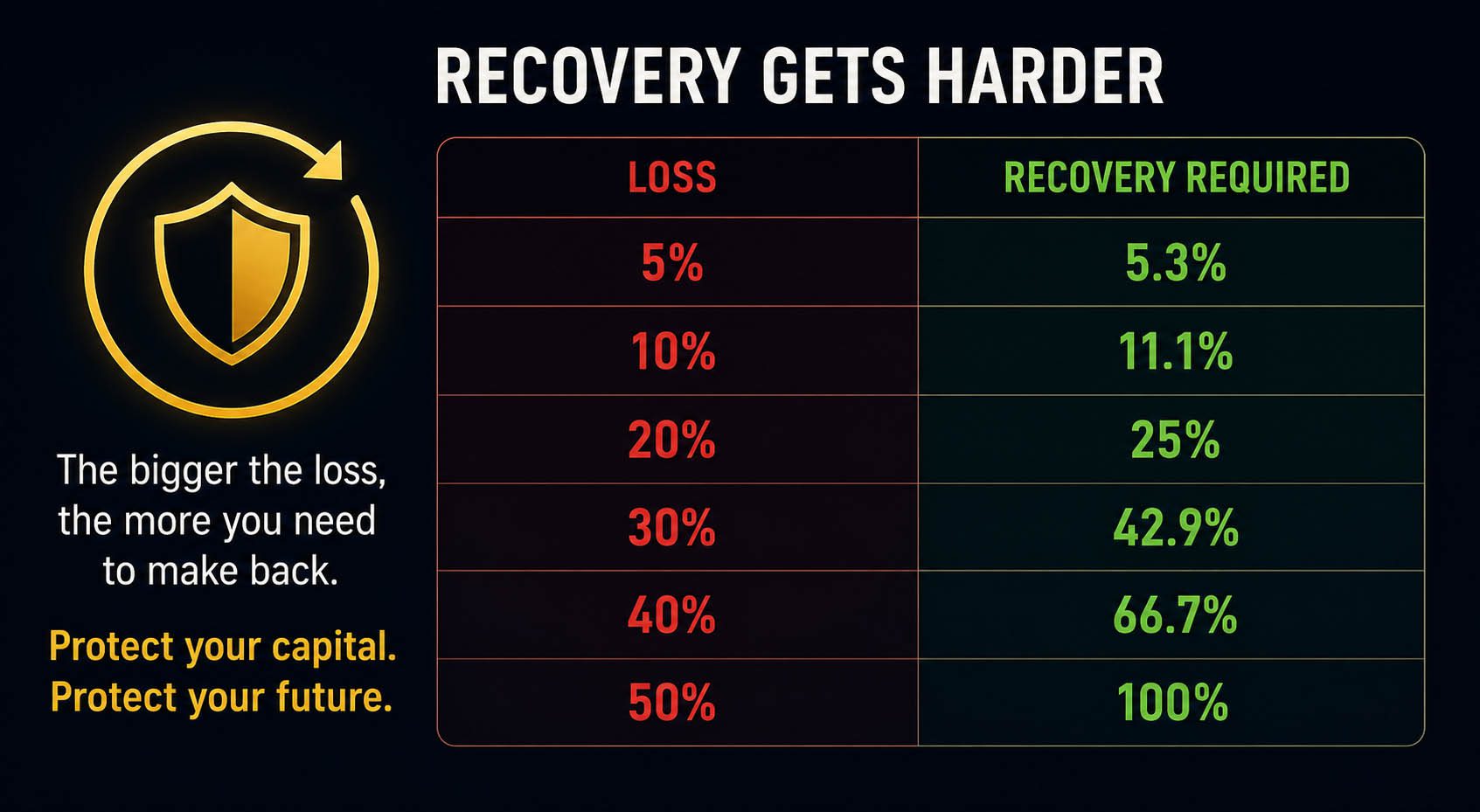
Large losses are dangerous because the percentage gain required to recover becomes much larger. Losing 10% does not require 10% to recover. It requires 11.1%. Losing 50% requires a 100% gain just to get back to break even.
| Account Loss | Gain Needed to Recover |
|---|---|
| 5% | 5.3% |
| 10% | 11.1% |
| 20% | 25% |
| 30% | 42.9% |
| 40% | 66.7% |
| 50% | 100% |
How WePassChallenges Protects Drawdown
At WePassChallenges, drawdown protection is built into the trading process from the start. Before managing any evaluation, we review the firm’s drawdown model, daily limits, maximum loss rules, consistency rules, and payout requirements.
We use controlled position sizing, predefined daily limits, conservative scaling, and strict trade management to avoid unnecessary drawdown pressure. If conditions are not favorable, we wait. If the account needs protection, we reduce risk. Passing a challenge is not about trading aggressively; it is about staying compliant long enough to reach the objective.
Our View
Drawdown is not just a number. It is the account’s oxygen. Once it runs out, the opportunity is over.
That is why we also respect when not to trade. Sometimes the best way to protect drawdown is to stay out of bad conditions completely.
Professional Drawdown Checklist
- Know your firm’s exact maximum drawdown rule.
- Understand whether drawdown is static or trailing.
- Track both balance and equity.
- Create a personal safety buffer.
- Reduce risk after strong winning days.
- Never revenge trade near the drawdown limit.
- Stop trading before the firm forces you to stop.
Key Takeaways
- Maximum drawdown is the account’s survival line. Once it is breached, the account can fail permanently.
- Daily loss and maximum drawdown are not the same rule. Daily loss protects one day. Maximum drawdown protects the full account.
- Static drawdown is usually easier to manage than trailing drawdown. Trailing drawdown requires tighter discipline.
- Many traders fail after profits because they become overconfident. Winning does not remove risk.
- A safety buffer protects your account from accidental breaches. Do not trade all the way down to the firm’s failure line.
- Professionals focus on preservation before profit. Staying alive is what gives you the chance to get paid.
Frequently Asked Questions
What is maximum drawdown?
Maximum drawdown is the largest total loss your account is allowed to take before the challenge or funded account fails.
Is drawdown calculated on balance or equity?
It depends on the prop firm. Some firms use balance, others use equity, and some rules include floating losses. Always read the firm’s rulebook before trading.
What is trailing drawdown?
Trailing drawdown is a drawdown limit that moves upward as your account reaches new highs. It can make risk management more difficult because your failure line may rise with your profits.
Which is easier: static or trailing drawdown?
Most beginners find static drawdown easier because the failure line usually stays fixed. Trailing drawdown requires tighter control because the drawdown level may move as the account grows.
How much drawdown should I leave as a safety buffer?
Many disciplined traders stop trading well before the maximum limit. A 20% to 30% buffer can help protect against slippage, spreads, emotional decisions, and floating losses.
Does WePassChallenges monitor drawdown?
Yes. Drawdown management is a core part of our process. We monitor risk, adjust exposure, and prioritize account protection before aggressive profit targets.
Lesson Quiz
- What is maximum drawdown?
- How is maximum drawdown different from daily loss?
- What is the difference between static and trailing drawdown?
- Why do traders often fail after making money?
- Why should traders use a safety buffer?
Lesson Summary
Maximum drawdown is one of the most important rules in funded trading. It determines how much room your account has before the opportunity is lost. By understanding static and trailing drawdown, tracking your account buffer, avoiding emotional risk increases, and using a disciplined safety buffer, you can protect your capital and trade with far more confidence.