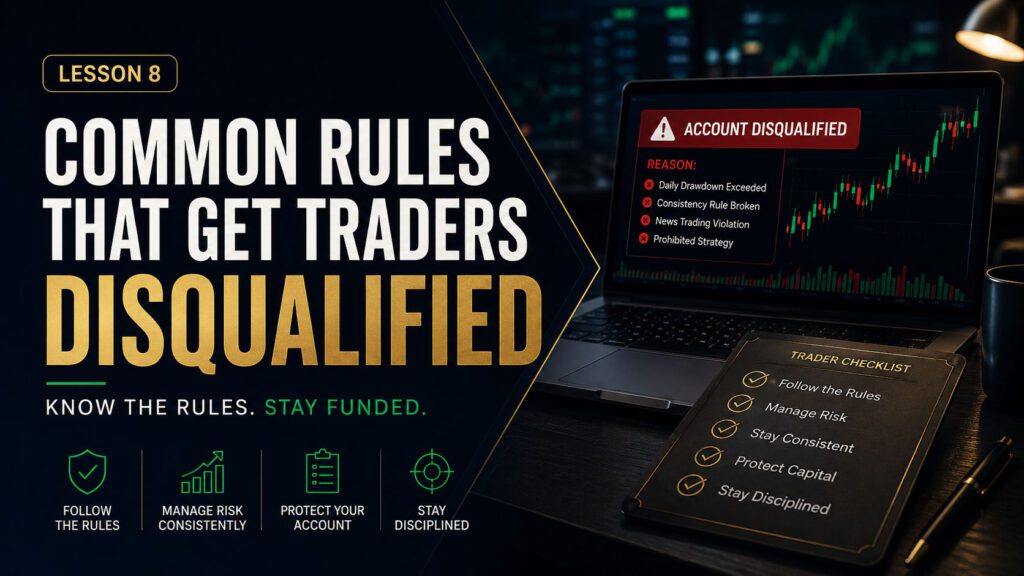
Common Rules That Get Traders Disqualified
Learn the most common prop firm rule violations, why traders get disqualified, and how to protect your evaluation before one small mistake becomes expensive.
Lesson Goal
Most traders don’t fail because they can’t find winning trades. They fail because they unknowingly break one of the firm’s rules. Understanding these rules before you purchase a challenge dramatically increases your chances of becoming funded.
Every prop firm has its own rulebook, but many restrictions appear across multiple firms. The good news is that almost all of these mistakes are preventable.
This lesson brings together everything from Module 1: what prop firms are, how challenges work, profit targets, drawdown, and consistency rules.
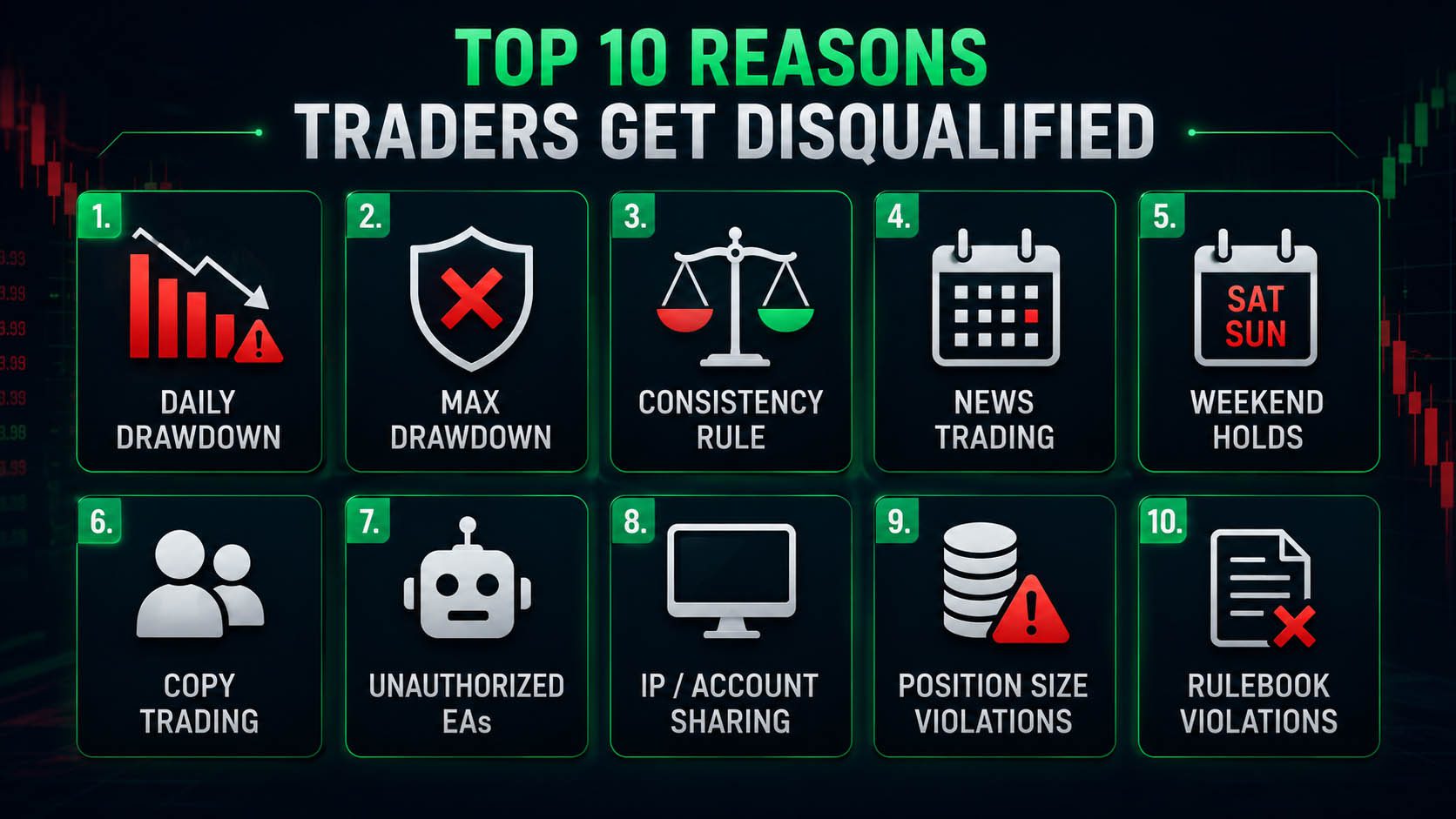
The Most Common Reasons Traders Fail
- Exceeding Daily Drawdown
- Exceeding Maximum Drawdown
- Breaking Consistency Rules
- Holding Trades During Restricted News Events
- Trading Prohibited Instruments
- Violating Weekend Holding Rules
- Copy Trading When Not Allowed
- Using Unauthorized EAs
- Sharing Accounts or IP Violations
- Breaking Position Size Rules
1. Daily Drawdown Violations
Daily drawdown remains one of the biggest reasons traders lose evaluations. A single emotional trade late in the session often wipes out an otherwise successful week.
Avoid This
Trying to recover losses by increasing position size near the end of the day.
Before taking a challenge, make sure you understand daily drawdown and maximum daily loss. These rules can fail an account even when the trader thinks they are still “safe.”
2. Maximum Drawdown Violations
Maximum drawdown is the total account loss limit. It controls how much your account can lose across the entire challenge or funded stage. Traders often focus on the daily limit but forget the total account boundary.
This rule becomes even more important when the firm uses static or trailing drawdown. A trailing drawdown can move upward as your account makes new highs, which means your room for error can shrink after profitable days.
3. Consistency Rule Violations
Some firms require profits to be earned consistently instead of coming from one oversized trade or one huge trading day. A trader can hit the profit target and still be non-compliant if one day produced too much of the total profit.
This is why understanding consistency rules matters before buying the evaluation. You do not want to discover the rule after hitting the target.
4. News Trading Violations
Many firms prohibit opening or closing trades around high-impact news events such as Non-Farm Payrolls, CPI, or FOMC announcements.
Always read the firm’s news policy carefully before trading major economic releases. Some firms restrict opening trades before news. Others restrict closing trades during the news window. Some restrict both.
5. Weekend Holding Rules
Some firms require all trades to be closed before the weekend, while others allow swing trading. Never assume the rules are the same across firms.
If you hold trades past the allowed time, the account may be disqualified even if the trade is profitable. This is especially important for swing traders and anyone holding forex, indices, crypto, or commodities across market closures.
6. Copy Trading & Trade Copiers
Certain firms allow personal trade copiers while others prohibit copying between funded accounts. Violating these policies can result in immediate account termination.
Some firms allow copying from your own personal account into your own challenge account. Others may prohibit copying signals, mirroring other traders, or using identical trades across multiple accounts.
7. Expert Advisors (EAs)
Some prop firms welcome automated trading while others restrict commercial EAs, latency arbitrage, grid systems, martingale systems, or high-frequency strategies.
Before using any Expert Advisor, confirm whether the firm allows automation, whether the EA must be unique, and whether the strategy violates any prohibited trading behavior.
8. Trading Prohibited Instruments
Some firms limit which instruments can be traded. A firm may allow forex majors but restrict crypto, indices, metals, exotic pairs, or specific symbols during certain conditions.
Trading a prohibited instrument can fail the account even if your risk was controlled. Always verify the allowed symbol list before placing your first trade.
9. Account Sharing or IP Violations
Many firms have strict rules around who can access the account, where the account is accessed from, and whether multiple accounts are being traded from the same IP address or device.
If a firm detects account sharing, suspicious login behavior, or rule-breaking access patterns, it may freeze, review, or terminate the account.
10. Position Size Rule Violations
Some firms limit maximum lot size, contract size, or sudden changes in trade size. Even when no formal consistency rule exists, a dramatic jump in position size can trigger a review.
Clean traders use consistent position sizing because they want the account to look professional, not random.
Always Verify These Rules
- EA policy
- News policy
- Weekend rules
- Consistency requirements
- Drawdown calculation
- Copy trading rules
- Allowed instruments
- Maximum position size
- Payout requirements
- Account login and IP rules
Professional Traders Think Differently
Professional traders spend just as much time protecting their account as they do looking for entries. Before every trade they ask one question:
That question belongs inside your professional trading plan. If a trade looks good technically but violates a rule, it is not a valid trade.
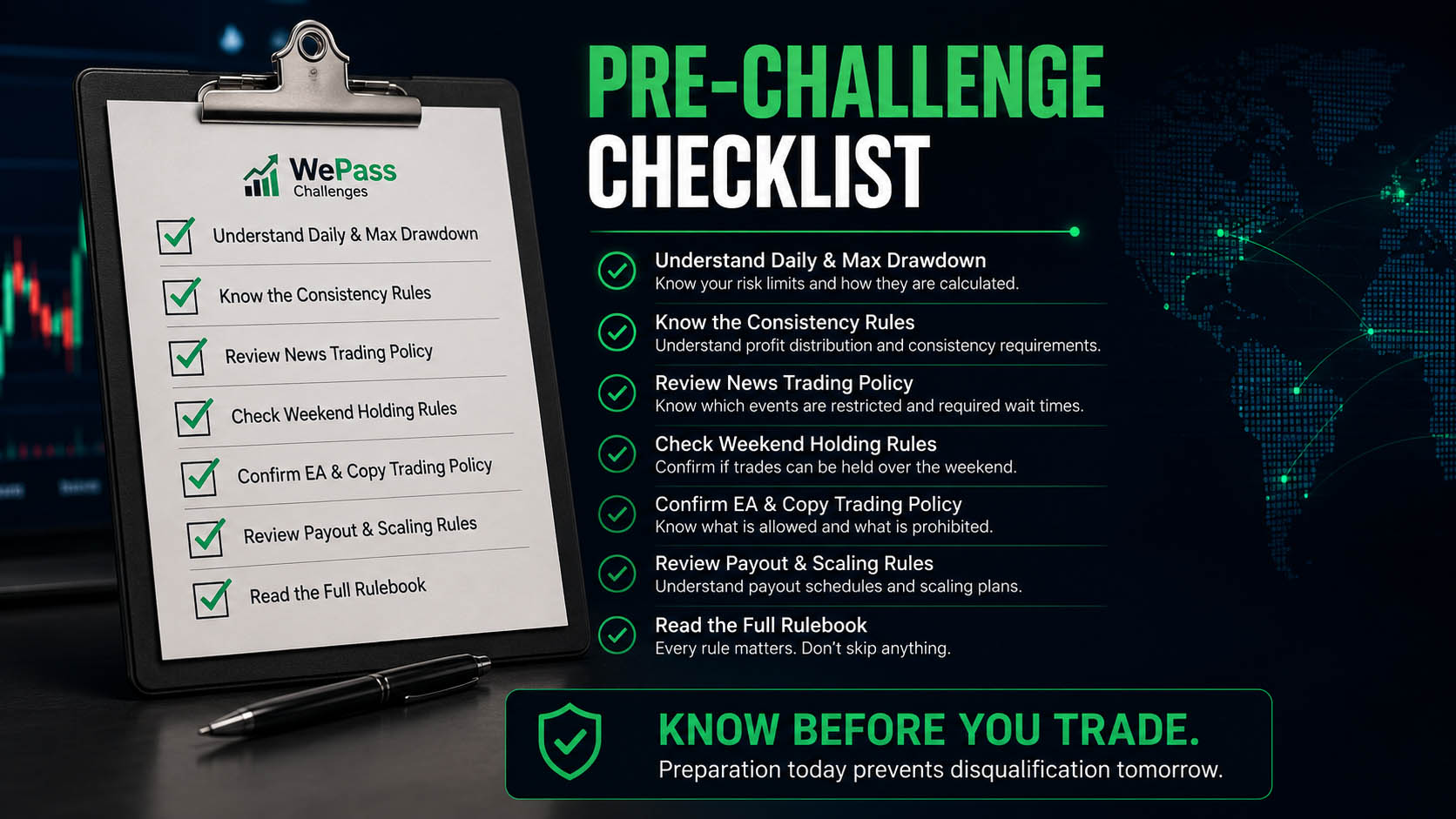
Before You Buy Any Challenge
- Read the full rulebook.
- Understand daily and maximum drawdown.
- Know the consistency rules.
- Review news restrictions.
- Check weekend holding policies.
- Understand payout requirements.
- Confirm EA and copy trading policies.
Lesson Quiz
- What is one of the most common reasons traders fail challenges?
- Should you assume every prop firm has identical rules?
- Why is reading the rulebook important?
- Can copy trading violate some firms’ rules?
- Why should risk management always come before profit?

🎉 Module 1 Complete: Prop Firm Fundamentals
Congratulations! You’ve completed Module 1: Prop Firm Fundamentals. You now understand how prop firms work, how challenges are structured, the most important risk rules, and the mistakes that eliminate thousands of traders every month.
Next, you’ll move into professional risk management, where you’ll learn how to control risk per trade, calculate position size, protect daily loss limits, manage drawdown, and trade like a serious funded trader.
Lesson Summary
Most prop firm disqualifications are preventable. Traders usually fail because they ignore daily drawdown, maximum drawdown, consistency rules, news restrictions, weekend policies, copy trading rules, EA restrictions, or position size limits. The professional trader reads the rulebook first, builds a plan around the rules, and only takes trades that keep the account compliant.