

Profit Splits, Scaling Plans & Payouts
A big profit split sounds attractive, but real funded traders compare payout schedules, minimum withdrawals, scaling opportunities, payout rules, and long-term account protection.
Learning Objectives
By the end of this lesson, you should understand how prop firm payouts work beyond the flashy marketing numbers.
- Understand how profit splits are calculated.
- Learn why the highest split is not always the best deal.
- Compare daily, weekly, bi-weekly, and monthly payout cycles.
- Understand minimum withdrawals and payout eligibility rules.
- Learn how scaling plans can increase long-term earning potential.
- Spot hidden payout rules before you buy an account.
How Prop Firm Payouts Actually Work
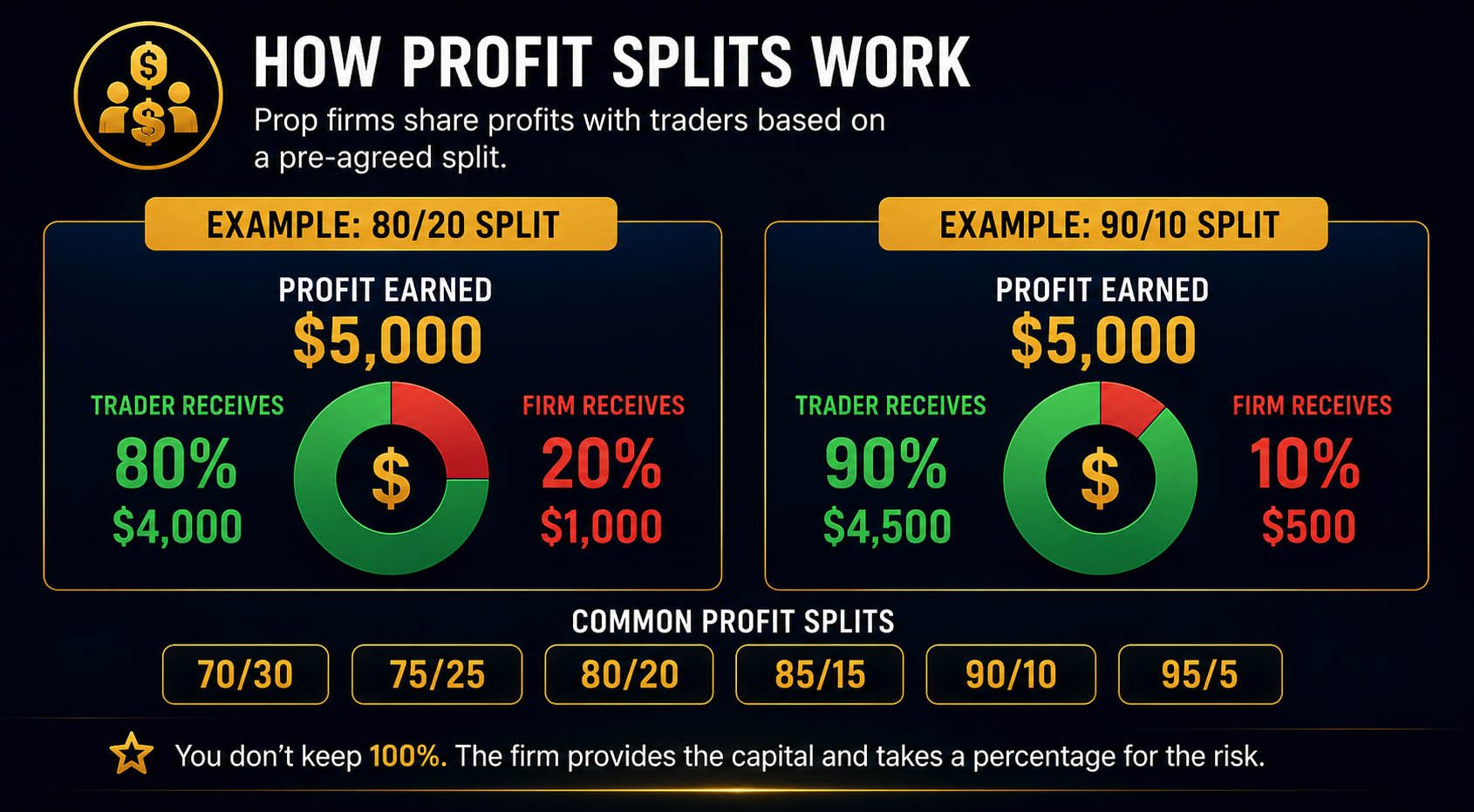
When you trade a funded account, you usually do not keep 100% of the profits. The prop firm keeps a percentage, and the trader keeps the rest. This is called the profit split.
Common profit splits include 70/30, 75/25, 80/20, 85/15, 90/10, and sometimes 95/5. The first number usually represents the trader’s share, while the second number represents the firm’s share.
Trader Share
If the split is 80/20, the trader keeps 80% of eligible profits.
Profit Example
If the account earns $5,000, the split is applied to that amount.
Trader Payout
With an 80% split, the trader receives $4,000 and the firm keeps $1,000.
| Profit Earned | Profit Split | Trader Receives | Firm Receives |
|---|---|---|---|
| $2,000 | 80/20 | $1,600 | $400 |
| $5,000 | 80/20 | $4,000 | $1,000 |
| $10,000 | 90/10 | $9,000 | $1,000 |
This is why profit split should be compared alongside daily drawdown, maximum drawdown, consistency rules, and payout restrictions.
Does a Higher Profit Split Mean a Better Firm?
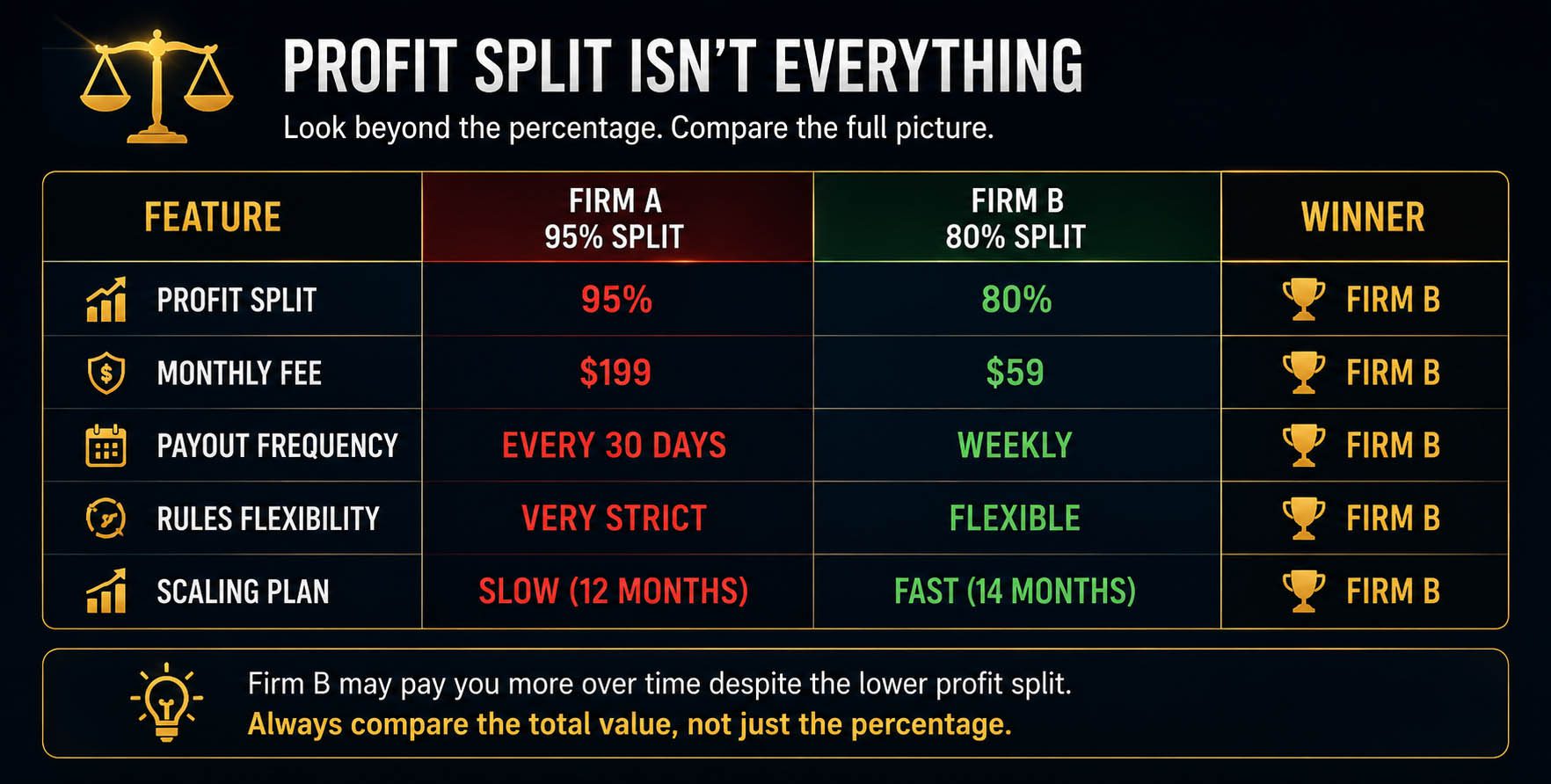
No. A higher profit split can be attractive, but it is only one piece of the full deal. Some firms advertise a 90% or 95% split while adding stricter payout rules, higher fees, slower withdrawals, tighter drawdown, or limited scaling.
A firm with an 80% split may actually be better if it has clear rules, faster payouts, fair drawdown, and reliable withdrawal processing.
| Feature | Firm A | Firm B |
|---|---|---|
| Profit Split | 95% | 80% |
| Challenge Fee | Higher | Lower |
| Payout Cycle | Every 30 days | Weekly |
| Rules | Strict consistency limits | Clear and manageable |
| Scaling | Limited | Strong long-term scaling plan |
| Better for Many Traders? | Not always | Often more practical |
The same logic applies when comparing instant funding vs evaluation accounts. A faster path is not useful if the payout rules are too restrictive.
Understanding Payout Cycles
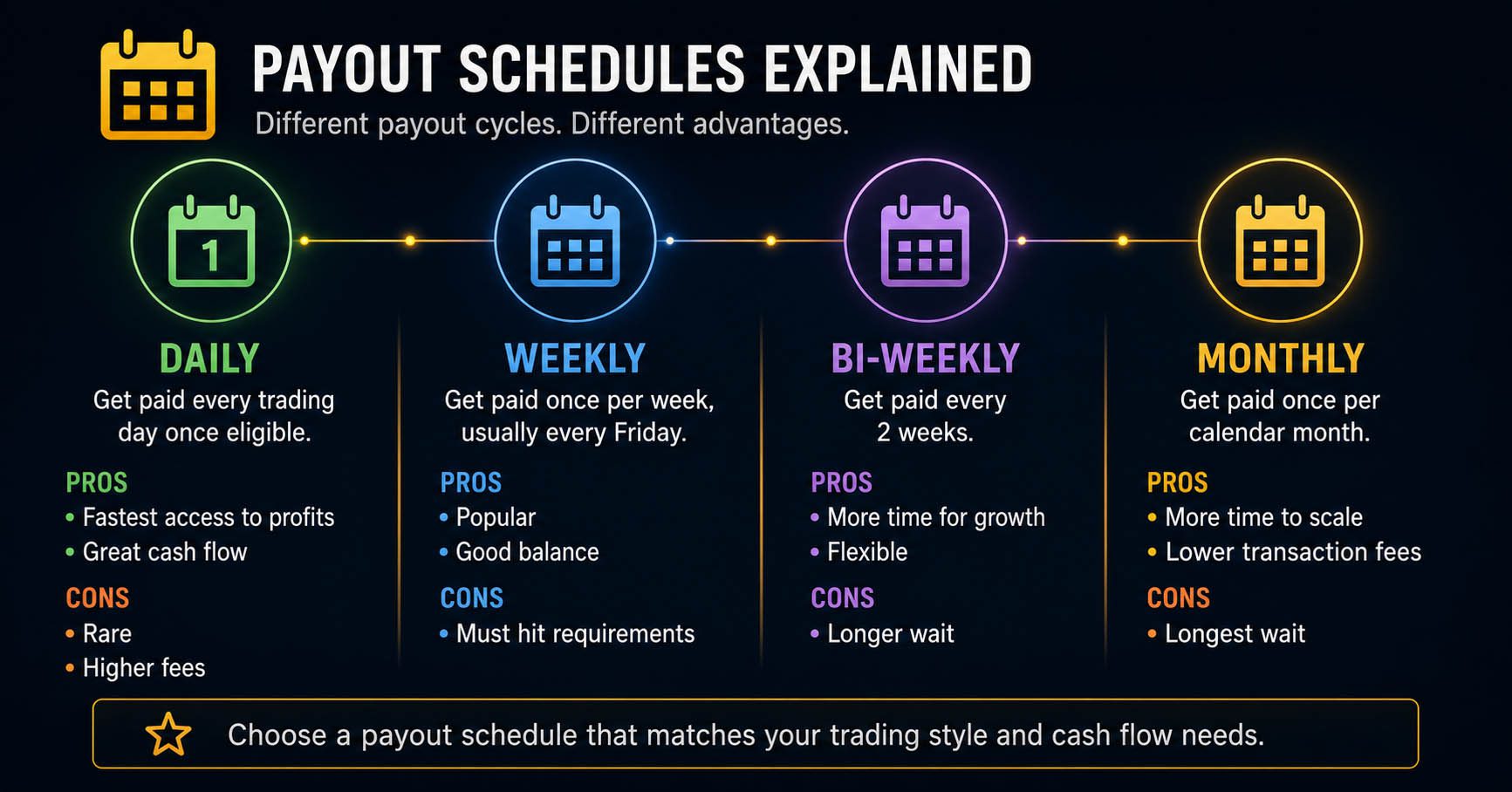
The payout cycle tells you how often you can request profits. Different firms have different schedules, and this can affect your cash flow as a funded trader.
Daily
Fastest access, but often comes with strict requirements or mature funded account conditions.
Weekly
Trader-friendly and useful for consistent cash flow.
Bi-Weekly
Common structure that balances firm protection and trader access.
Monthly
Slower, but can encourage patience and larger payout planning.
| Payout Cycle | Pros | Cons |
|---|---|---|
| Daily | Fast access to profits | May require strict eligibility or prior payouts |
| Weekly | Great balance for active traders | Can tempt traders to over-focus on short-term withdrawals |
| Bi-Weekly | Common and practical | Requires patience |
| Monthly | Encourages longer-term thinking | Slower cash flow |
Minimum Withdrawal Rules
Many firms require traders to reach a minimum payout amount before requesting a withdrawal. Common minimums may be $100, $250, $500, or more depending on the firm and account size.
Some firms also require a minimum number of trading days, a profit buffer above the drawdown level, or a consistency rule before approving payouts.
Common Payout Requirements
- Minimum payout amount.
- Minimum trading days.
- No rule violations.
- Profit consistency limits.
- Account must remain above a safety buffer.
- Identity verification must be completed.
Payout rules often connect directly to consistency rules, minimum trading days, and account drawdown safety buffers.
Understanding Scaling Plans
A scaling plan is how a prop firm increases your account size after you demonstrate consistency. This can be more valuable than a slightly higher profit split because scaling gives you the chance to manage more capital over time.
A good scaling plan rewards patience. Instead of forcing bigger trades, you grow the account size by following the rules and building a payout history.
| Stage | Account Size | Requirement | Professional Focus |
|---|---|---|---|
| Start | $100,000 | Pass challenge or receive funded account | Protect the account |
| Scale 1 | $200,000 | Consistent profits over several months | Keep risk stable |
| Scale 2 | $400,000 | Continued rule compliance | Build payout history |
| Scale 3 | $800,000+ | Long-term consistency | Think like a money manager |
Why Scaling Beats High Risk
Many traders try to make more money by risking more. Professional traders try to make more money by accessing more capital while keeping risk controlled.
Trader A: Professional Growth
- Starts with $100,000
- Risks small per trade
- Takes consistent payouts
- Qualifies for scaling
- Builds long-term income
Trader B: Aggressive Cycle
- Buys large accounts
- Risks too much
- Chases one huge payout
- Breaks drawdown rules
- Repeats the same mistake
This is why capital preservation must come before payout size.
Hidden Payout Rules to Watch For
Prop firms may have additional payout rules that are easy to miss. These rules can determine whether your profits are actually withdrawable.
- Consistency rules that limit how much one day can contribute to total profit.
- Profit buffer requirements before payout approval.
- Maximum withdrawal caps for first payouts.
- Minimum trading days before requesting funds.
- Restrictions on news trading, weekend holds, or overnight positions.
- Maximum allocation rules across multiple accounts.
- Identity verification and payment processor requirements.
- Rule changes between challenge phase and funded phase.
Many payout problems are connected to the same common rules that get traders disqualified, so rule review must happen before the purchase.
The Professional Payout Mindset
A beginner asks, “How much can I make today?”
A professional asks, “How long can I stay funded, how consistently can I withdraw, and how can I scale without increasing risk?”
The goal is not one screenshot payout. The goal is to build a payout history that proves you can manage capital responsibly.
FAQ
How much do prop firms pay traders?
Most firms pay traders a percentage of eligible profits, commonly between 70% and 90%. Some offer higher splits after scaling or repeated payouts.
How often can funded traders get paid?
It depends on the firm. Some offer weekly payouts, some bi-weekly, some monthly, and some may offer faster payouts after the trader builds a history.
Can payout percentages change?
Yes. Some firms increase the trader’s split after certain milestones, scaling levels, or successful payout history.
Is a 95% profit split always better?
No. A lower split with faster payouts, clear rules, and better scaling can be more valuable than a high split with restrictive conditions.
Can scaling increase my account size?
Yes. Many firms offer scaling plans that increase account allocation after consistent profits and rule compliance.
What happens after multiple payouts?
Some firms reward consistent traders with higher splits, larger allocations, faster payout access, or scaling opportunities.
Knowledge Check Quiz
- What does an 80/20 profit split mean?
Answer: The trader keeps 80% of eligible profits and the firm keeps 20%. - Is the highest profit split always the best deal?
Answer: No. Payout rules, fees, drawdown, and scaling also matter. - Why do payout cycles matter?
Answer: They determine how often traders can request profits and manage cash flow. - What is a scaling plan?
Answer: A structure that increases account size after consistent profits and rule compliance. - Why can scaling be better than risking more?
Answer: It increases earning potential without requiring higher percentage risk per trade. - What is a minimum withdrawal rule?
Answer: A required profit amount before a payout can be requested. - What is a hidden payout rule traders should watch for?
Answer: Consistency rules, minimum trading days, profit buffers, or maximum withdrawal caps. - What should traders read before buying?
Answer: The full challenge, funded, payout, and scaling rules. - What is the beginner mindset?
Answer: Focusing only on how much can be made quickly. - What is the professional mindset?
Answer: Protect the account, build payout history, and scale over time.
Key Takeaways
- Profit split is important, but it is not the only thing that matters.
- A lower split with better payout rules may be more valuable than a higher split with restrictions.
- Payout cycles affect cash flow and trading psychology.
- Scaling plans can significantly increase long-term earning potential.
- Professional funded traders think in months and years, not one huge payout.
- Always read payout rules before buying any prop firm account.
Lesson Summary
Profit splits, payout cycles, and scaling plans all matter when choosing a funding partner. A high split can look impressive, but it is not valuable if the payout rules are restrictive or the drawdown model is hard to survive. Professional traders focus on sustainable withdrawals, account protection, and long-term scaling instead of chasing one big payout screenshot.