

Time Limits & Trading Day Requirements
Some prop firm challenges give you unlimited time. Others require minimum trading days, active trading days, or payout waiting periods. These timing rules can completely change how you should trade.
Learning Objectives
- Understand the difference between time limits and trading day requirements.
- Learn why unlimited time can be safer for most traders.
- Understand minimum trading days and active trading day rules.
- Know how payout waiting periods affect funded accounts.
- Learn how to avoid rushing trades just to satisfy a rule.
- Compare timing rules before choosing a prop firm.

Why Time Rules Matter
Most traders look at account size, profit split, and drawdown first. That makes sense, but timing rules are just as important. A challenge with a realistic profit target can become dangerous if the time limit forces you to trade aggressively.
The purpose of a prop firm evaluation is to prove that you can manage risk. If the rules pressure you to force trades, overtrade, or take low-quality setups, the account may not fit your style.
Before choosing a funding partner, compare timing rules with profit targets, drawdown, payout rules, and your actual trading frequency.
What Is a Time Limit?
A time limit is the maximum amount of time you have to complete an evaluation phase. Older prop firm models often required traders to hit the profit target within 30 days, 60 days, or another fixed window.
Many modern firms now offer unlimited time, which gives traders more breathing room. This is usually better because it allows you to wait for quality setups instead of forcing trades because the calendar is running out.
Unlimited Time
- No fixed deadline to pass.
- More room to trade patiently.
- Better for swing traders and selective traders.
- Less pressure to overtrade.
Fixed Time Limit
- Must pass within a set number of days.
- Can create pressure if market conditions are slow.
- May reward aggressive trading.
- Harder for conservative traders.
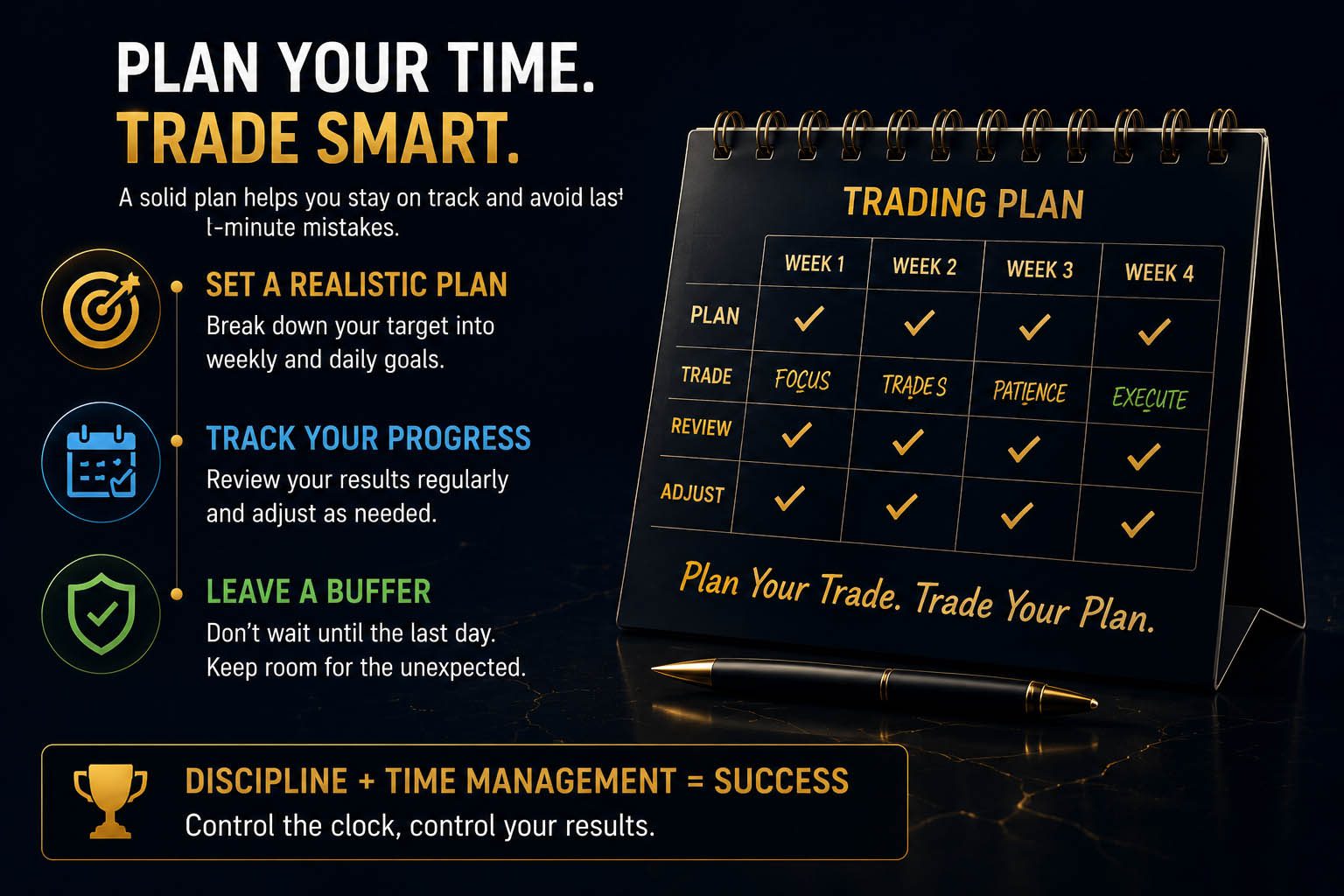
This is why your professional trading plan should decide when you trade — not the calendar pressure from the challenge.
Minimum Trading Days Explained
A minimum trading day rule means you must place trades on a certain number of days before passing or requesting a payout. For example, a firm may require 3, 5, or 10 trading days.
This rule is designed to prevent traders from passing in one lucky trade. The firm wants to see activity over time, not one random win.
| Requirement | What It Means | How Traders Misuse It |
|---|---|---|
| 3 Minimum Trading Days | You must trade on at least 3 separate days. | Taking tiny meaningless trades just to count days. |
| 5 Minimum Trading Days | You must show activity across 5 days. | Forcing trades when no setup exists. |
| 10 Minimum Trading Days | You must trade over a longer period before approval. | Overtrading because the process feels slow. |
What Counts as a Trading Day?
Not every firm defines a trading day the same way. Some count any day with a closed trade. Others require a trade to be open for a minimum time, or require a certain amount of activity.
Common Trading Day Definitions
- At least one closed trade during the day.
- At least one trade opened and closed during the day.
- A trade must remain open for a minimum number of minutes.
- The trade must not be obviously meaningless or abusive.
- Only days with real activity count toward payout eligibility.
Active Trading Day Requirements
Some firms use the phrase active trading days. This usually means they want to see genuine trading activity instead of one tiny trade placed only to satisfy a rule.
For example, a trader may open a 0.01 lot trade for a few seconds just to mark a day as active. Some firms may reject that behavior or apply consistency rules if it looks like rule manipulation.
Real Setup
The best active day is based on a real setup from your trading plan.
Real Risk
The trade should be reasonable, not a fake trade designed only to count a day.
Real Process
Your activity should prove consistency, not loophole hunting.
This also connects to consistency rules, because fake activity and oversized shortcut trades can create compliance issues.
Payout Waiting Periods
After you become funded, time rules do not disappear. Many firms require a waiting period before your first payout. For example, you may need to wait 7, 14, or 30 days before requesting your first withdrawal.
Some firms also require a certain number of trading days between payouts. This affects cash flow and can pressure impatient traders into forcing more activity.
| Payout Rule | Example | What It Means for You |
|---|---|---|
| First Payout Wait | 14 days | You cannot withdraw until the account meets the waiting period. |
| Trading Days Required | 5 active days | You must show real activity before requesting payout. |
| Recurring Payout Cycle | Every 2 weeks | You can request payouts only during approved windows. |
| Profit Buffer | Stay above drawdown buffer | You may need extra profit left in the account after payout. |
For deeper context, review profit splits, scaling plans, and payouts.
Unlimited Time vs Minimum Trading Days
Unlimited time and minimum trading days are not opposites. A firm can offer unlimited time to pass but still require a minimum number of trading days before the phase is complete.
| Rule Combination | What It Feels Like | Best Approach |
|---|---|---|
| Unlimited Time + No Minimum Days | Most flexible | Trade only your best setups. |
| Unlimited Time + Minimum Days | Still reasonable | Spread trades naturally across valid setup days. |
| Fixed Time + Minimum Days | More pressure | Use smaller risk and avoid chasing. |
| Short Fixed Time + High Target | High pressure | Only suitable for aggressive or very experienced traders. |
How Timing Rules Affect Different Trading Styles
Scalpers and Day Traders
Minimum trading days are usually easier for active traders because they naturally trade more often. The danger is overtrading and increasing risk to pass faster.
Swing Traders
Swing traders may struggle with short time limits or high active-day requirements because quality setups may take longer to develop.
| Trading Style | Best Timing Structure | Timing Risk |
|---|---|---|
| Scalper | Unlimited time with clear daily loss rules | Overtrading to finish quickly |
| Day Trader | Unlimited or moderate time limit | Forcing trades on slow days |
| Swing Trader | Unlimited time and overnight holding allowed | Minimum day rules and time limits |
| News Trader | Firm must allow news trading | Restricted event windows |
The best timing structure depends on how often your strategy naturally produces quality trades. A good firm should fit your trading style, not force you to become a different trader.
Common Timing Mistakes
- Rushing trades because the challenge has a deadline.
- Placing meaningless trades just to count trading days.
- Ignoring first payout waiting periods.
- Assuming every trade day counts without checking the rulebook.
- Choosing an account that does not fit your trading frequency.
- Overtrading near the end of the challenge.
- Trying to pass in one day and then getting delayed by minimum day rules.
Questions to Ask Before Buying
- Is there a maximum time limit to pass?
- Are there minimum trading days?
- What exactly counts as a trading day?
- Are active trading days required for payout?
- Is there a first payout waiting period?
- How often can payouts be requested?
- Are weekend holds allowed?
- Are overnight trades allowed?
- Can my strategy naturally meet these timing rules?
- Will these rules pressure me to overtrade?
Professional Example
Two traders buy the same $100,000 evaluation. Both need to make 8% profit. Trader A wants to pass as fast as possible and starts forcing trades in the first week. Trader B understands there is unlimited time and waits for high-quality setups.
Trader A gets close quickly, then gives profits back and violates daily loss. Trader B takes longer, but protects risk, follows the plan, and has a better chance of finishing without emotional damage.
FAQ
Are unlimited time challenges better?
For most traders, yes. Unlimited time reduces pressure and allows better decision-making, especially for traders who wait for high-quality setups.
What are minimum trading days?
Minimum trading days are the required number of days you must trade before passing a phase or requesting a payout.
Can I place tiny trades just to count trading days?
Some firms may allow it, but it is risky to assume. Many firms expect genuine trading activity and may define active trading days more strictly.
Do payout rules have trading day requirements?
Often, yes. Some firms require a certain number of active trading days before a payout can be requested.
Should I choose a firm with no time limit?
If you are a beginner or a patient trader, no time limit is usually better. But you should still compare drawdown, payout rules, and trading restrictions.
Knowledge Check Quiz
- What is a time limit?
Answer: The maximum time allowed to complete an evaluation phase. - Why is unlimited time usually helpful?
Answer: It reduces pressure and allows traders to wait for better setups. - What are minimum trading days?
Answer: The number of separate trading days required before completion or payout eligibility. - Does every firm define a trading day the same way?
Answer: No. Each firm can define it differently. - What is the danger of short time limits?
Answer: They can pressure traders into overtrading or taking poor setups. - What is a payout waiting period?
Answer: The time a funded trader must wait before requesting a payout. - Who may struggle most with strict timing rules?
Answer: Swing traders or selective traders who wait longer for setups. - What should your trading day activity be based on?
Answer: Valid setups from your trading plan. - What should you check before buying?
Answer: Time limits, minimum days, active day definitions, payout waiting periods, and trading restrictions. - What is the professional mindset?
Answer: Pass safely without abandoning the trading plan.
Key Takeaways
- Timing rules can affect your strategy as much as drawdown or profit targets.
- Unlimited time is usually better for patient and beginner traders.
- Minimum trading days are designed to prove activity over time.
- Active trading day definitions vary by firm.
- Payout waiting periods affect when profits become withdrawable.
- Never force trades just to satisfy a timing rule.
- Choose a prop firm account that fits your natural trading frequency.
Lesson Summary
Time limits, minimum trading days, active trading day definitions, and payout waiting periods can all affect how a trader behaves. Unlimited time often gives traders more room to wait for quality setups, while short deadlines can encourage emotional decisions. The professional approach is simple: choose a firm whose timing rules fit your strategy instead of forcing your strategy to fit the firm.