
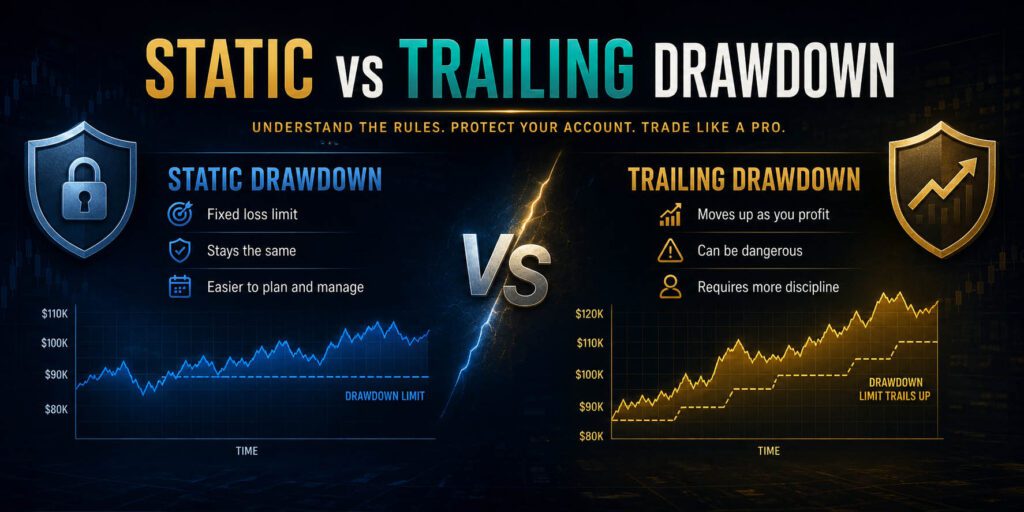
Static vs Trailing Drawdown Across Different Firms
Drawdown rules can make or break your prop firm account. Learn how static and trailing drawdown work, why some firms are harder than they look, and how to choose an account that fits your trading style.
Learning Objectives
- Understand what static drawdown means.
- Understand what trailing drawdown means.
- Learn why trailing drawdown can be more dangerous for beginners.
- Compare drawdown rules across different prop firm models.
- Choose a firm based on realistic risk, not just account size.
- Ask the right questions before buying a challenge or funded account.
Why Drawdown Rules Matter
Most traders focus on the profit target first. That is backwards. The drawdown rule is usually more important than the profit target because it controls how much room you have to make mistakes.
A $100,000 prop firm account does not mean you can risk like you have $100,000. If the account has a $5,000 maximum drawdown, your real working risk is closer to $5,000, not $100,000.
This is why every trader should understand maximum drawdown before comparing firms.
What Is Static Drawdown?
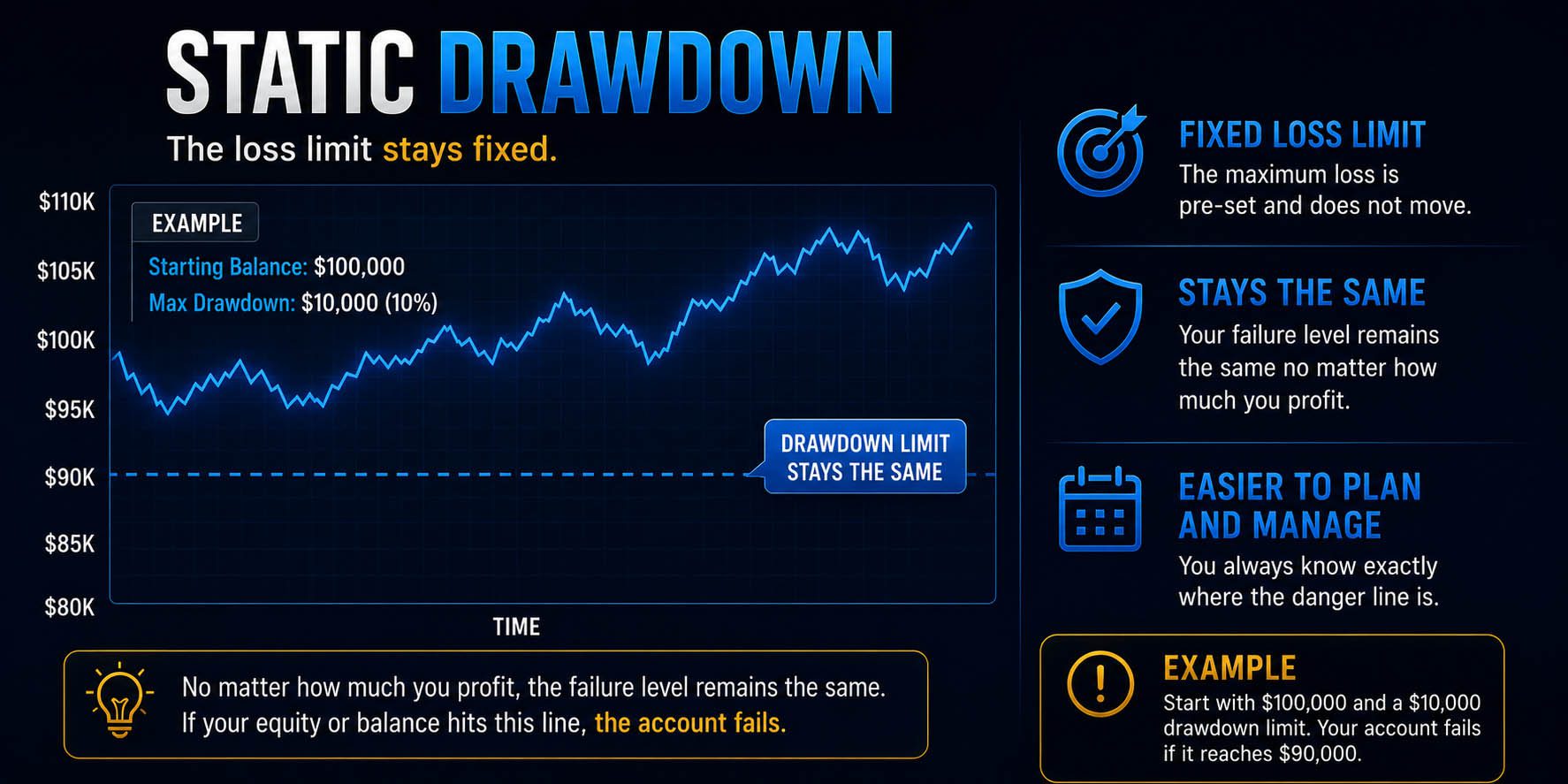
Static drawdown means the maximum loss limit stays fixed. It does not move up when your account balance increases.
For example, if you start with a $100,000 account and the maximum loss limit is $90,000, your account fails if equity or balance reaches $90,000. If you grow the account to $105,000, the failure level usually remains $90,000.
| Account Balance | Static Drawdown Limit | Failure Level |
|---|---|---|
| $100,000 | 10% | $90,000 |
| $105,000 | Still fixed | Still $90,000 |
Static drawdown is usually cleaner for traders who need predictable risk limits, especially swing traders or anyone holding trades through normal market fluctuations.
What Is Trailing Drawdown?
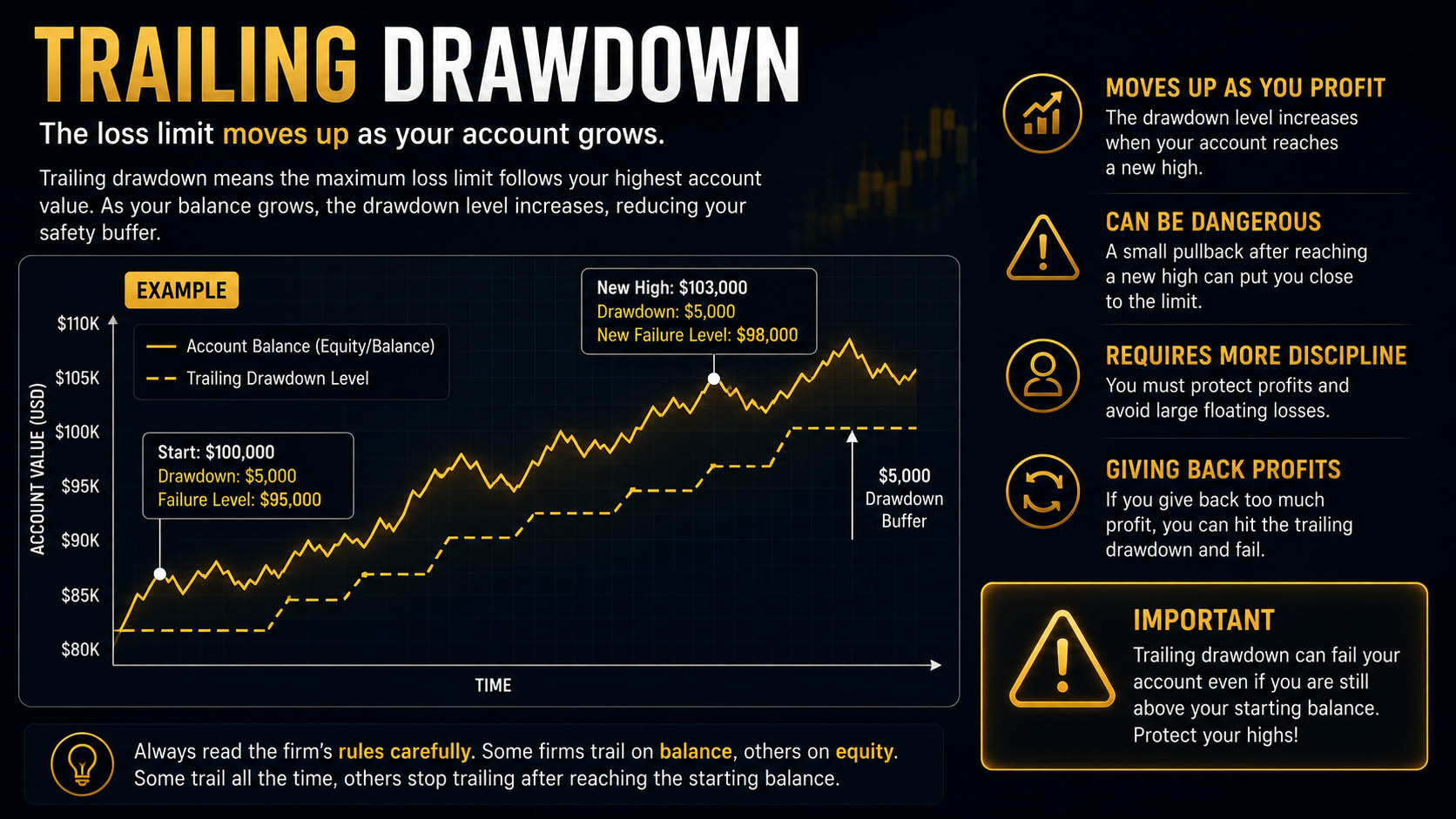
Trailing drawdown means the loss limit moves upward as your account makes new highs. This can be dangerous because early profits may not give you as much safety as you think.
If your account starts at $100,000 with a $5,000 trailing drawdown, your failure level may begin at $95,000. If you grow the account to $103,000, the drawdown level may trail up to $98,000.
| Highest Account Value | Trailing Drawdown | New Failure Level |
|---|---|---|
| $100,000 | $5,000 | $95,000 |
| $103,000 | $5,000 | $98,000 |
This is especially important when comparing instant funding vs evaluation accounts, because some faster funding products may come with tighter risk rules.
Static vs Trailing Drawdown Comparison
| Feature | Static Drawdown | Trailing Drawdown |
|---|---|---|
| Failure Level | Usually fixed | Moves up as account grows |
| Difficulty | Easier to understand | Harder for beginners |
| Best For | Most traders | Highly disciplined traders |
| Main Risk | Over-risking near the fixed limit | Giving back profits after the limit moves |
The Biggest Mistake Traders Make
The biggest mistake is treating drawdown like extra money to gamble with. Drawdown is not spending power. Drawdown is the maximum damage your account can take before it is closed.
If you have a $100,000 account with $5,000 drawdown, your risk plan should be based around protecting that $5,000 buffer.
This connects directly to position sizing. Your lot size should be based on the real risk cushion, not the headline account size.
Which Drawdown Type Is Better?
For most beginners, static drawdown is better because it is easier to understand and easier to plan around.
Trailing drawdown can still work, but it requires more discipline. You must avoid large floating losses, protect profits, and understand exactly when the trailing limit updates.
Choose Static Drawdown If:
- You want cleaner risk planning.
- You are newer to prop firm trading.
- You need more room to manage normal trade fluctuation.
- You prefer a fixed account failure level.
Choose Trailing Drawdown If:
- You fully understand how the rule moves.
- You can trade conservatively after profits.
- You track balance, equity, and trailing thresholds carefully.
- You can reduce risk immediately after strong winning days.
Balance-Based vs Equity-Based Drawdown
Some firms calculate drawdown based on closed balance. Others calculate it using live equity, which includes floating profit and loss. This detail matters because an open losing trade may trigger a breach before it is closed.
| Calculation Type | What It Means | Why It Matters |
|---|---|---|
| Balance-Based | Uses closed trades only. | Open trades may not affect the breach line until closed. |
| Equity-Based | Includes floating profit and loss. | Open losses can violate the account before the trade closes. |
| End-of-Day Based | May evaluate balances at a specific reset time. | Timing and open trades can become critical. |
This also connects to daily drawdown, because floating losses can matter more than many traders expect.
Questions to Ask Before Buying
- Is the drawdown static or trailing?
- Does the drawdown trail based on balance or equity?
- Does the trailing drawdown stop after reaching the starting balance?
- Can open trades cause a violation?
- How much real risk buffer do I have?
- Can my strategy survive this rule?
FAQ
Is static drawdown easier than trailing drawdown?
Usually, yes. Static drawdown is easier because the failure level is fixed and simpler to plan around.
Can trailing drawdown fail an account even after profit?
Yes. If the drawdown trails upward and you give back profits, you can fail even if the account is still near or above the starting balance.
Should beginners avoid trailing drawdown?
Most beginners should be careful with trailing drawdown. It requires strong discipline and a clear understanding of how the limit moves.
What is the safest drawdown structure?
The safest structure is usually a static drawdown with clear daily loss and total loss rules.
Knowledge Check Quiz
- What does static drawdown mean?
Answer: The loss limit stays fixed. - What does trailing drawdown mean?
Answer: The loss limit moves up as the account reaches new highs. - Why can trailing drawdown be dangerous?
Answer: You can fail after giving back profits even if the account was previously profitable. - Should you risk based on account size or drawdown limit?
Answer: Drawdown limit. - Which drawdown type is usually better for beginners?
Answer: Static drawdown.
Key Takeaways
- Drawdown rules are more important than account size.
- Static drawdown is fixed and easier to manage.
- Trailing drawdown moves up as the account grows.
- Trailing drawdown can fail traders who give back profits.
- Choose a prop firm account based on realistic risk, not marketing.
Lesson Summary
Static and trailing drawdown can completely change the difficulty of a prop firm account. Static drawdown gives traders a fixed failure level, while trailing drawdown moves upward as the account reaches new highs. Neither model is automatically good or bad, but each must match your strategy, risk tolerance, and trade management style. The safest traders compare drawdown rules before account size, price, or marketing claims.