Instant Funding vs Evaluation Accounts
Instant funding sounds attractive because you can start trading faster, but evaluation accounts may give newer traders a safer, more structured path to long-term funded trading.
Learning Objectives
By the end of this lesson, you should be able to compare instant funded accounts and evaluation accounts without getting distracted by marketing hype.
- Understand what an instant funded account actually is.
- Understand how evaluation accounts work.
- Compare upfront cost, risk rules, payout rules, and account pressure.
- Know which model is better for beginners, experienced traders, and conservative traders.
- Identify hidden rules that can make either option harder than it looks.
- Choose the funding path that matches your risk tolerance and trading plan.
The Big Difference
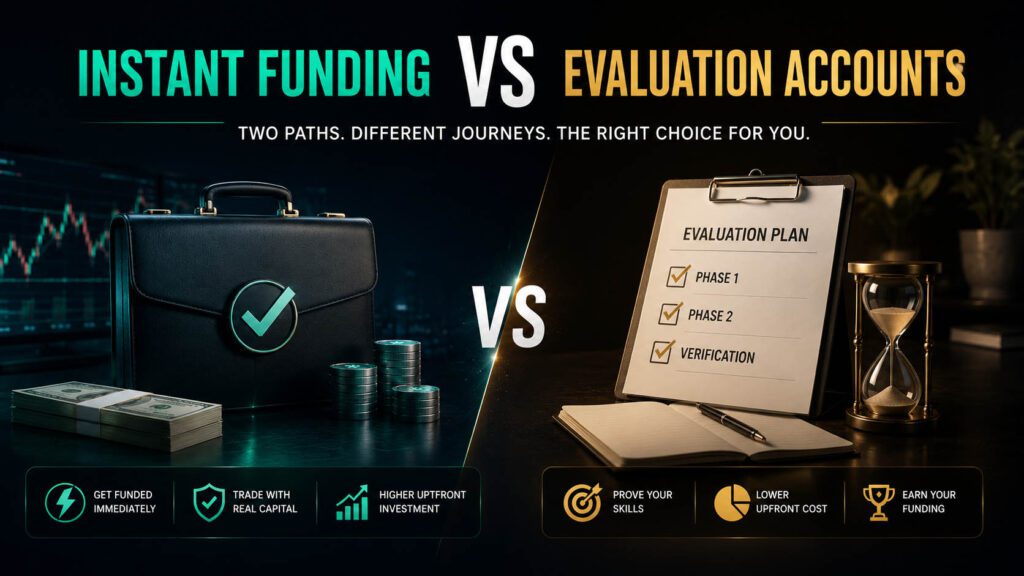
The main difference is simple: with an instant funded account, you skip the traditional challenge and begin trading a funded-style account right away. With an evaluation account, you must first pass a challenge by meeting profit targets while staying within drawdown rules.
Instant Funding
You pay more upfront, receive account access quickly, and attempt to earn payouts under a firm’s funded account rules.
- Faster access to capital.
- No traditional Phase 1 or Phase 2.
- Usually higher purchase cost.
- Often stricter payout and drawdown rules.
Evaluation Account
You pay a lower upfront fee, pass one or more phases, and only receive funded status after proving consistency.
- Lower upfront cost.
- Profit targets must be reached.
- Rules may be easier to understand.
- Better training ground for newer traders.
This is the same decision-making mindset from one-step vs two-step programs: the right path depends on your strategy, risk control, and discipline.
What Is an Instant Funded Account?
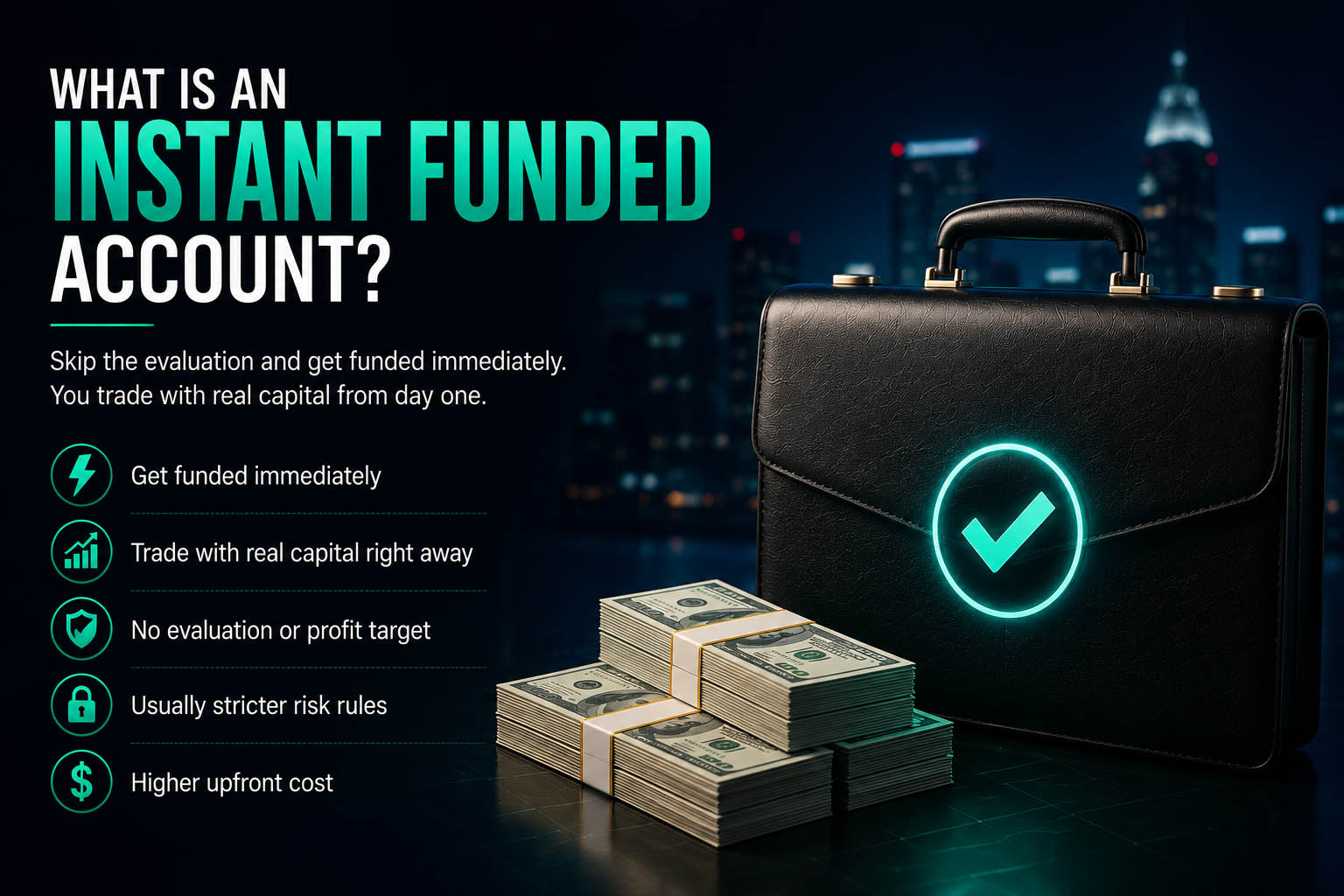
An instant funded account is a prop firm account where the trader does not need to complete the standard evaluation phase before trading. The firm gives you access to a funded-style account immediately after purchase, subject to that firm’s rules.
This sounds powerful, but there is a catch: instant funded accounts usually have stricter risk limits, payout conditions, consistency requirements, or lower starting payout percentages. The firm is giving you quicker access, so it normally protects itself with tighter rules.
Common Instant Funding Features
- No traditional challenge phase.
- Higher account purchase price compared with evaluations.
- Strict maximum daily loss and maximum drawdown limits.
- Possible payout minimum days, consistency requirements, or scaling restrictions.
- Some firms may offer lower leverage or smaller drawdown allowances.
What Is an Evaluation Account?
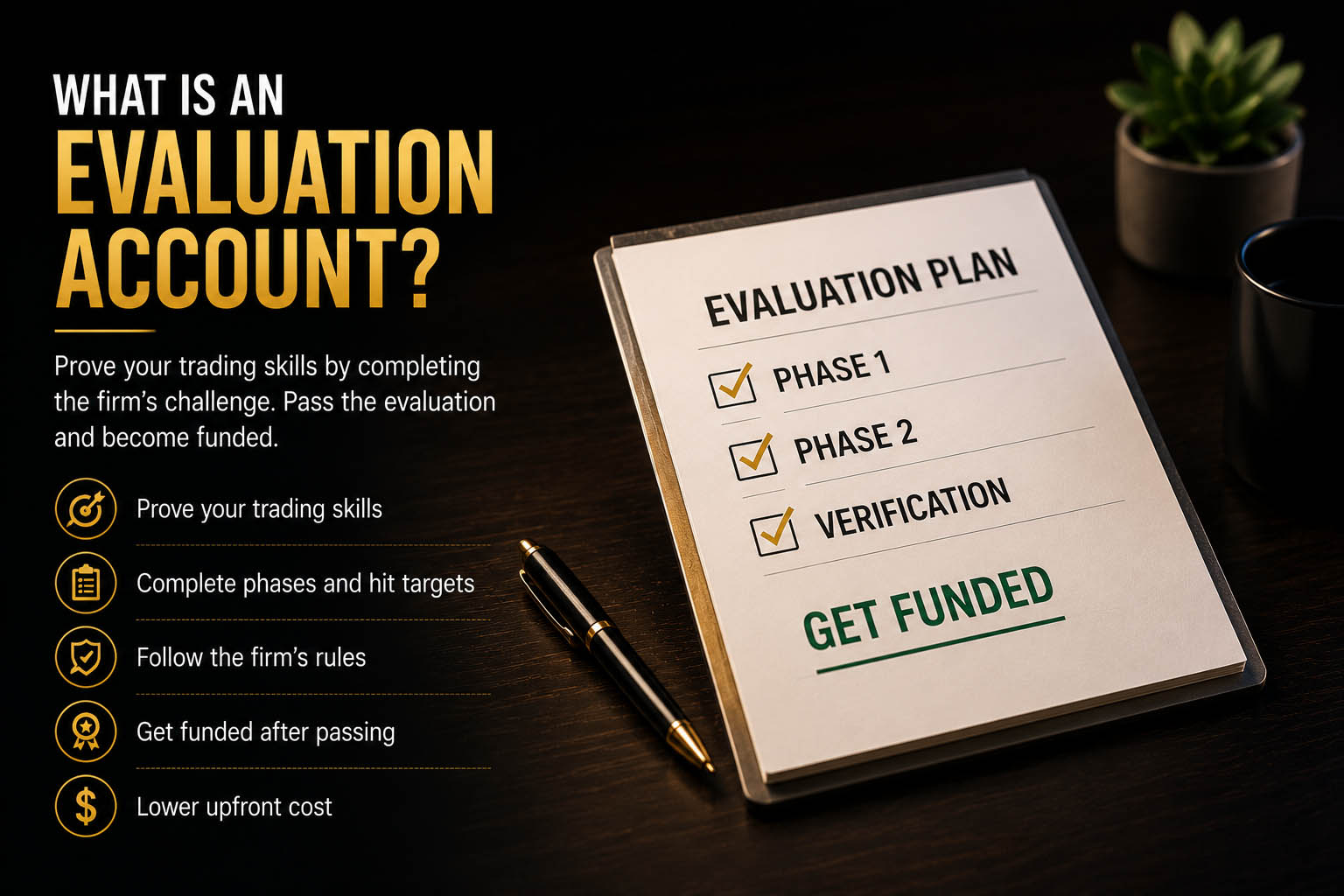
An evaluation account is the traditional prop firm challenge model. You purchase a challenge, trade within the firm’s rules, and must hit a profit target without breaking drawdown limits. If you pass the required phases, the firm gives you access to a funded account.
Evaluation accounts can be one-step or two-step, but the core idea is the same: prove that you can trade responsibly before managing the firm’s capital.
Common Evaluation Features
- Lower cost compared with most instant funded accounts.
- Profit target required before funded status.
- Risk limits apply during the challenge.
- Some accounts require minimum trading days.
- After passing, funded account rules may differ from challenge rules.
Before choosing an evaluation, make sure you understand how prop firm challenges work from purchase to funded account access.
Side-by-Side Comparison
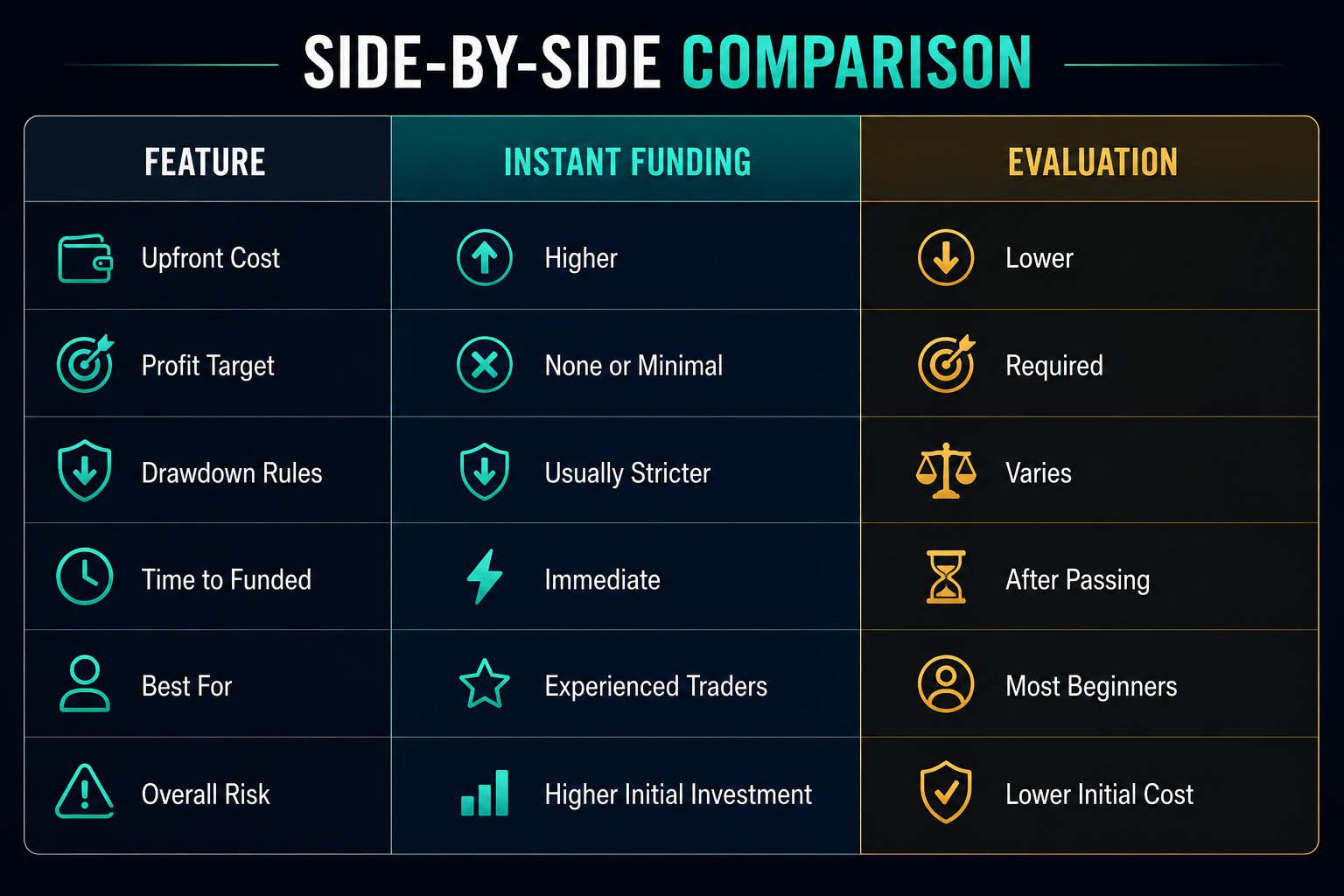
| Feature | Instant Funding | Evaluation Account |
|---|---|---|
| Speed to Account Access | Very fast. You usually start trading soon after purchase. | Slower. You must pass the challenge first. |
| Upfront Cost | Usually higher. | Usually lower. |
| Profit Target Before Funded | Usually none before account access. | Required during the challenge. |
| Drawdown Pressure | Often stricter because the firm is giving immediate access. | Varies by firm, but often easier to calculate upfront. |
| Best For | Experienced, disciplined traders with a proven system. | Beginners, developing traders, and anyone who wants a lower-cost path. |
| Main Risk | Paying more and losing the account quickly due to strict rules. | Failing before funded status because the profit target is too aggressive. |
| Psychological Pressure | High. You feel like real payout money is on the line immediately. | Moderate. You are proving yourself first, which can reduce pressure. |
Why Traders Choose Instant Funding
Instant funding is popular because it removes the waiting period. A trader who already has a proven strategy may prefer to skip the challenge and start working toward payouts immediately.
Instant Funding Can Make Sense If:
- You already have a consistent trading record.
- You understand drawdown rules extremely well.
- You can trade small and patient without forcing profits.
- You are not emotionally attached to getting paid immediately.
- You can afford the higher upfront fee without desperation.
Why Traders Choose Evaluations
Evaluations are slower, but they are usually the cleaner path for most traders. They give you a defined target, clear rules, and a lower-cost way to prove your system.
Evaluation Accounts Can Make Sense If:
- You are still developing consistency.
- You want a lower upfront cost.
- You need structure and accountability.
- You want to test your system under real prop firm rules.
- You are focused on long-term funding, not fast access.
The Hidden Cost Nobody Talks About
Traders often compare only the purchase price. That is a mistake. The real cost is not just the fee. The real cost is the combination of fee, difficulty, rule strictness, time pressure, and probability of failure.
| Cost Type | Why It Matters |
|---|---|
| Purchase Fee | The amount paid to access the account or challenge. |
| Rule Difficulty | A cheaper account can become expensive if the rules are unrealistic for your strategy. |
| Time Cost | A slower evaluation may still be better if it gives you a higher chance of passing. |
| Emotional Cost | Pressure can cause overtrading, revenge trading, and poor risk decisions. |
| Opportunity Cost | Buying the wrong account can delay your progress and waste capital that could have been used better. |
This is why you must compare profit targets, daily drawdown, and static vs trailing drawdown before buying.
Which One Fits Your Trading Style?
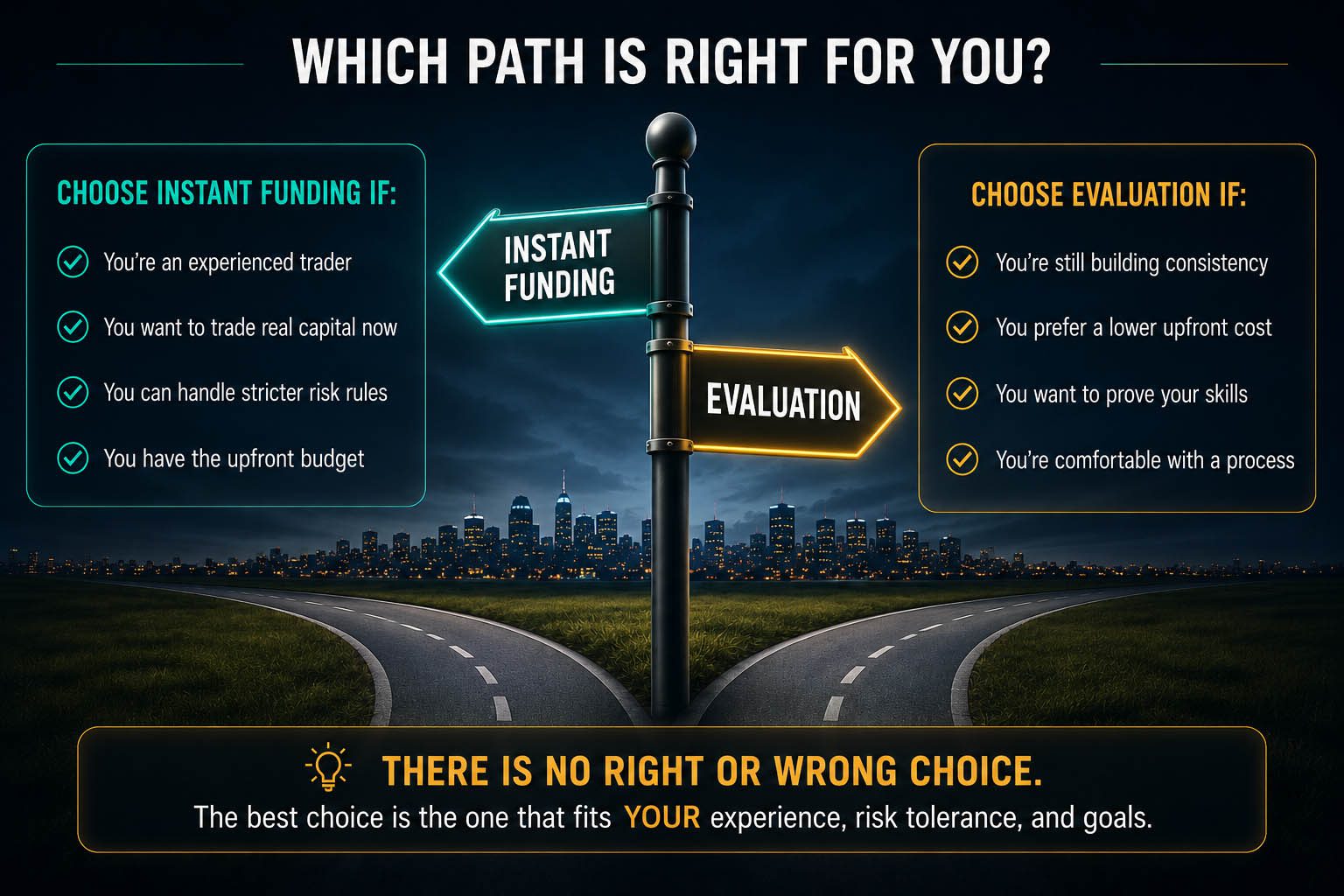
Choose Instant Funding If You Are…
- Already consistent over several months.
- Comfortable risking very small per trade.
- Patient enough to wait for clean setups.
- Experienced with prop firm rules.
- Not dependent on a quick payout.
Choose Evaluation If You Are…
- Still learning how prop firm rules work.
- Trying to build discipline.
- Working with a smaller budget.
- Testing a newer strategy.
- Focused on long-term consistency.
Real-World Examples
Example 1: The Impatient Trader
A trader buys an instant funded account because they want to get paid fast. They risk too much during the first week, hit a drawdown limit, and lose the account before ever requesting a payout. The problem was not the account type. The problem was unrealistic expectations.
Example 2: The Developing Trader
A newer trader chooses a two-step evaluation with a lower upfront cost. They trade smaller, focus on process, and use the challenge to improve discipline. Even if they do not pass the first time, they collect useful feedback about their strategy and risk management.
Example 3: The Professional Trader
An experienced trader with months of consistent results chooses instant funding because they already understand the risk rules. They trade conservatively, aim for steady payout eligibility, and treat the account like a business asset instead of a lottery ticket.
Common Mistakes New Traders Make
- Choosing instant funding because it sounds easier.
- Ignoring payout rules until after buying the account.
- Assuming “funded” means they can withdraw profits immediately.
- Buying the biggest account instead of the most manageable account.
- Failing to compare drawdown rules, consistency rules, and restricted trading styles.
- Trading too aggressively because the account feels like a shortcut.
This is why capital preservation must come before the desire for fast access.
Questions to Ask Before Buying
- What is the maximum daily loss?
- What is the maximum total drawdown?
- Is the drawdown static, trailing, or balance-based?
- Are there minimum trading days?
- Are there consistency rules?
- How soon can payouts be requested?
- Does the firm restrict news trading, holding overnight, or holding over weekends?
- Can my strategy realistically follow these rules?
- Can I afford to lose the fee without emotional pressure?
- Does this account support my long-term growth plan?
FAQ
Is instant funding really funded?
It depends on the firm and account structure. Many instant funding products give immediate access to a funded-style account, but payouts, rules, and scaling conditions still apply. Always read the full rulebook.
Are instant funded accounts easier than evaluations?
No. They may be faster, but faster does not mean easier. Instant funded accounts can have stricter payout requirements and tighter risk controls.
Which option is better for beginners?
Most beginners are better off starting with an evaluation because it costs less and teaches the discipline required to operate under prop firm rules.
Which option has better payout potential?
Both can lead to payouts. The better option depends on the firm’s rules, your risk management, and your ability to trade consistently.
Can I use the same strategy for both?
Sometimes, but not always. A strategy that works in an evaluation may need lower risk on an instant funded account because payout and drawdown rules may be stricter.
Knowledge Check Quiz
- What is the main advantage of instant funding?
Answer: Faster access to a funded-style account. - What is the main advantage of an evaluation account?
Answer: Lower upfront cost and a structured path to prove consistency. - Does instant funding mean guaranteed payout?
Answer: No. You still must follow payout rules and risk requirements. - Which account type is usually better for newer traders?
Answer: Evaluation accounts. - What should traders compare before buying?
Answer: Drawdown rules, payout rules, consistency rules, costs, and trading restrictions.
Key Takeaways
- Instant funding gives faster access, but it usually costs more and can come with stricter rules.
- Evaluation accounts are slower, but they are often better for learning discipline and reducing upfront risk.
- Neither option is automatically better. The right choice depends on your skill level, strategy, budget, and emotional control.
- Read the rulebook before buying any account.
- The best prop firm account is the one your trading plan can realistically survive.
Lesson Summary
Instant funding and evaluation accounts can both lead to payouts, but they are built for different types of traders. Instant funding offers faster access, usually with higher cost and stricter pressure. Evaluation accounts take longer, but often provide a better training ground for traders still building consistency. The smartest choice is not the fastest option. It is the account your trading plan can realistically survive.