
One-Step vs Two-Step Programs
Before you buy a prop firm challenge, learn how one-step and two-step programs compare across rules, pressure, timing, targets, drawdown, and payout conditions.
Lesson Goal
Before you buy a prop firm challenge, you need to understand the structure. A one-step program and a two-step program can both lead to funding, but the rules, pressure, timing, and risk are not the same.
The goal is not to choose the program that sounds fastest. The goal is to choose the program that gives your strategy the best chance of passing without forcing trades, breaking risk rules, or changing your trading behavior for the worse.
Main Goal
Understand which evaluation structure gives you the best chance of passing without forcing trades.
Core Skill
Compare rules, targets, drawdown, timing, and payout conditions before paying for a challenge.
Why This Lesson Matters
Many traders fail before they ever place a trade because they choose the wrong evaluation model. They see a large account size, a cheap price, or a fast payout advertisement, then rush into a challenge without studying the structure. That is not professional decision-making.
Prop firm evaluations are not all built the same. A one-step challenge may sound easier because there is only one phase, but that does not automatically make it safer. A two-step challenge may feel longer, but the targets and risk rules may be more forgiving.
Your job is to compare the whole rulebook, not just the headline. That means reviewing profit targets, daily drawdown, maximum loss, consistency rules, and payout requirements before buying.
What Is a One-Step Program?
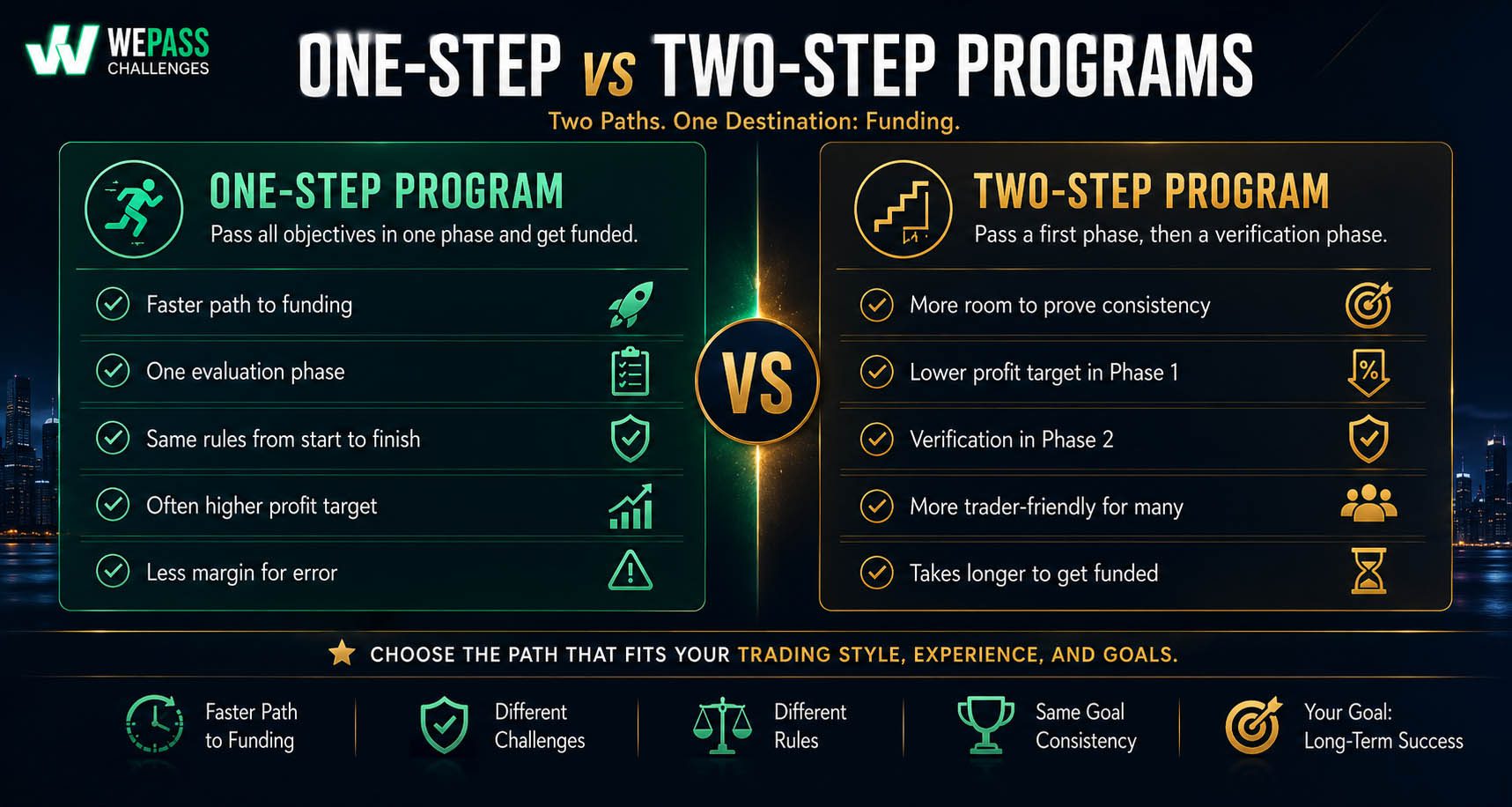
A one-step prop firm program is an evaluation where you usually need to complete one main challenge before becoming eligible for a funded account. Instead of passing Phase One and then Phase Two, you have a single evaluation stage with one profit target and one set of risk rules.
The attraction is simple: if you pass, you may reach funding faster. This is why one-step programs are popular with traders who already have a proven system, strong discipline, and experience following strict risk parameters.
Professional Note
One-step does not mean easy. It simply means fewer evaluation stages. The actual difficulty depends on the profit target, drawdown type, consistency rules, minimum trading days, and payout policy.
If you are newer to evaluations, review how prop firm challenges actually work before choosing a program structure.
What Is a Two-Step Program?
A two-step prop firm program requires you to pass two separate evaluation phases before receiving a funded account. The first phase usually has a higher profit target. The second phase usually has a lower profit target and is designed to confirm that your results were not luck or reckless overtrading.
Two-step programs are common because they give the firm more information about your consistency. From a trader’s perspective, they may feel slower, but they can be more manageable if the rules are balanced and the targets are realistic.
One-Step vs Two-Step: Side-by-Side Comparison
| Category | One-Step Program | Two-Step Program |
|---|---|---|
| Evaluation Length | Usually faster because there is only one phase. | Usually longer because you must pass two phases. |
| Pressure Level | Can feel higher because there is less room to prove consistency over time. | Can feel more structured because progress is separated into phases. |
| Profit Targets | May be higher or paired with stricter rules. | Often split between a higher Phase One and lower Phase Two target. |
| Best Fit | Experienced traders with a proven edge and strong discipline. | Traders who want a more traditional path and time to demonstrate consistency. |
| Main Risk | Traders may rush because funding feels close. | Traders may become impatient or overtrade during the second phase. |
Advantages and Disadvantages
Advantages of One-Step Programs
- Faster route to funding if you trade well.
- Less evaluation fatigue because there is only one main stage.
- Useful for experienced traders who already know their risk model.
- Can be attractive when the rules are simple and transparent.
Disadvantages of One-Step Programs
- Rules may be tighter than they first appear.
- Drawdown limits may leave less room for normal losing streaks.
- Higher pressure can cause traders to force setups.
- Some programs include hidden restrictions in the payout rules.
Advantages of Two-Step Programs
- More common structure across major prop firms.
- Often gives traders a clearer path to prove consistency.
- Phase Two may have a lower target than Phase One.
- Good for traders who prefer a measured approach.
Disadvantages of Two-Step Programs
- It takes longer to reach the funded stage.
- Psychological fatigue can build after passing Phase One.
- Some traders become careless because Phase Two feels easier.
- You must stay disciplined for a longer period.
The Real Question: Which One Fits Your Trading Style?
The right choice depends less on the label and more on your behavior as a trader. If you are patient, consistent, and already comfortable managing risk, either model can work. If you are still developing discipline, a slower program with clearer milestones may protect you from making emotional decisions.
Scalpers, day traders, swing traders, forex traders, futures traders, and index traders may all experience the same rules differently. A trailing drawdown can be difficult for one strategy but manageable for another. A minimum trading day rule can be annoying for an aggressive trader but helpful for someone learning patience.
Ask Yourself Before Buying
- Can my strategy realistically hit the profit target without overleveraging?
- Does the drawdown rule match the way my trades move?
- Am I disciplined enough to stop trading after a bad day?
- Do I understand the payout requirements before funding?
- Would this program still make sense during a losing streak?
Warning: Do Not Choose Based on Speed Alone
A faster path is only valuable if it does not push you into reckless trading. Many traders buy a one-step challenge because they want to get funded quickly, then fail because they trade too large, force entries, or ignore their own trading plan.
Professional traders do not choose challenges based on hype. They choose based on rules, probability, and sustainability.
Before choosing a faster program, make sure your professional trading plan can handle the pressure.
Decision Table: Which Program Should You Consider?
| Trader Profile | Better Starting Point | Reason |
|---|---|---|
| Beginner trader still building consistency | Two-Step | The phased structure encourages patience and discipline. |
| Experienced trader with verified performance | One-Step or Two-Step | Both can work if the rules match the trader’s strategy. |
| Trader who struggles with impatience | Two-Step | A slower process may reduce emotional decision-making. |
| Trader using high-risk, high-frequency entries | Depends on drawdown rules | The drawdown model matters more than the number of phases. |
Example Scenario
Imagine two traders, both buying a $100,000 prop firm challenge.
Trader A chooses a one-step program because it looks faster. The target is aggressive, and the drawdown rule is tight. After two losing trades, Trader A increases lot size to recover. The account fails in one week.
Trader B chooses a two-step program with realistic targets. Trader B risks small, accepts slow progress, and passes by following the same routine every day. The process takes longer, but the trader stays in control.
FAQ
Is a one-step prop firm challenge easier than a two-step challenge?
Not always. One-step programs can be faster, but they may have stricter targets, tighter drawdown, or more demanding payout conditions. Always compare the full rulebook.
Is a two-step program better for beginners?
Often, yes. The structure can help beginners focus on consistency instead of rushing. However, the firm’s rules still matter more than the label.
Which program gets funded faster?
A one-step program can lead to funding faster because there is only one evaluation stage. But speed should not be the main reason for choosing a challenge.
Should I choose the cheapest prop firm challenge?
No. Cheap pricing can be attractive, but rule quality, payout reliability, drawdown structure, and customer support matter. A cheap challenge with bad rules can become expensive quickly.
Knowledge Quiz
- What is the main difference between a one-step and two-step prop firm program?
- Why can a one-step program still be difficult even though it has fewer phases?
- What type of trader may benefit from a two-step program?
- Why should you compare drawdown rules before buying a challenge?
- What is more important than choosing the fastest route to funding?
Key Takeaways
- One-step programs can be faster, but faster does not always mean easier.
- Two-step programs can provide a more structured path for traders still developing consistency.
- The number of phases matters less than the profit target, drawdown model, payout rules, and trading restrictions.
- Never buy a challenge based only on price, account size, or marketing promises.
- The best prop firm program is the one that allows you to trade your strategy without breaking your risk plan.
Lesson Summary
One-step and two-step programs can both work, but neither one is automatically better. A one-step program can offer a faster path to funding, while a two-step program can provide a more structured evaluation process. The right choice depends on your trading style, discipline, risk tolerance, and ability to follow the rulebook without forcing trades.