
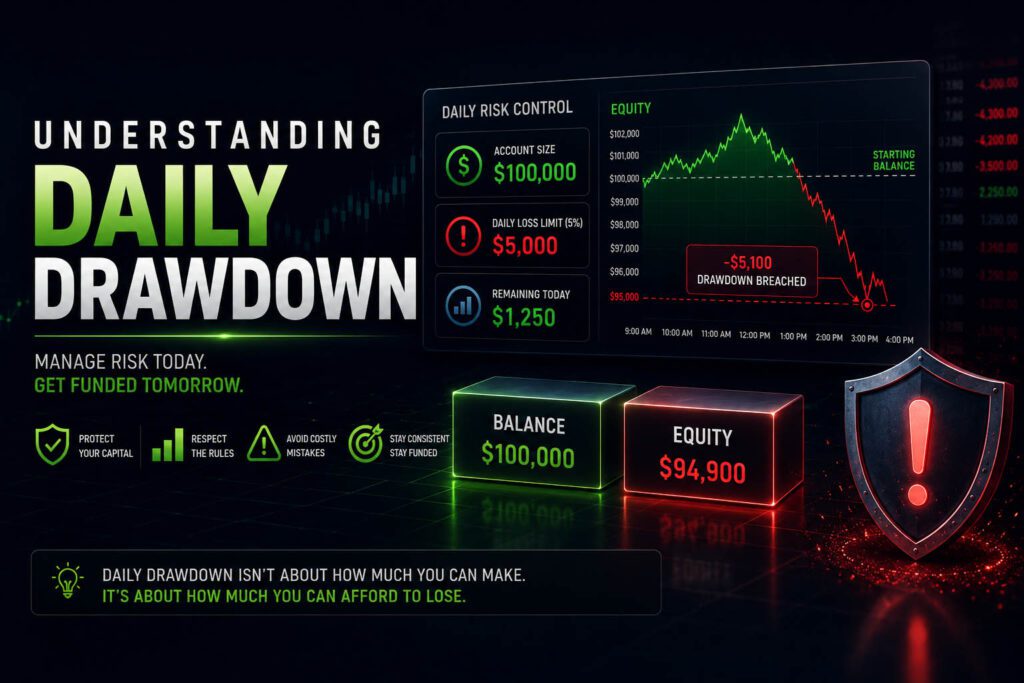
Understanding Daily Drawdown
Learn how daily drawdown works, why floating losses can breach an account, and how professional traders protect themselves before the firm’s daily loss limit is reached.
Lesson Goal
Ask experienced prop firm traders why most evaluations fail, and you’ll hear the same answer over and over again: daily drawdown. It isn’t bad entries or poor analysis that usually ends a challenge. It’s poor risk management and a misunderstanding of how daily loss limits actually work.
Many traders believe they’re safe because they’re only down a small amount on the day. Then one trade moves against them, their floating loss exceeds the firm’s daily limit, and the account is automatically breached. In many cases, they didn’t even realize it happened until it was too late.
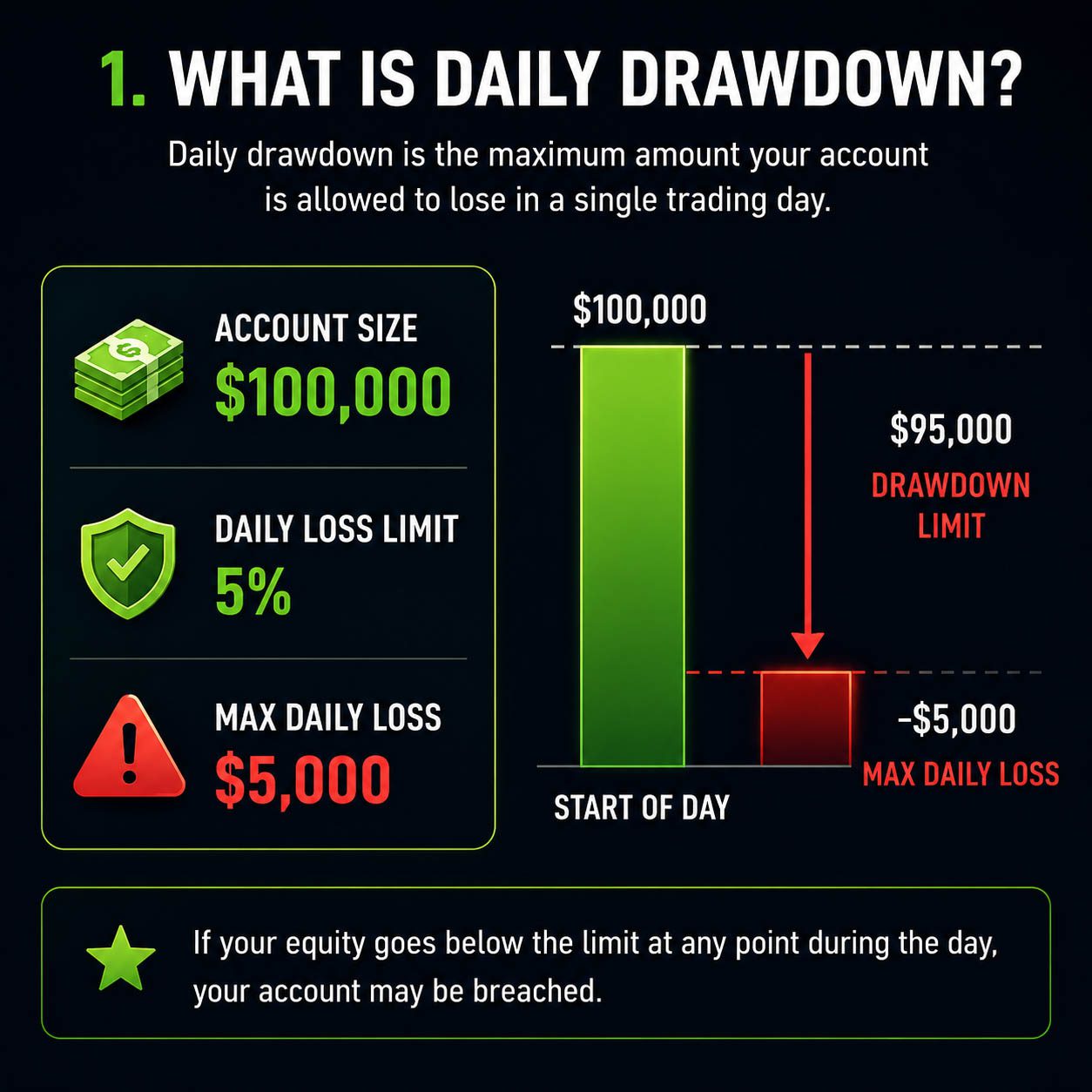
What Is Daily Drawdown?
Daily drawdown is the maximum amount your account is allowed to lose during a single trading day. If your losses exceed this limit — even for a moment — many prop firms will consider your account breached.
The exact calculation varies between firms. Some measure drawdown from your starting balance for the day, while others calculate it from your highest equity or your previous day’s closing balance. This is why reading the firm’s rulebook is critical.
| Rule | Example |
|---|---|
| Starting Balance | $100,000 |
| Daily Loss Limit | 5% |
| Maximum Daily Loss | $5,000 |
This rule is closely connected to maximum daily loss, which every funded trader needs to understand before taking a challenge.
Balance vs Equity
One of the biggest sources of confusion is the difference between balance and equity.
| Balance | Equity |
|---|---|
| Closed trade results only | Balance + floating P/L |
| Doesn’t move until trades close | Changes every tick |
Many firms calculate daily drawdown using equity. That means an open losing position can fail your account before you ever close the trade.
Floating Drawdown
Floating drawdown refers to losses on trades that are still open. Traders often ignore floating losses because “the trade isn’t closed yet.” Unfortunately, many prop firms don’t ignore them.
Example
Your account starts at $100,000. Your daily loss limit is $5,000. You open a position that temporarily drops to -$5,100 before recovering. Even if the trade eventually closes in profit, many firms would already consider the account breached because your equity exceeded the daily drawdown limit.
This is why proper position sizing matters so much. If your lot size is too large, a normal floating loss can become a rule violation.
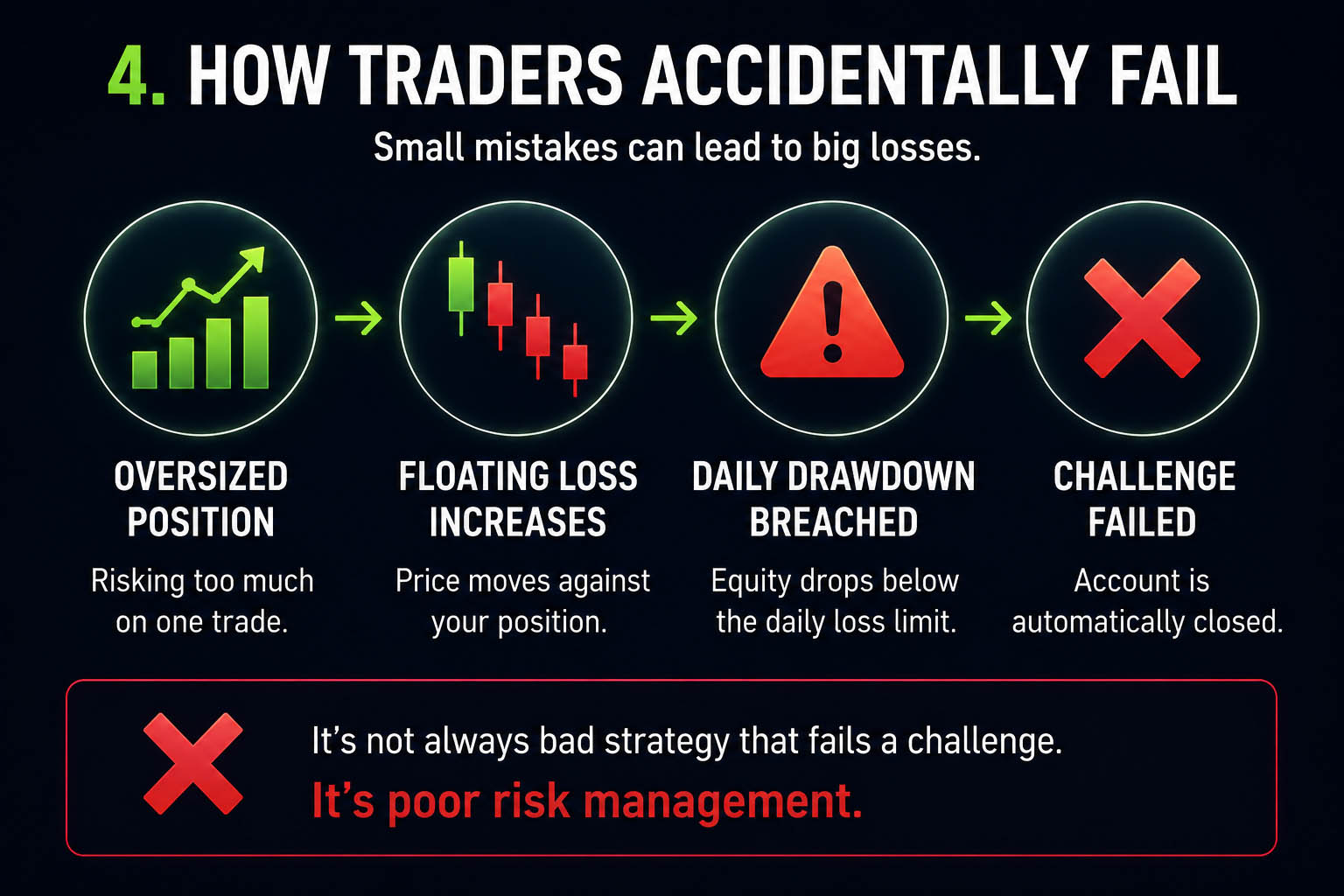
Why Traders Accidentally Fail
Most drawdown violations don’t happen because traders intentionally break the rules. They happen because traders underestimate risk, add to losing positions, move stop losses farther away, or refuse to close losing trades.
Common Reasons
- Trading too large
- Moving stop losses
- Holding losing positions too long
- Averaging down
- Ignoring floating losses
- Revenge trading after losses
These mistakes are also covered in common rules that get traders disqualified, because daily drawdown breaches are one of the fastest ways to fail an evaluation.
How Professionals Protect Daily Drawdown
Professional traders rarely trade anywhere near the firm’s maximum daily loss. Instead, they create their own personal stop long before the firm’s rule is reached.
| Firm Rule | Professional Rule |
|---|---|
| 5% Daily Drawdown | Stop trading after 2% |
Professional Tip
Never allow the prop firm to decide when your trading day ends. Decide that yourself well before the maximum loss limit.
This mindset should be written into your professional trading plan. If your daily stop is not defined before the session begins, emotions will define it for you.
Daily Drawdown Checklist
- Know your firm’s calculation method.
- Know whether floating losses count.
- Use stop losses.
- Risk less than the maximum allowed.
- Have your own daily stop.
- Walk away after reaching it.
Daily Drawdown vs Maximum Drawdown
Daily drawdown controls how much damage can happen in one trading day. Maximum drawdown controls how much damage can happen across the full life of the account.
| Daily Drawdown | Maximum Drawdown |
|---|---|
| Applies to one trading day | Applies to the account overall |
| Can reset daily depending on firm rules | Usually follows the account throughout the challenge |
| Often triggered by equity and floating losses | May be static, trailing, or end-of-day based |
Lesson Quiz
- What is daily drawdown?
- What’s the difference between balance and equity?
- Can floating losses count toward daily drawdown?
- Why do professionals stop trading before reaching the firm’s limit?
- What causes most drawdown violations?
Lesson Summary
Daily drawdown is one of the most important rules in prop firm trading. Understanding how it is calculated — and creating your own stricter personal loss limits — can dramatically improve your chances of passing a challenge. The best traders don’t trade up to the maximum allowed risk; they stay comfortably below it.