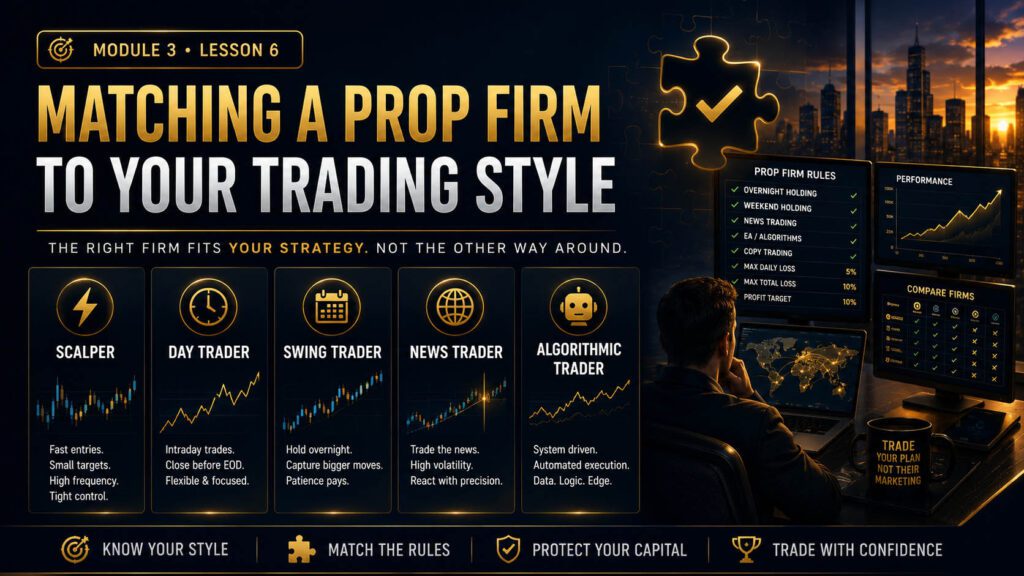
Matching a Prop Firm to Your Trading Style
There is no single best prop firm for every trader. The best funding partner is the one that matches how you already trade, manage risk, hold trades, and execute your strategy.
Learning Objectives
- Understand why no prop firm is perfect for every trader.
- Learn which rules matter most for scalpers, day traders, swing traders, news traders, algorithmic traders, and agile traders.
- Know which restrictions can hurt your strategy before you buy.
- Compare platforms, spreads, commissions, holding rules, and payout policies.
- Build a checklist for matching a prop firm to your natural trading style.
- Choose a firm based on rule fit instead of hype, discounts, or account size.
One Size Does Not Fit All
Many beginners ask, “What is the best prop firm?” That is the wrong question.
Professional traders ask, “Which prop firm matches my strategy?” That small shift changes everything. A firm that works perfectly for a scalper may be terrible for a swing trader. A firm that allows overnight holds may still be bad for a news trader if it restricts trading around major releases.
Your goal is not to find the most popular firm. Your goal is to find the firm that allows you to trade your system without constantly bending your rules.
This is why choosing a firm should include time limits, drawdown type, payout rules, platform access, and trading restrictions — not just price.
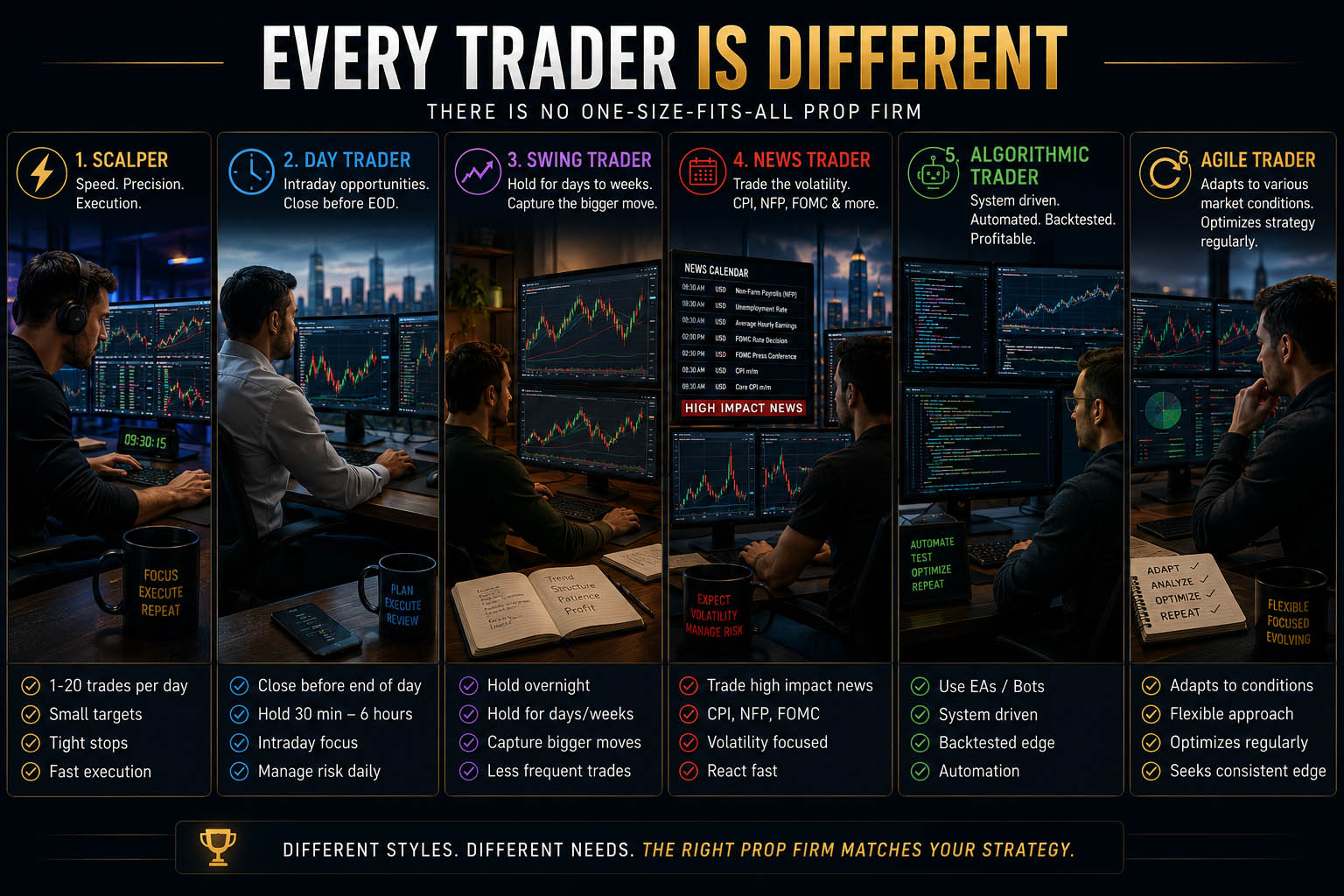
Scalpers: Fast Entries, Small Targets, Tight Rules
Scalpers usually take multiple trades per day. They may hold trades for seconds or minutes and target small moves. Because scalpers depend on execution quality, they need a firm with tight spreads, fast fills, and a fair commission structure.
Scalpers Need
- Tight spreads.
- Fast execution.
- No minimum holding time.
- Low commissions.
- Low slippage during active sessions.
- Reliable MT5, TradeLocker, or futures platform access.
Scalpers Should Avoid
- Minimum trade duration rules.
- Wide spreads.
- Delayed fills.
- High commissions.
- Restrictions on high-frequency entries.
- Firms with unclear execution policies.
Day Traders: Flexibility Without Overnight Exposure
Day traders usually enter and exit during the same session. They may hold positions for 30 minutes to several hours, but they do not normally hold overnight. This style needs clean intraday conditions, fair drawdown rules, and enough flexibility to manage trades during London or New York sessions.
Day Traders Should Look For
- Reasonable daily loss limits.
- Low spreads during major sessions.
- Clear news rules.
- No forced overnight holding.
- Flexible trade management.
- Fast payout cycles if trading actively.
Daily traders should also understand daily drawdown, because one bad session can end an otherwise solid evaluation.
Swing Traders: Holding Time Is Everything
Swing traders may hold trades overnight or across multiple days. Some may hold positions over the weekend. That means they must be careful with firms that ban overnight holding, weekend holding, or certain market exposure around major news.
Swing Traders Need
- Overnight holding allowed.
- Weekend holding allowed if the strategy requires it.
- Unlimited time evaluations.
- Fair swap, commission, or futures holding conditions.
- Drawdown rules that allow normal trade fluctuation.
Swing Traders Should Avoid
- Mandatory end-of-day close rules.
- Weekend close restrictions.
- Short time limits.
- Tight trailing drawdown.
- Rules that punish normal floating drawdown.
This is where static vs trailing drawdown becomes important. Swing traders usually need enough room for normal floating drawdown.
News Traders: Read the Event Rules First
News traders focus on major economic events like CPI, NFP, FOMC, rate decisions, unemployment reports, and inflation data. Some prop firms allow news trading. Others ban opening, closing, or holding trades around major releases.
This is one of the easiest ways to lose an account by mistake. A trader may win a trade during news and still violate the firm’s rules.
| News Rule | What It Means | Risk |
|---|---|---|
| News Trading Allowed | You can trade during major releases. | Execution may still be volatile. |
| No Opening Around News | You cannot open trades before or after restricted events. | Entering too close to news may violate rules. |
| No Closing Around News | You may not close trades during restricted windows. | Manual exits can create violations. |
| No Holding Through News | Trades must be closed before major events. | Swing and day trades may need adjustment. |
Algorithmic Traders: EA, VPS, and Copy Trading Rules
Algorithmic traders use expert advisors, bots, trade copiers, VPS setups, or semi-automated systems. This style can work well with prop firms, but only if the firm allows your specific setup.
Algo Traders Should Check
- Are expert advisors allowed?
- Is copy trading allowed?
- Can you use a VPS?
- Are trade copiers allowed between personal and prop accounts?
- Are grid, martingale, latency arbitrage, or tick scalping systems banned?
- Does the platform support your EA or automation tools?
EA and copy trading policies are also part of the common rules that get traders disqualified, so they need to be confirmed before the account is purchased.
Agile Traders: Adapting Without Losing Discipline
Agile traders adjust their approach based on market conditions. They may scalp during high-liquidity sessions, day trade clean intraday trends, step back during choppy price action, or swing trade when the market offers a larger directional opportunity.
This does not mean random trading. A true agile trader has rules for when to adapt, when to reduce risk, and when to avoid the market completely. Because their style is flexible, they need a prop firm with broad permissions and clear rules.
Agile Traders Need
- Flexible trading rules.
- Multiple instruments available.
- Clear news, overnight, and weekend rules.
- Reasonable drawdown that allows strategy changes.
- Reliable execution across different market conditions.
- Enough freedom to optimize strategy regularly.
Agile Traders Should Avoid
- Firms with unclear restrictions.
- Rules that punish changing position frequency.
- Very tight consistency rules.
- Limited instruments that restrict opportunity.
- Overly strict news or holding limitations.
- Any firm that forces one narrow trading style.
Trading Style vs Prop Firm Rules
| Trading Style | Best Rules to Look For | Rules to Avoid |
|---|---|---|
| Scalper | Tight spreads, fast fills, no minimum hold time | Wide spreads, delayed execution, minimum hold rules |
| Day Trader | Flexible intraday rules, clear daily loss, unlimited time | Strict time limits, confusing daily drawdown, poor execution |
| Swing Trader | Overnight and weekend holding allowed, unlimited time | Forced daily close, weekend bans, tight trailing drawdown |
| News Trader | News trading allowed or clearly defined | News bans, unclear event windows, no holding through releases |
| Algorithmic Trader | EA allowed, VPS allowed, stable platform | Bot restrictions, copy trading bans, prohibited strategies |
| Agile Trader | Flexible rules, multiple instruments, clear restrictions, room to adapt | Overly narrow rules, strict consistency limits, unclear permissions |
Platform Fit: MT5, TradeLocker, Futures, and More
The platform matters because execution, charting, trade management, and automation tools can change your results. Do not choose a firm only because the account looks cheap. Make sure the platform supports how you trade.
Forex/CFD Traders
Popular for forex, indices, gold, and EAs. Check symbol names, spreads, leverage, and broker feed.
TradeLocker
Modern interface for manual traders. Make sure your workflow and order entry style fit the platform.
Futures Platforms
Used for futures prop firms. Rules may include trailing drawdown, daily loss, and consistency requirements.
Questions to Ask Before Buying
- Does the firm allow my trading style?
- Can I hold trades overnight?
- Can I hold trades over the weekend?
- Can I trade news events?
- Are EAs or bots allowed?
- Is copy trading allowed?
- Is hedging allowed?
- Can I use multiple accounts?
- Does the platform support my strategy?
- Are spreads, commissions, and slippage realistic for my targets?
- Does the drawdown rule fit my normal losing streaks?
- Does the firm give me enough flexibility to adapt when market conditions change?
- Does the payout schedule fit my goals?
The Cheapest Account Is Not Always the Best Account
Many traders fail because they buy the cheapest challenge instead of the account that actually matches their trading style. Cheap can become expensive if the rules force you into bad decisions.
A slightly more expensive account with better rules, better execution, and better payout conditions can be the smarter long-term choice.
This is why comparing the full structure from profit splits, scaling plans, and payouts matters before making a decision.
Professional Example
A swing trader buys a cheap challenge without reading the rules. The account does not allow weekend holding. Their best setups usually take two to four days to develop, and some trades naturally remain open over the weekend.
Now the trader has two bad choices: close good trades too early or violate the rules. The problem is not the strategy. The problem is that the trader chose the wrong firm for that strategy.
FAQ
Which prop firm is best for scalpers?
The best firm for scalpers is one with tight spreads, fast execution, low commissions, no minimum hold time, and clear rules around high-frequency trading.
Which prop firm is best for swing traders?
Swing traders should look for firms that allow overnight and weekend holding, offer unlimited time, and have drawdown rules that allow normal floating losses.
Can algorithmic traders use prop firms?
Yes, but only if the firm allows EAs, trade copiers, VPS usage, and the specific strategy type being used. Always check prohibited strategies.
What is an agile trader?
An agile trader adapts to different market conditions and optimizes their strategy regularly while still following a defined risk plan.
What kind of prop firm fits an agile trader?
Agile traders usually need firms with flexible rules, multiple instruments, clear news and holding policies, and enough room to adjust between different market conditions.
Can I trade news on a prop firm account?
It depends on the firm. Some allow news trading, while others restrict opening, closing, or holding trades around major events.
Can I use multiple prop firms?
Yes, many traders use multiple firms to diversify opportunity. However, you must understand each firm’s copy trading, allocation, and risk rules.
Should I change my strategy to fit a prop firm?
Small adjustments are normal, but completely changing your strategy just to fit a firm’s rules is usually a bad idea.
Knowledge Check Quiz
- What is the right question to ask when choosing a prop firm?
Answer: Which firm matches my trading strategy? - What do scalpers need most?
Answer: Tight spreads, fast execution, low commissions, and no minimum hold time. - What do swing traders need?
Answer: Overnight and weekend holding allowed, plus enough time for trades to develop. - Why must news traders read event rules?
Answer: Some firms restrict opening, closing, or holding trades around major news. - What should algorithmic traders check?
Answer: EA rules, VPS rules, copy trading rules, and prohibited strategy rules. - What is an agile trader?
Answer: A trader who adapts to various market conditions and optimizes strategy regularly. - What kind of rules do agile traders need?
Answer: Flexible rules, clear restrictions, multiple instruments, and room to adapt. - Why is the cheapest account not always best?
Answer: Bad rule fit can make the account harder to pass and easier to lose. - What platform factors matter?
Answer: Execution, spreads, commissions, automation support, and order management. - Should you force your strategy to fit a firm?
Answer: No. Choose a firm that fits your strategy whenever possible. - What should day traders look for?
Answer: Clear intraday rules, fair drawdown, low spreads, and flexible trade management. - What is the professional rule?
Answer: Trade your strategy, not the firm’s marketing.
Key Takeaways
- There is no universally best prop firm.
- Your trading style determines the best firm for you.
- Scalpers need speed, tight spreads, and no hold restrictions.
- Swing traders need overnight and weekend flexibility.
- News traders must understand event restrictions.
- Algorithmic traders must confirm EA, VPS, and copier rules.
- Agile traders need flexible rules that allow them to adapt to various market conditions.
- Never buy based only on price, account size, or profit split.
- Choose the account that lets your edge work naturally.
Lesson Summary
The best prop firm is not the most popular, cheapest, or fastest one. It is the firm that fits your trading style. Scalpers need execution quality. Swing traders need holding flexibility. News traders need clear event rules. Algorithmic traders need platform and automation permission. Agile traders need flexible rules that allow them to adapt without losing discipline. When the firm fits the strategy, the trader can focus on execution instead of fighting the rulebook.