

Consistency Rules Explained: The Hidden Rule That Surprises Most Traders
Learn how prop firm consistency rules work, why one big winning day can create compliance problems, and how professional traders pass with steady, controlled progress.
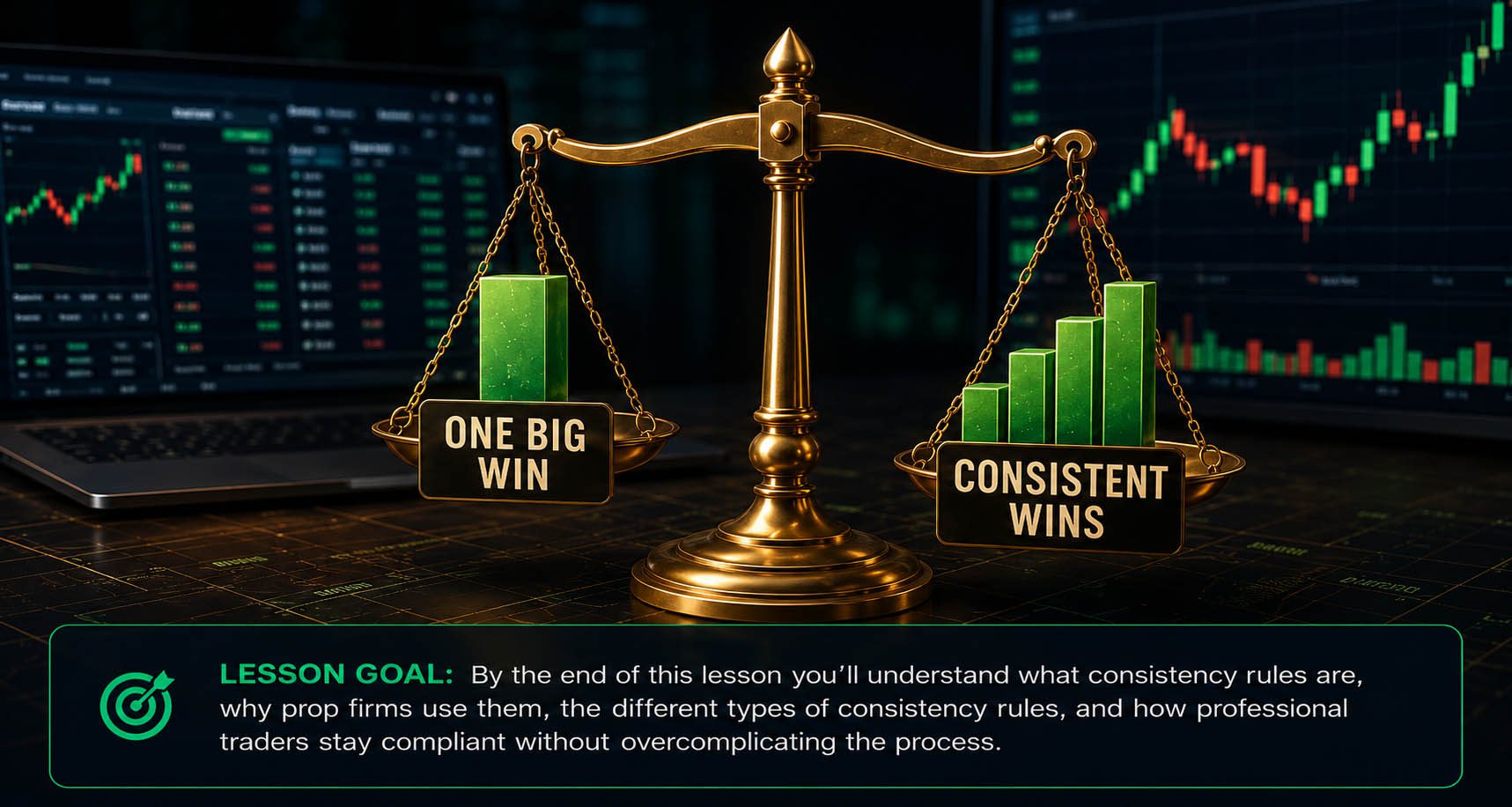
Lesson Goal
Many traders believe passing a prop firm challenge is simply about reaching the profit target. That is only partly true. Some prop firms also require your profits to be earned consistently instead of coming from one oversized trade or one lucky trading day.
This is called a consistency rule, and it catches a lot of traders off guard. You can hit the profit target, avoid daily drawdown, avoid maximum loss, and still not qualify because your profits were too concentrated in one day.
What Is a Consistency Rule?
A consistency rule is a prop firm rule designed to prevent traders from passing a challenge with one oversized win. Instead of rewarding one lucky trade, the firm wants to see steady, repeatable performance.
The exact rule depends on the firm. Some use a 20%, 30%, 40%, or 50% rule. Others do not use consistency rules at all. That is why you need to review the rulebook before buying a challenge.
This is one of the most overlooked prop firm rules that get traders disqualified because traders often do not notice it until after they have already reached the target.
30% Consistency Rule Example
Let’s say your challenge requires a $10,000 profit target and has a 30% consistency rule. That means no single trading day should account for more than 30% of your total profit.
| Profit Target | Consistency Rule | Max From One Day |
|---|---|---|
| $10,000 | 30% | $3,000 |
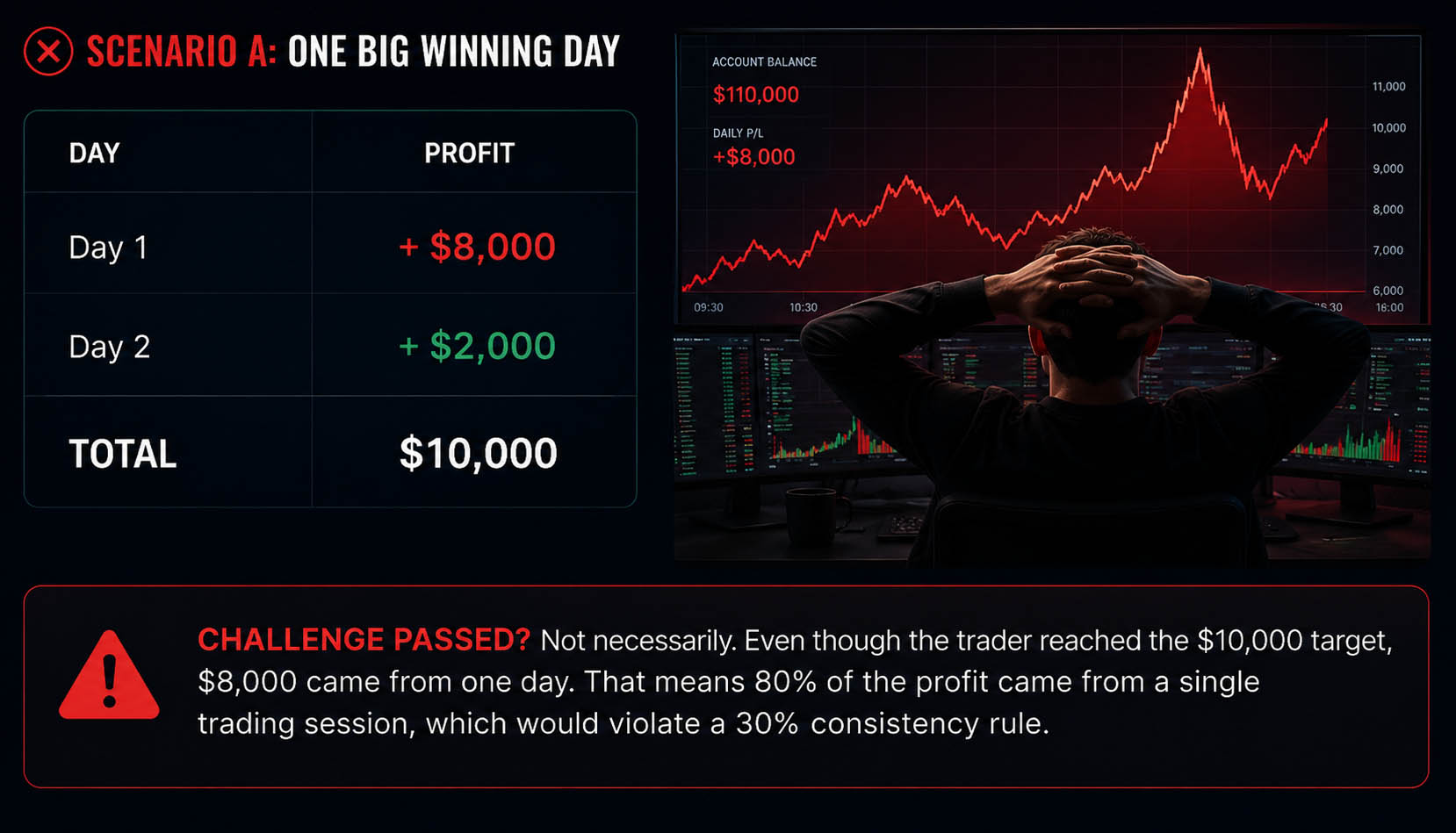
Scenario A: One Big Winning Day
| Day | Profit |
|---|---|
| Day 1 | +$8,000 |
| Day 2 | +$2,000 |
| Total | $10,000 |
Challenge Passed?
Not necessarily. Even though the trader reached the $10,000 target, $8,000 came from one day. That means 80% of the profit came from a single trading session, which would violate a 30% consistency rule.
This is why chasing one giant day can be dangerous. It may look impressive on the dashboard, but it can create a rule problem.
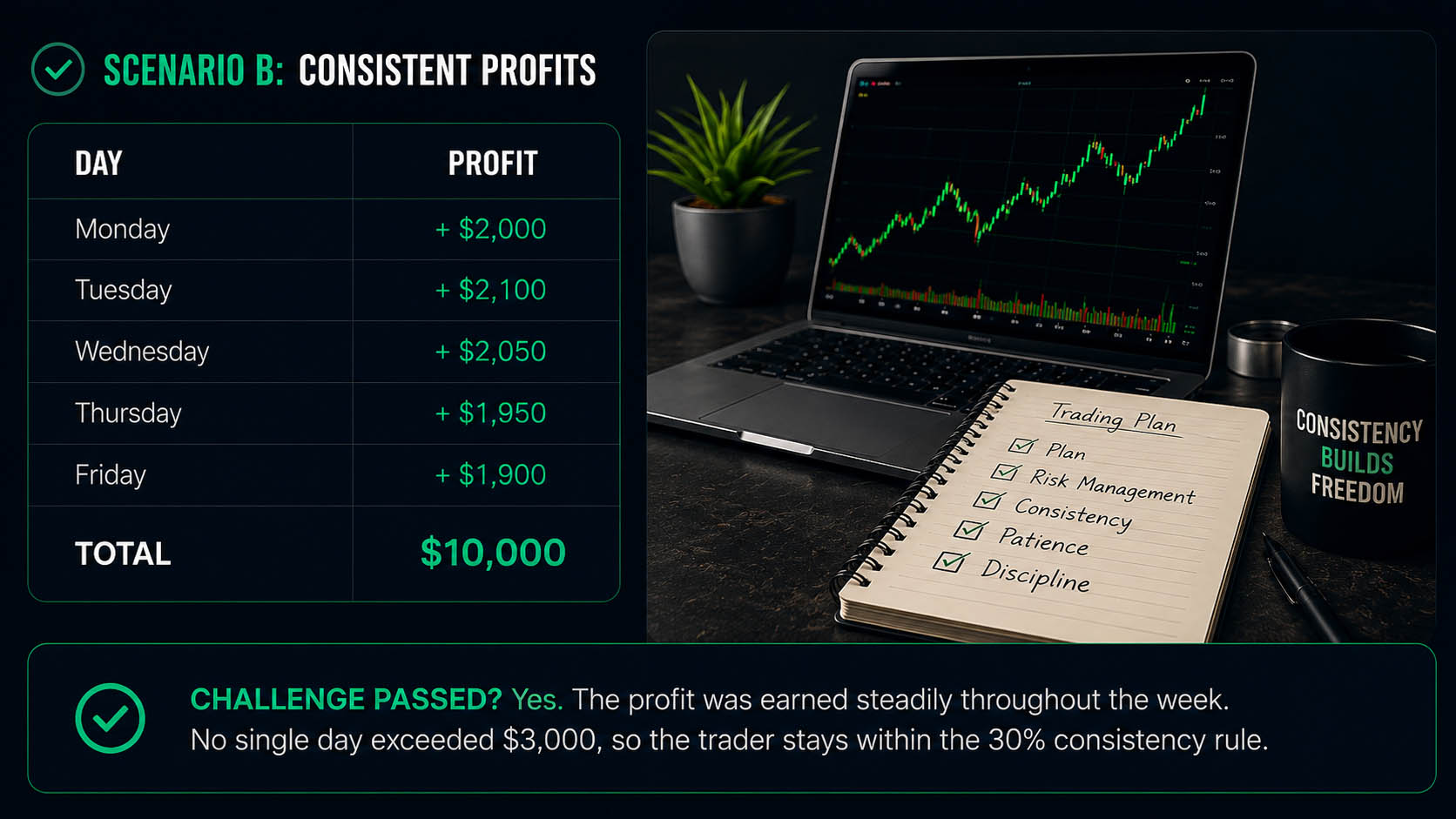
Scenario B: Consistent Profits
| Day | Profit |
|---|---|
| Monday | +$2,000 |
| Tuesday | +$2,100 |
| Wednesday | +$1,900 |
| Thursday | +$2,000 |
| Friday | +$2,000 |
| Total | $10,000 |
Challenge Passed?
This is much cleaner. No single day dominates the total profit. The results are spread out, controlled, and more likely to satisfy a consistency requirement.
Why Do Prop Firms Use Consistency Rules?
Prop firms are not looking for gamblers. They want traders who can repeat a process. A trader who makes $8,000 in one day may look impressive, but it can also suggest oversized risk, news gambling, emotional trading, or luck.
Consistency rules push traders toward smoother performance. The goal is not to make one heroic trade. The goal is to show that your trading approach can survive more than one lucky moment.
Large One-Day Gains Can Signal:
- Oversized positions
- High leverage
- News gambling
- Revenge trading
- Random luck instead of repeatable process
Professional traders avoid this by using controlled position sizing and planning the challenge around steady progress.
Different Types of Consistency Rules
Not every consistency rule works the same way. Some firms focus on daily profit. Others look at individual trades, position size, or unusual changes in risk.
1. Daily Profit Consistency
Your largest winning day cannot exceed a certain percentage of your total profit.
2. Trade Consistency
Some firms may review whether one individual trade produced most of your results.
3. Position Size Consistency
Some firms may flag traders who suddenly jump from normal position sizing to oversized lots or contracts.
4. Payout Consistency
Some firms apply consistency rules during payout eligibility, meaning clean performance still matters after passing.
Example Red Flag
A trader uses 0.50 lots, 0.50 lots, 0.50 lots, then suddenly jumps to 12.00 lots to hit the target. That is exactly the kind of behavior consistency rules are designed to discourage.
The Biggest Mistake Traders Make
The biggest mistake is not knowing the rule exists. Traders often celebrate after one huge winning day, only to discover they are not actually compliant yet.
In some cases, they need to continue trading until the large winning day becomes a smaller percentage of the total profit. That creates a dangerous situation because now the trader is forced to keep trading after already reaching the target.
Quick Truth
One big winning day may feel good, but steady profits are usually what pass challenges cleanly.
This is why understanding consistency rules belongs inside your professional trading plan before the first trade is placed.
The Professional Approach
Professional traders do not aim for one giant day. They aim for dozens of controlled days. They are not trying to impress the dashboard. They are trying to stay alive long enough to get funded and eventually reach payouts.
Small, consistent wins may not feel exciting, but they build stronger funded traders. One giant win can create pressure, emotional attachment, and unnecessary rule problems.
Professional Consistency Habits
- Use consistent position sizing
- Avoid oversized trades
- Break profit targets into smaller daily goals
- Stop trading after strong progress
- Track the largest winning day
- Review the rulebook before scaling risk
These habits also help protect daily drawdown and maximum drawdown, because consistency usually comes from controlled risk.
How We Manage Consistency at WePassChallenges
At WePassChallenges, one of the first things we review before managing an evaluation is whether the firm has a consistency requirement. This matters because every firm has different rules, and the trading plan must match the account structure.
Our approach is built around controlled progress, drawdown protection, and rule-aware execution. The goal is not to pass in the flashiest way possible. The goal is to pass cleanly, protect the account, and avoid unnecessary violations.
Our View
Consistency is not just a prop firm rule. It is the foundation of serious trading.
That means the goal is not just to hit the target. The goal is to hit it while staying compliant with the firm’s rulebook.
Pre-Challenge Consistency Checklist
- Does the firm have a consistency rule?
- Is the rule based on daily profit?
- Is the rule based on individual trades?
- Does the firm monitor position size?
- Are there minimum trading days?
- Are there news restrictions?
- Do payout rules include consistency requirements?
Key Takeaways
- Consistency rules prevent traders from passing with one lucky oversized win. They reward controlled, repeatable performance.
- Some rules limit how much profit can come from one day or one trade. Others may monitor position size or payout behavior.
- Not all prop firms use consistency rules. Always check before buying a challenge.
- One big winning day can create compliance problems. Reaching the target is not enough if the profit distribution breaks the rule.
- Professional traders prefer steady progress over emotional spikes. Clean performance is easier to defend.
- Always review the firm’s exact rulebook before buying a challenge. Rules can vary dramatically between firms.
Lesson Quiz
- What is a consistency rule?
- Why do prop firms use consistency rules?
- Can one large winning day prevent you from passing?
- Do all prop firms use consistency rules?
- Why do professional traders prefer steady profits over one oversized gain?
Lesson Summary
Consistency rules are designed to reward disciplined trading instead of lucky oversized wins. While not every prop firm uses them, understanding how they work is essential before purchasing a challenge. The traders who pass most cleanly are rarely the ones chasing massive days. They are the ones who build profits gradually, protect drawdown, manage position size, and respect every rule.