
One-Step vs Two-Step Prop Firm Challenges
Learn the difference between one-step and two-step prop firm challenges, how each model works, and which evaluation structure fits your trading style best.
Learning Objectives
- Understand the difference between one-step and two-step prop firm challenges.
- Learn how each evaluation model works.
- Compare profit targets, cost, pressure, and verification requirements.
- Understand which model may fit your trading personality.
- Identify the hidden risks of choosing the wrong challenge.
- Learn why faster does not always mean better.
- Build a professional decision framework before buying.
- Avoid common beginner mistakes when choosing an evaluation.
One-Step vs Two-Step Prop Firm Challenges
One-step vs two-step prop firm challenges can look like a simple choice at first. One step sounds faster. Two steps sound harder. But in reality, the better option depends on how you trade.
The best prop firm challenge is not always the fastest one. The best challenge is the one that gives your strategy the highest chance of surviving the rulebook.
Choosing the wrong evaluation structure can make passing much harder than it needs to be. A trader who needs time and lower pressure may struggle with a one-step model. A trader who is experienced and consistent may find a two-step model too slow.
Before choosing either model, make sure you understand how prop firm challenges work and what the firm is testing.
What Is a One-Step Challenge?
A one-step challenge requires only one evaluation before funded account access. If you hit the profit target without violating any rules, you pass that evaluation and may move directly toward funded status.
There is no second verification stage. This is why one-step prop firm challenges are attractive to traders who want a faster path to funding.
Advantages of One-Step Challenges
- Only one evaluation phase.
- Faster path to funding.
- Simpler overall process.
- Less waiting between stages.
- Can be attractive for experienced traders.
Disadvantages of One-Step Challenges
- Often higher purchase price.
- Usually higher psychological pressure.
- May have tighter rules.
- Less room for mistakes.
- Can encourage traders to rush.
How a One-Step Challenge Works
In a one-step challenge, the trader usually purchases the evaluation, receives account credentials, trades toward the profit target, and must avoid all rule violations.
If the trader completes the requirements successfully, the firm may approve the account for funded access or payout eligibility, depending on the firm’s rules.
Typical One-Step Process
- Purchase the challenge.
- Trade the evaluation account.
- Reach the required profit target.
- Avoid daily and maximum drawdown violations.
- Complete minimum trading days if required.
- Move toward funded account access.
This structure is simple, but the pressure can be intense because there is only one phase standing between you and funded status.
What Is a Two-Step Challenge?
A two-step challenge separates the evaluation into two phases. First, you complete the initial challenge. Then you complete a second verification phase before receiving funded account access.
Although this takes longer, many traders perform better with a two-step challenge because the process feels more structured and less rushed.
Advantages of Two-Step Challenges
- Usually lower entry cost.
- More structured evaluation process.
- Often lower target in phase two.
- Better pacing for patient traders.
- Can reduce emotional pressure.
Disadvantages of Two-Step Challenges
- Takes longer to reach funded status.
- Requires consistency across more time.
- More stages where mistakes can happen.
- Delayed payout eligibility.
- Can frustrate impatient traders.
How a Two-Step Challenge Works
In a two-step challenge, phase one usually has the larger profit target. After passing phase one, the trader enters phase two, which may have a smaller target but still requires full rule compliance.
Phase two is not a celebration lap. It is a second test of discipline. Many traders pass phase one and fail phase two because they start trading carelessly.
Typical Two-Step Process
- Purchase the challenge.
- Trade phase one.
- Hit the phase one profit target.
- Move into phase two or verification.
- Hit the phase two target.
- Avoid all rule violations in both phases.
- Move toward funded account access.
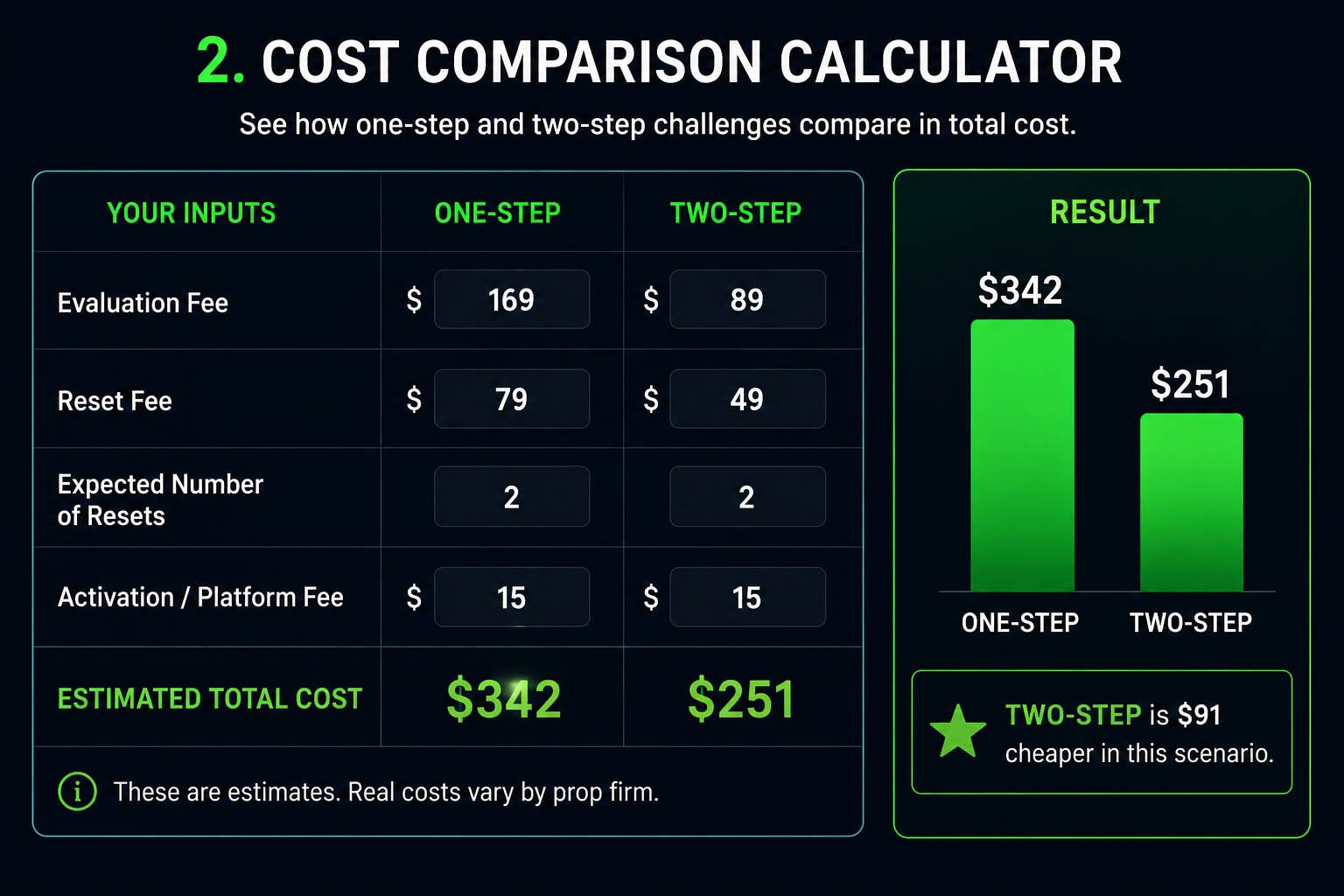
Cost is only one part of the decision. You also need to compare targets, rules, drawdown, payout timing, and psychological pressure.
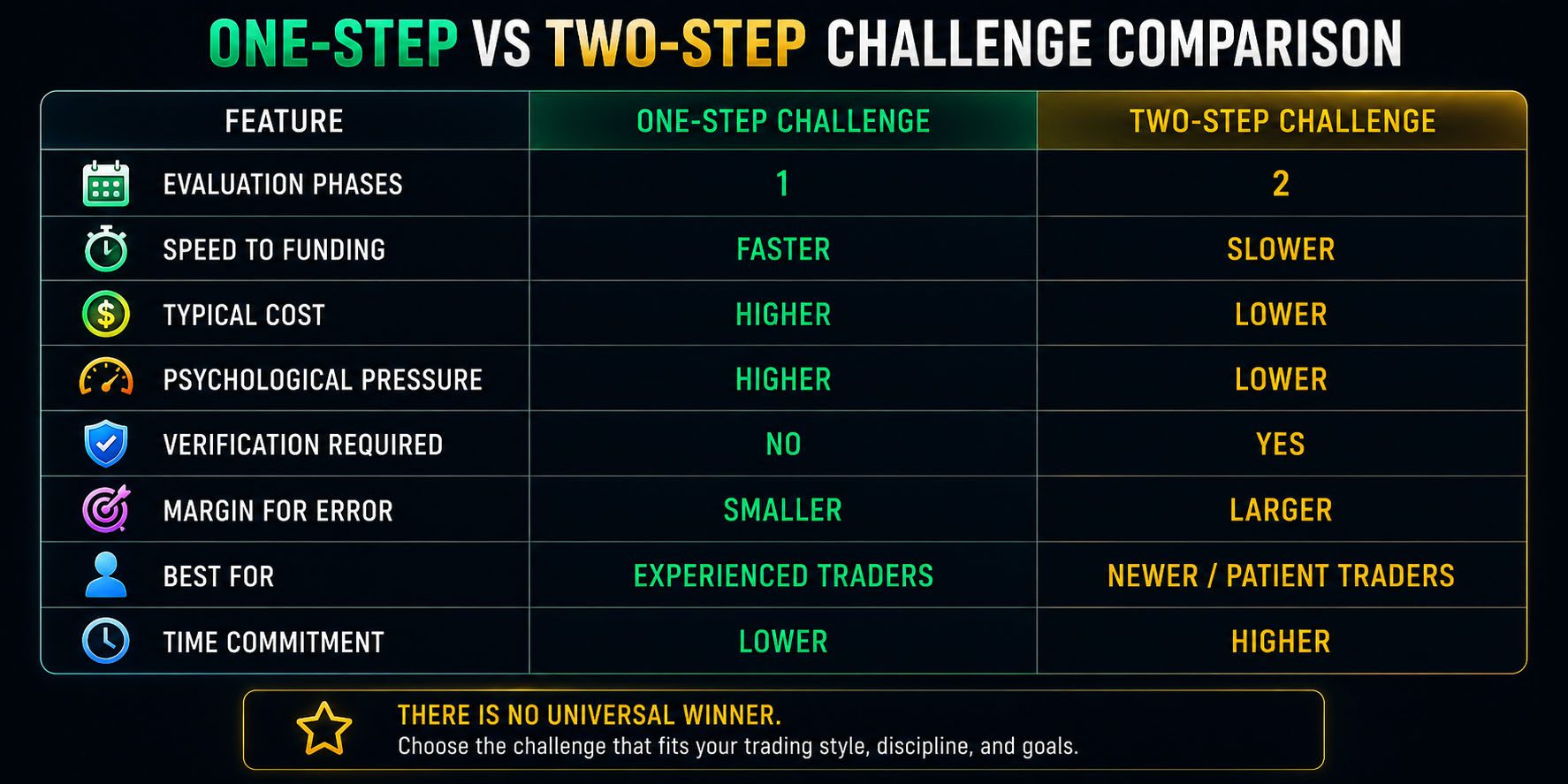
One-Step vs Two-Step Challenge Comparison
The easiest way to compare one-step vs two-step prop firm challenges is to look at the practical differences that affect your trading experience.
| Feature | One-Step Challenge | Two-Step Challenge |
|---|---|---|
| Evaluation Phases | One phase. | Two phases. |
| Speed to Funding | Usually faster. | Usually slower. |
| Typical Cost | Often higher. | Often lower. |
| Psychological Pressure | Higher pressure. | More gradual pressure. |
| Verification Required | Usually no second phase. | Yes, phase two is required. |
| Best For | Experienced, consistent traders. | Patient, process-driven traders. |
| Margin for Error | Usually smaller. | Often more structured. |
| Risk of Rushing | Higher. | Lower, but still possible. |
Which Traders Should Choose One-Step?
One-step challenges tend to attract experienced traders who already have a proven strategy and simply want a faster path to funded status.
This model may work well if you already understand prop firm rules, have passed challenges before, and can manage pressure without increasing risk emotionally.
One-Step May Be Better If You:
- Already have consistent profitability.
- Have passed prop firm challenges before.
- Want funding quickly.
- Handle pressure well.
- Trust your discipline under strict rules.
- Can avoid overtrading when the target is close.
Which Traders Should Choose Two-Step?
Two-step challenges are often better suited for traders who prefer slower, more methodical progress.
This model may be a better fit if you are newer to prop firms, trade swing setups, prefer lower pressure, or want more time to prove consistency.
Two-Step May Be Better If You:
- Are newer to prop firm trading.
- Prefer slower progress.
- Trade swing setups or wait for fewer high-quality trades.
- Focus heavily on risk management.
- Do not mind waiting longer for funding.
- Perform better when pressure is spread across phases.
Common Mistakes When Choosing a Challenge
Many traders choose whichever challenge is currently on sale. That is backwards. The cheapest challenge can become the most expensive if you keep failing it.
Choosing Based on Price
A discount does not matter if the rules do not fit your trading style.
Choosing Based on Ego
Bigger and faster may sound better, but pressure can ruin an undisciplined trader.
Ignoring Drawdown Rules
Profit targets get attention, but drawdown rules usually decide whether you survive.
Copying Another Trader
A challenge that works for someone else may be a poor fit for your personality.
Before buying, compare the account against your position sizing, daily risk limits, and drawdown tolerance.
Professional Decision Framework
Before choosing between one-step vs two-step prop firm challenges, ask yourself how you actually trade. Be honest. The market does not care what you wish your personality was.
Choose One-Step If:
- You already have a tested system.
- You can handle pressure without forcing trades.
- You understand drawdown deeply.
- You have experience with funded evaluations.
- You want a faster path and can stay controlled.
Choose Two-Step If:
- You are still building consistency.
- You prefer slower, cleaner progress.
- You trade fewer high-quality setups.
- You perform better with structured pacing.
- You value discipline more than speed.
Real Trader Scenario
Trader A: The Experienced Scalper
Trader A has already passed challenges before, tracks every trade, understands daily drawdown, and can stop trading after a loss. A one-step challenge may fit because speed is useful and pressure is manageable.
Trader B: The Patient Swing Trader
Trader B takes fewer trades, waits for clean setups, and does not like rushing. A two-step challenge may fit better because the structure allows more time and less pressure.
Our Professional Recommendation
There is no universally better evaluation model. We have seen traders pass both one-step and two-step prop firm challenges.
Experienced traders with proven consistency often prefer one-step challenges because they can reach funded status faster. Newer traders usually benefit from two-step evaluations because the slower structure encourages patience and better risk control.
The most successful traders usually are not the most aggressive. They are the most disciplined. Whether it is one step or two, consistency beats speed.
Strong traders also compare the challenge model against profit targets, daily drawdown, and maximum drawdown before buying.
FAQ
1. What is a one-step prop firm challenge?
A one-step prop firm challenge is an evaluation with only one phase before funded account access. If you hit the profit target and follow the rules, you may move toward funded status faster.
2. What is a two-step prop firm challenge?
A two-step prop firm challenge has two evaluation phases. Traders must usually pass phase one and phase two before receiving funded account access.
3. Is a one-step challenge harder?
It can be harder psychologically because there is less room for mistakes and usually more pressure to perform quickly. The rules may also be tighter depending on the firm.
4. Which challenge is better for beginners?
Many beginners are better suited for two-step challenges because the process is slower and more structured. However, beginners should focus on risk management before buying any challenge.
5. Why do some firms require verification?
Verification helps firms confirm that a trader can repeat disciplined performance instead of passing from one lucky or oversized trade.
Knowledge Quiz
- What is the main difference between one-step and two-step challenges?
A. One-step has one evaluation, two-step has two phases
B. Two-step has no rules
C. One-step guarantees payouts
D. Both are exactly the same - Which challenge is usually faster?
A. Two-step
B. One-step
C. Neither ever leads to funding
D. The slowest challenge only - Which model may be better for patient traders?
A. Two-step
B. No challenge
C. Random selection
D. The most expensive option - What should traders avoid when choosing a challenge?
A. Reading the rules
B. Choosing only because it is on sale
C. Understanding drawdown
D. Matching the challenge to their strategy - What matters most when choosing a challenge?
A. Marketing hype
B. Your trading style, discipline, and risk management
C. The biggest account size only
D. The fastest payout claim - What is a disadvantage of one-step challenges?
A. They never fund traders
B. They may create higher pressure
C. They always have no target
D. They remove drawdown rules - What is a benefit of two-step challenges?
A. More structured pacing
B. Guaranteed success
C. No verification
D. No need for discipline - Why can the cheapest challenge become expensive?
A. Because repeated failures cost money
B. Because rules do not matter
C. Because all firms are free
D. Because traders never fail - What should come before speed?
A. Consistency
B. Ego
C. Guessing
D. Revenge trading - Is there one universal best challenge type?
A. Yes, always one-step
B. Yes, always two-step
C. No, it depends on the trader
D. No challenge has rules
Answer Key
1. A · 2. B · 3. A · 4. B · 5. B · 6. B · 7. A · 8. A · 9. A · 10. C
Key Takeaways
- One-step vs two-step prop firm challenges should be chosen based on strategy, not hype.
- One-step challenges are usually faster but can create more pressure.
- Two-step challenges usually take longer but provide more structure.
- The cheapest challenge is not always the best choice.
- Experienced traders may prefer one-step evaluations.
- Newer or more patient traders may prefer two-step evaluations.
- Drawdown rules, profit targets, and payout rules matter more than marketing.
- Consistency beats speed in prop firm trading.