

Static vs Trailing Drawdown: The Rule That Changes Everything
Learn the difference between static and trailing drawdown, why trailing drawdown can be harder to manage, and how to protect your prop firm account from accidental breaches.
Lesson Goal
One of the first things experienced traders look for when comparing prop firms isn’t the profit split or account size — it’s the type of drawdown. A static drawdown and a trailing drawdown may sound similar, but they behave very differently and can dramatically affect your chances of passing a challenge.
If you don’t fully understand how your drawdown moves, you could accidentally violate the rules even while making money.
What Is Static Drawdown?
A static drawdown never moves. Your maximum loss limit stays fixed from the moment your account begins.
For example, if a $100,000 account has a maximum loss level at $94,000, that failure line remains fixed.
| Account | Maximum Loss Level |
|---|---|
| $100,000 | $94,000 |
Whether your account grows to $105,000 or $125,000, your maximum loss remains $94,000.
This is different from daily drawdown, which limits how much damage can happen inside one trading day.
What Is Trailing Drawdown?
A trailing drawdown moves upward as your account reaches new highs.
The more profit you make, the higher your drawdown threshold becomes.
Unlike a static drawdown, it never moves back down.
Example
Start Balance: $100,000
Maximum Loss: $6,000
Lowest Balance Allowed: $94,000
After growing the account to: $105,000
Your trailing drawdown moves to: $99,000
If your account falls below $99,000, you fail.
This is why trailing drawdown can feel frustrating. You can make money, move your failure line higher, and then lose the account after giving back profits.
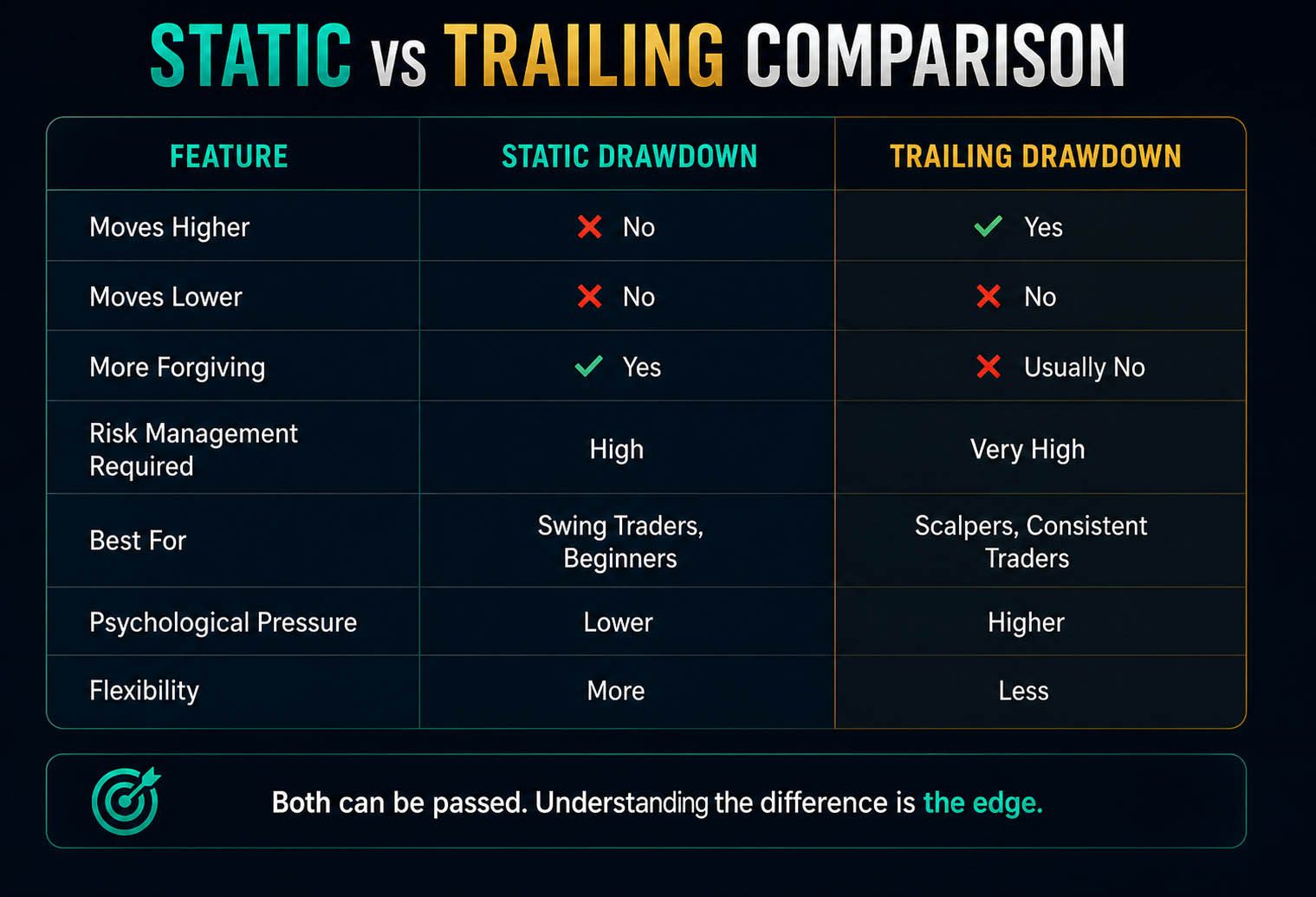
Static vs Trailing Comparison
| Feature | Static Drawdown | Trailing Drawdown |
|---|---|---|
| Moves Higher | ❌ No | ✅ Yes |
| Moves Lower | ❌ No | ❌ No |
| More Forgiving | ✅ Yes | ❌ Usually No |
| Risk Management Required | High | Very High |
For a broader explanation of account-wide loss limits, review maximum drawdown explained.
The Biggest Mistake Traders Make
Many traders celebrate after making a large winning trade.
What they don’t realize is they’ve also moved their trailing drawdown much closer to their current balance.
A few careless trades afterward can erase profits and trigger an account breach.
Common Pattern
A trader makes a strong profit, feels confident, increases lot size, gives back part of the profit, and suddenly breaches the new trailing drawdown line. The trader was profitable earlier — but still failed the account.
Professional Tip
After a strong winning day, reduce your risk — not increase it.
This is where position sizing becomes critical. If your account is in profit, your risk should still be controlled, not emotional.
Which Drawdown Is Better?
Most traders prefer static drawdowns because they provide greater flexibility and make long-term account management easier.
Trailing drawdowns aren’t necessarily bad — they simply require much tighter discipline and position sizing.
- Static drawdowns are easier for swing traders.
- Trailing drawdowns reward consistency.
- Both require excellent risk management.
- Always understand the firm’s exact rules before buying.
Before buying a challenge, compare the drawdown model with the firm’s profit target, daily loss limit, and payout rules.
How to Manage Trailing Drawdown Professionally
Trailing drawdown requires a different level of awareness because your account can become more fragile after profitable trades. Professionals manage this by protecting the new equity high instead of treating profits like free room to gamble.
Do This
- Track your current trailing threshold.
- Reduce risk after strong winning days.
- Keep a personal safety buffer.
- Stop trading before emotions take over.
- Use smaller position sizes near the trailing limit.
Avoid This
- Increasing risk after a win streak.
- Giving back profit carelessly.
- Ignoring floating equity losses.
- Holding trades too close to the breach line.
- Assuming profit gives you unlimited breathing room.
Static vs Trailing and Your Trading Style
Your trading style matters when choosing a drawdown model. A trader who holds trades longer may prefer static drawdown because temporary pullbacks have more room. A scalper with tight control may be able to handle trailing drawdown, but only if they track equity carefully.
| Trading Style | Usually Easier With | Why |
|---|---|---|
| Swing Trading | Static Drawdown | More room for normal trade fluctuation. |
| Intraday Trading | Static or Trailing | Depends on risk control and trade frequency. |
| High-Frequency Scalping | Requires Careful Review | Commissions, spreads, and rule restrictions can matter heavily. |
| Beginner Trading | Static Drawdown | Usually easier to understand and manage. |
This is why choosing the right firm is part of risk management. The drawdown model must match how you actually trade.
Lesson Quiz
- Which drawdown moves as your account grows?
- Does a static drawdown ever change?
- Why can traders fail after a large winning day?
- Which drawdown do most traders find easier to manage?
- Why should you always read the firm’s rulebook?
Lesson Summary
Understanding the difference between static and trailing drawdowns can save your evaluation. A static drawdown remains fixed, while a trailing drawdown follows your account as it reaches new highs. Neither system is inherently better, but each requires a different approach to risk management. The more clearly you understand your firm’s drawdown rules, the more confidently you’ll be able to trade within them.