

Module 7 · Lesson 3
Building a Consistent Payout Strategy
Learn how to plan funded-account withdrawals, protect accumulated profit, maintain a safety buffer, and build a repeatable payout process without becoming aggressive near withdrawal dates.Profit is not truly secured when it appears on the trading platform. It is secured when the payout is approved and received.
Making Profit and Receiving a Payout Are Different Skills
A trader can be profitable during a funded-account cycle and still finish with no payout.
This happens when accumulated gains are returned to the market through overtrading, oversized positions, emotional decisions, or aggressive trading immediately before a withdrawal date. Funded traders must develop two separate skills:- The ability to generate trading profit.
- The ability to protect that profit until it becomes withdrawable.
A payout strategy should reduce pressure. It should not create a new target that causes the trader to force trades.
This lesson builds directly on The Funded Trader Mindset and Protecting Your Funded Account.
What You Will Learn
1Understand payout-cycle planning
Structure trading decisions around the firm’s withdrawal schedule without forcing performance.
2Set realistic payout targets
Choose targets based on strategy expectancy, drawdown, and account rules rather than emotion.
3Protect accumulated profit
Reduce the chance of returning an earned payout to the market before withdrawal.
4Maintain an account buffer
Leave enough capital inside the account to support future trading and absorb normal losses.
5Manage pre-payout pressure
Avoid increasing risk or trading frequency when payout eligibility is approaching.
6Build a repeatable process
Create a payout system that can be followed across multiple account cycles.
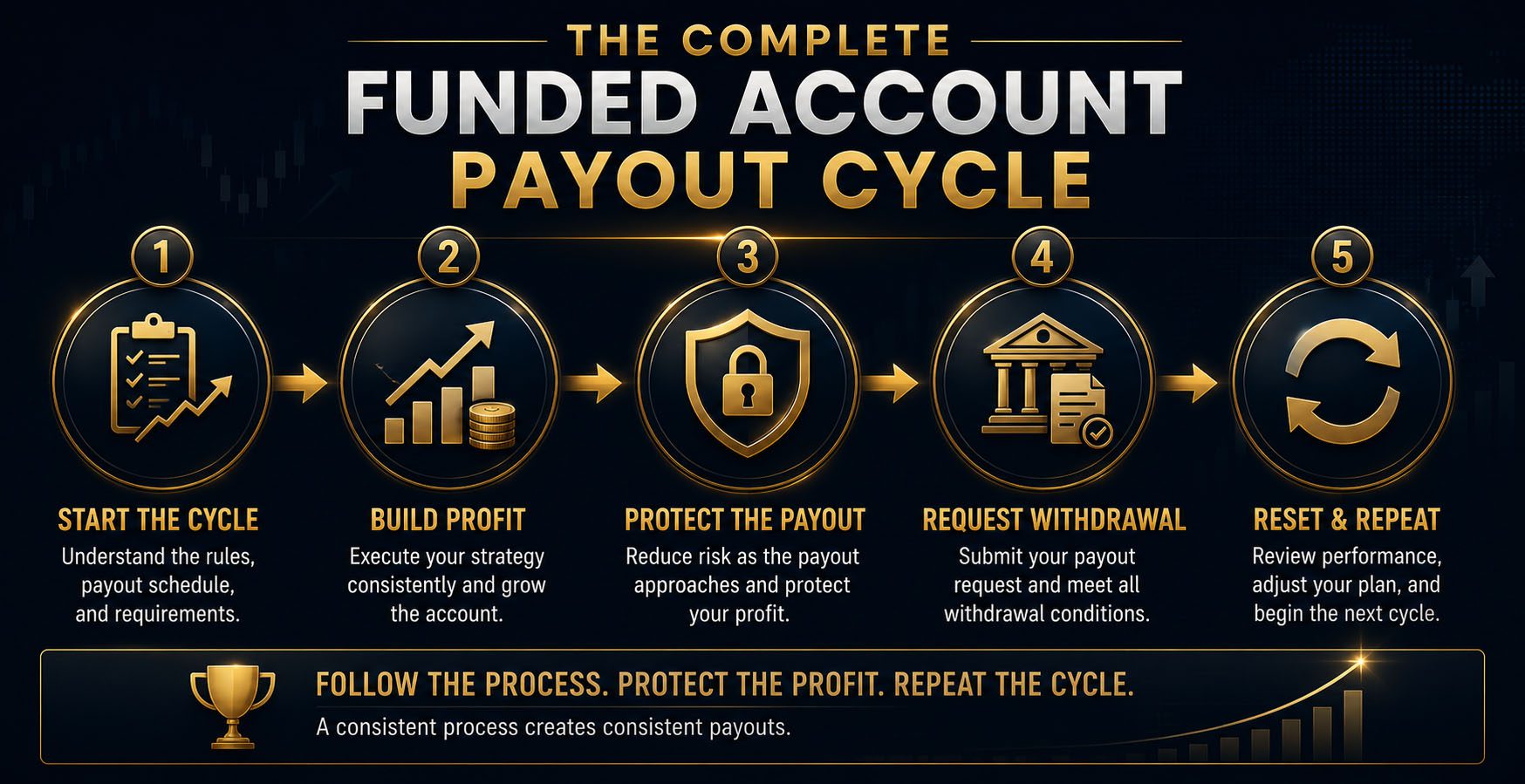
Understand the Complete Funded-Account Payout Process
A payout cycle is the period between the beginning of eligible trading and the date on which a withdrawal may be requested. Depending on the firm, the cycle may include:- A minimum number of trading days.
- A waiting period before the first payout.
- Weekly, biweekly, or monthly withdrawal schedules.
- Consistency requirements.
- Minimum profit thresholds.
- Maximum withdrawal amounts.
- Rules requiring a certain balance or safety buffer after withdrawal.
Stage 1Begin the payout cycle with protected risk.
Stage 2Build profit through valid strategy setups.
Stage 3Protect gains as withdrawal eligibility approaches.
Stage 4Request the payout and reset the next cycle.
Choose a Payout Target Your Strategy Can Support
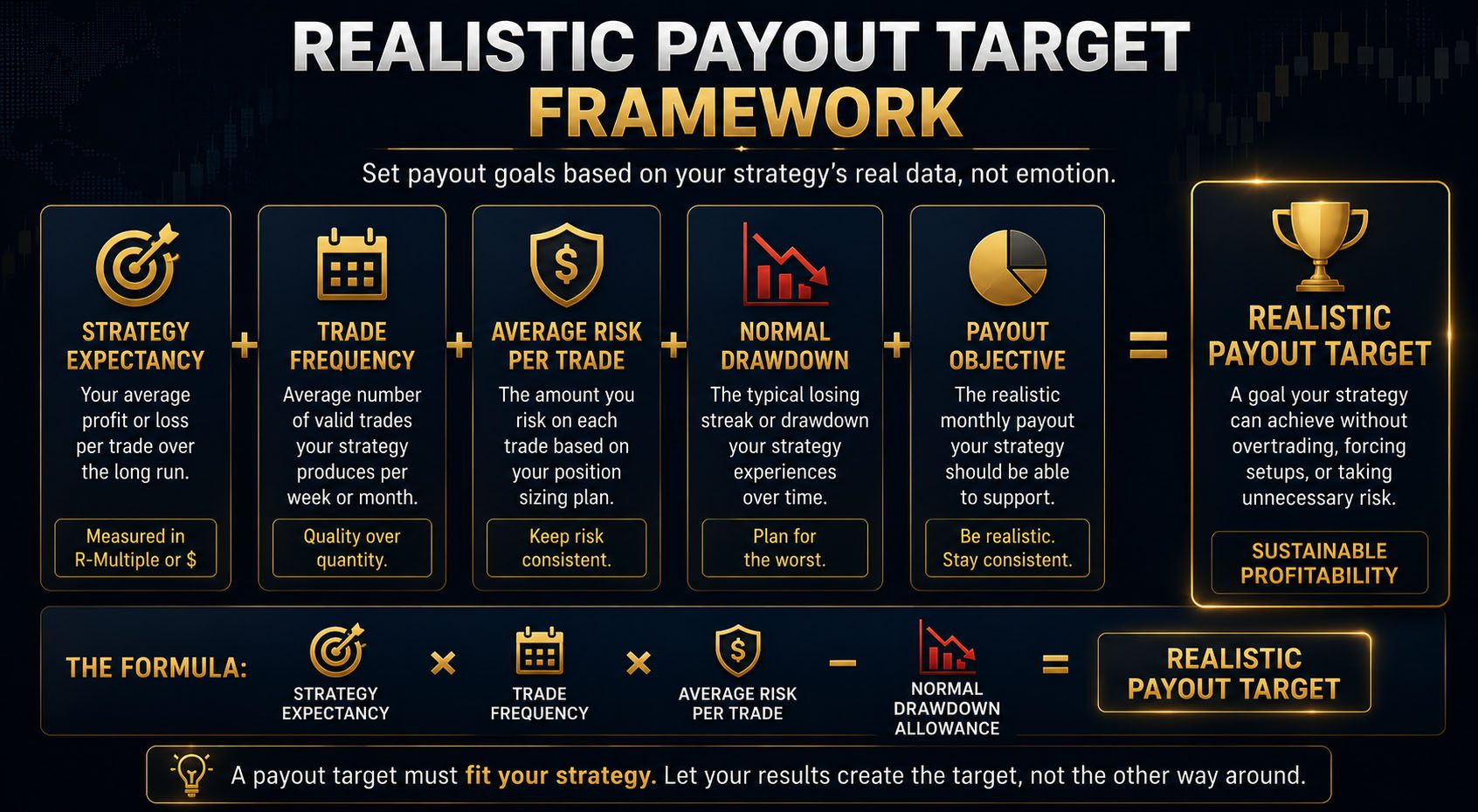
A payout target should come from strategy data, not lifestyle goals or social-media expectations. A trader should not decide that they need to make 10% this month simply because a larger payout would be attractive. The strategy may not provide enough high-quality opportunities to support that objective without excessive risk.Professional Payout Target
Expected Trade Frequency × Average Strategy Expectancy − Normal Drawdown Allowance
Factors that should influence a payout target include:
Payout Target Must Fit the Strategy- Average number of valid setups per week.
- Historical win rate.
- Average reward-to-risk ratio.
- Average losing sequence.
- Normal strategy drawdown.
- Risk per trade.
- Market conditions during the payout cycle.
- The firm’s consistency and withdrawal rules.
Do not reverse-engineer risk from the payout you want. Determine acceptable risk first, then allow the payout to develop from valid opportunities.
Conservative, Balanced and Aggressive Payout Planning
Conservative Approach
- Lower payout target.
- Smaller risk per trade.
- Strong account buffer.
- Reduced trading near payout eligibility.
- Focus on account longevity.
Balanced Approach
- Moderate payout objective.
- Stable predefined risk.
- Partial profit withdrawal.
- Reasonable post-payout buffer.
- Continued strategy execution.
Aggressive Approach
- Large payout target.
- Higher position risk.
- Greater drawdown exposure.
- Less room for normal variance.
- Greater chance of losing the payout.
The most profitable payout strategy is not always the one with the largest target. It is the one that can be repeated without repeatedly losing the funded account.
Why the First Payout Should Usually Be Conservative
The first payout is psychologically important. Before receiving it, the funded account may still feel like an opportunity rather than a realized return. Receiving an early controlled payout can:- Recover part or all of the trader’s evaluation and account fees.
- Reduce pressure to prove that the funded account is legitimate.
- Convert platform profit into real received income.
- Build confidence in the withdrawal process.
- Allow future cycles to be traded with less emotional urgency.
Dangerous First-Payout Thinking
- I need the first payout to be impressive.
- I should maximize the account before withdrawing.
- A small payout is not worth requesting.
- I can increase risk because I am already in profit.
- I should keep trading until the final possible day.
Professional First-Payout Thinking
- The first objective is to complete the payout process.
- A smaller received payout is real progress.
- I will not risk accumulated profit unnecessarily.
- I will preserve account room after withdrawal.
- Future cycles can increase only after proven consistency.
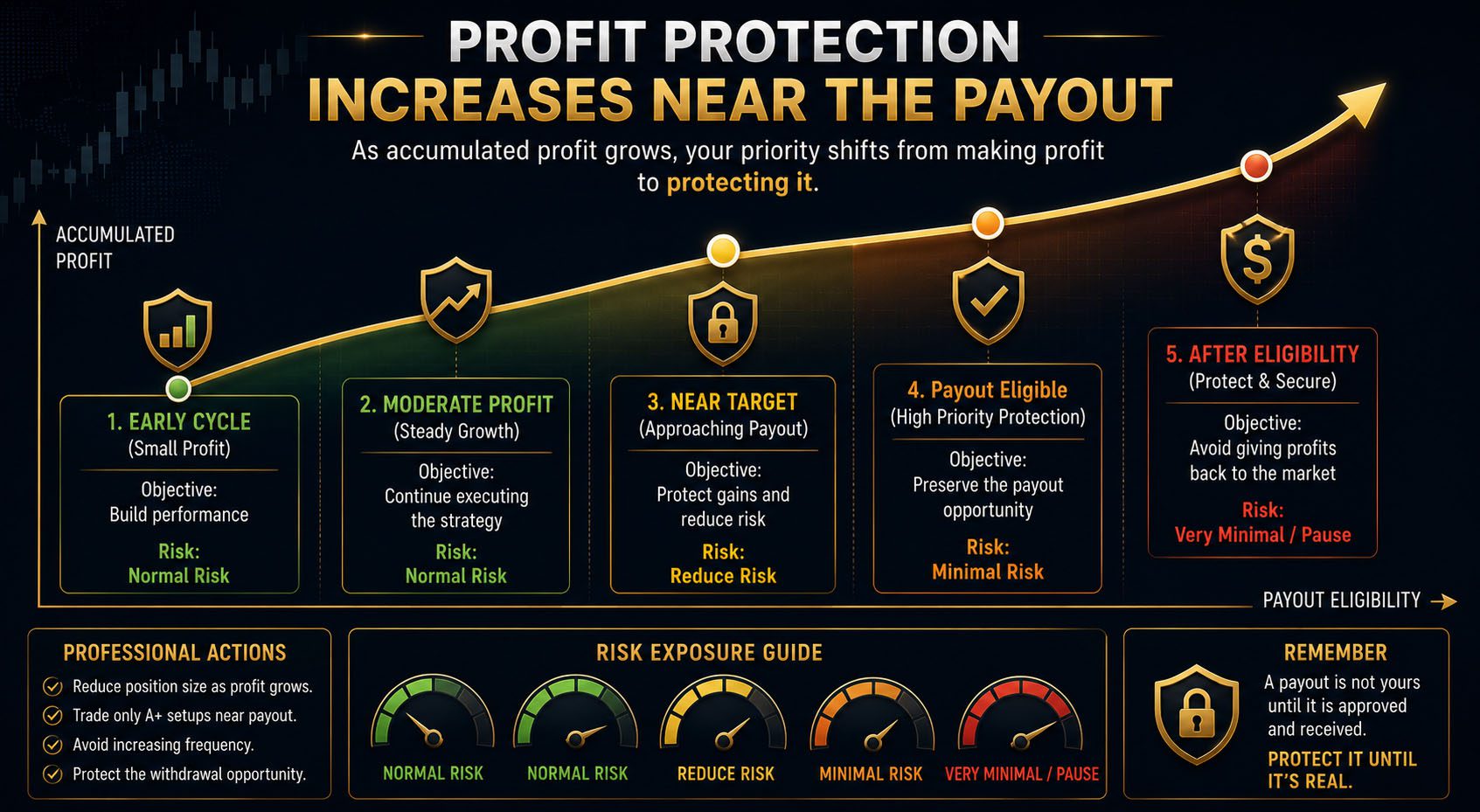
Profit Protection Must Increase as the Payout Grows
A trader who is up 0.5% and a trader who is up 4% should not necessarily operate with identical priorities. As accumulated profit approaches the planned payout objective, the value of protection increases.| Payout-Cycle Position | Primary Objective | Possible Risk Response |
|---|---|---|
| Beginning of cycle | Build performance without unnecessary pressure. | Use normal approved risk. |
| Moderate profit accumulated | Continue following the strategy. | Maintain risk if conditions remain strong. |
| Near payout target | Protect the withdrawal opportunity. | Reduce risk, limit frequency, or trade only top-tier setups. |
| Payout eligibility reached | Avoid giving profit back unnecessarily. | Pause trading or use minimum approved risk according to the plan. |
| After payout request | Protect account eligibility until processing is complete. | Follow firm rules and avoid unnecessary exposure. |
Do Not Withdraw the Account Down to a Vulnerable Level
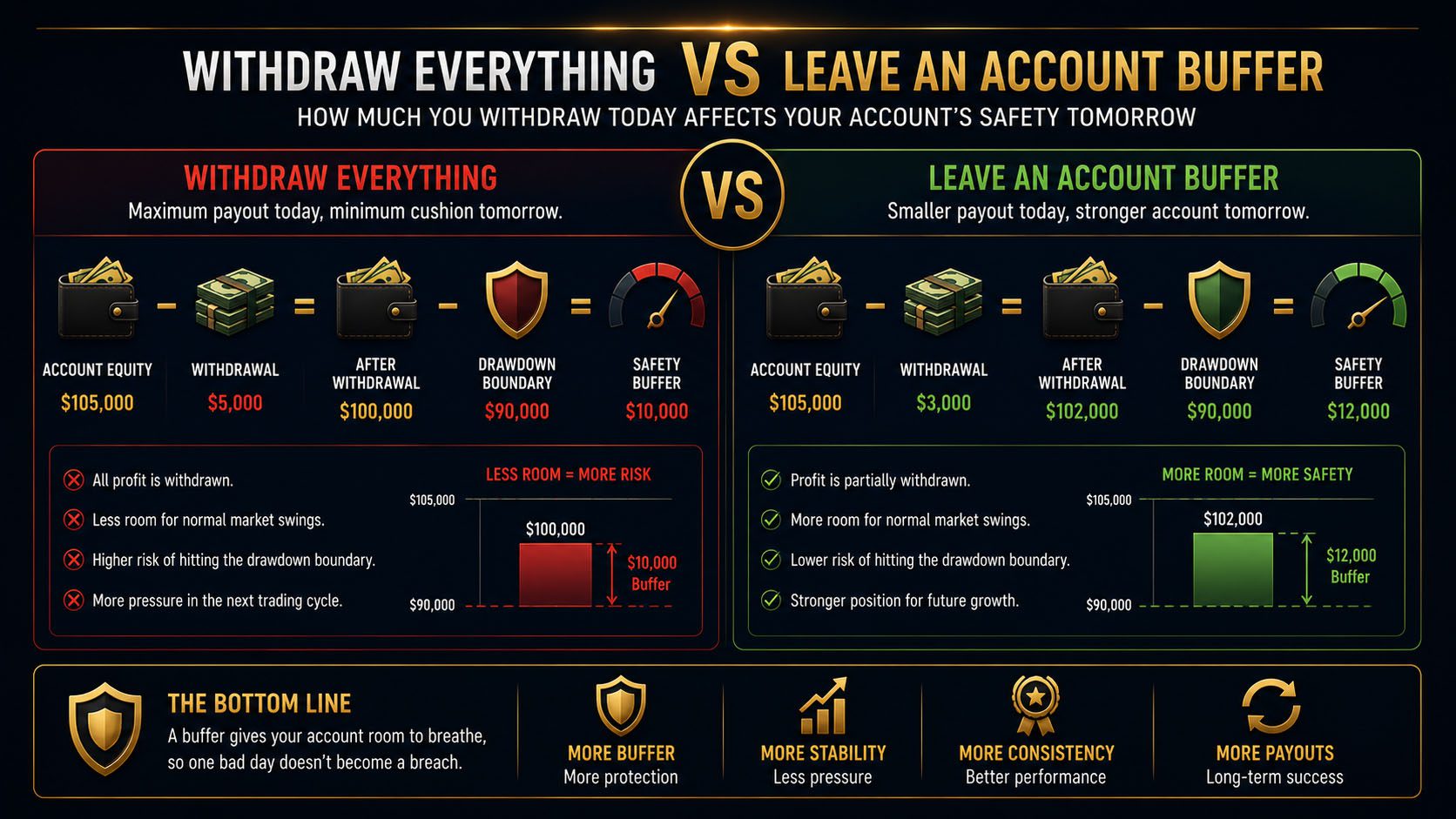
Withdrawing every available dollar may leave the account dangerously close to its drawdown boundary. A payout buffer is profit intentionally left inside the account to create additional room for future trading.Post-Payout Account Buffer
Account Equity After Withdrawal − Account Drawdown Boundary
More Buffer = More Room for Normal VarianceExample
Assume a funded account begins at $100,000 and has a breach boundary at $90,000. The trader grows the account to $105,000.Withdraw the Full $5,000
Account returns to $100,000. The trader has no additional profit cushion above the original starting balance.Withdraw $3,000 and Leave $2,000
Account remains at $102,000. The remaining profit provides additional protection against future losses.
Avoid the Most Dangerous Days of the Payout Cycle
Traders often become emotionally unstable when they are close to a payout target or eligibility date. Common thoughts include:- I only need one more winning trade.
- I want to increase the payout before requesting it.
- I have several days left, so I should keep trading.
- I am already in profit, so I can risk more.
- I do not want to withdraw a small amount.
Near-payout profit is often exposed to unnecessary risk because the trader stops seeing it as account capital and begins seeing it as money already owned.
Until the payout is approved and received, the profit remains exposed to trading losses, rule violations, platform problems, and payout conditions.
Professional Pre-Payout Rules
- Do not increase risk to improve the payout amount.
- Do not add trading sessions outside the normal plan.
- Do not chase a specific percentage.
- Do not take lower-quality setups because the deadline is approaching.
- Do not risk more than the planned amount of accumulated profit.
- Consider pausing once the planned payout objective is reached.
How Much Should Be Withdrawn?
The correct withdrawal amount depends on the trader’s goals, account rules, available buffer, and future risk plan.| Withdrawal Approach | Potential Benefit | Potential Risk |
|---|---|---|
| Withdraw all available profit | Maximizes immediate realized income. | May remove the account buffer and reduce future operating room. |
| Withdraw part of the profit | Balances realized income with account protection. | Some profit remains exposed to future trading risk. |
| Leave most profit in the account | Creates a larger buffer for scaling or future drawdown. | More unrealized profit remains exposed and may not yet be received. |
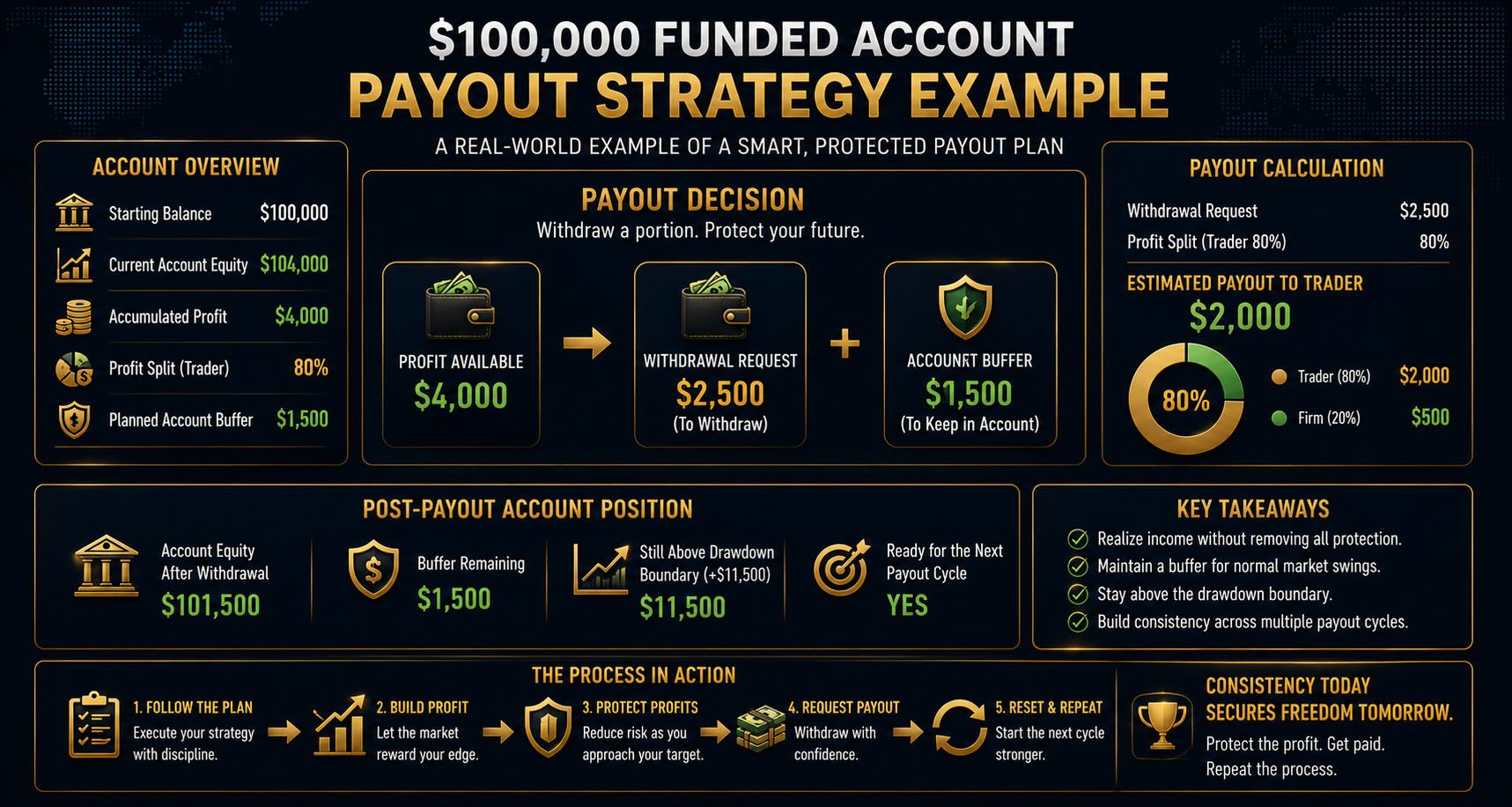
$100,000 Funded Account Payout Strategy
Account Conditions
- Starting balance: $100,000
- Current account equity: $104,000
- Accumulated profit: $4,000
- Profit split: 80% to trader
- Planned account buffer: $1,500
Withdrawal Plan
The trader decides to request $2,500 of the $4,000 profit and leave $1,500 inside the account.Trader Payout Before Other Adjustments
$2,500 × 80%
Estimated Trader Share = $2,000Post-Payout Account Position
- Account equity after withdrawal: approximately $101,500
- Profit buffer remaining: $1,500
- The trader has received a payout.
- The account retains additional room for the next cycle.
- Risk begins conservatively during the next payout period.
The Professional Payout Strategy Framework
Confirm the Firm’s Rules
Know payout dates, minimum trading days, consistency rules, profit split, withdrawal limits, and post-payout account conditions.Set a Realistic Objective
Choose a payout range supported by strategy data and protected risk rather than a forced target.Define Risk for the Cycle
Set normal risk, maximum daily exposure, profit-protection rules, and conditions for reducing size.Build Profit Through Valid Setups
Follow the strategy from Module 6 and avoid increasing frequency to accelerate the payout.Protect the Withdrawal
Reduce exposure or stop trading when the planned objective or payout eligibility is reached.Withdraw and Reset
Request the payout, preserve the planned buffer, review performance, and begin the next cycle without emotional pressure.Funded Account Payout Checklist
I know the firm’s payout schedule.
I know the minimum eligible trading days.
I understand the profit split.
I know the firm’s consistency requirements.
I have a realistic payout range.
My payout target is supported by strategy data.
I have defined normal risk for the payout cycle.
I know when risk must be reduced.
I will not force trades near the payout date.
I will not increase risk to improve the payout amount.
I know how much profit I plan to withdraw.
I know how much buffer I plan to leave.
I will verify the account after withdrawal.
I will reset risk conservatively for the next cycle.
Funded Account Payout Strategy FAQ
How large should my first funded-account payout be?
The first payout should be based on available profit, firm rules, and account protection. It does not need to be large. Completing the payout process while preserving the account is often more valuable than chasing an impressive amount.Should I stop trading once I become payout eligible?
That depends on your written plan and the firm’s rules. Some traders stop once the planned payout objective is reached. Others continue at reduced risk. The decision should be made before emotional pressure develops.Should I withdraw all available profit?
Not automatically. Withdrawing all profit realizes the maximum immediate income but may remove the account buffer. A partial withdrawal can balance income with continued account protection.What is a payout buffer?
A payout buffer is profit intentionally left inside the account after withdrawal. It provides additional room above the account’s starting balance or drawdown boundary.Can I increase risk because I am already in profit?
Profit does not make poor risk acceptable. Increasing size simply because the account is above its starting balance can quickly return the entire payout to the market.What if I am slightly below my payout target near the deadline?
Do not force a trade to reach an arbitrary number. Request the smaller payout if the rules allow it, or continue only when a complete valid setup appears.How should I begin the next payout cycle?
Restart with controlled risk. Do not immediately increase size because a previous payout was successful. Review the account balance, updated drawdown position, strategy performance, and current market conditions.Is a small repeatable payout better than one large payout?
For long-term funded trading, repeatable payouts with controlled drawdown are usually more valuable than one large payout produced through excessive risk.Lesson Quiz
1. When is funded-account profit fully secured?
2. What should determine a realistic payout target?
3. What is a payout buffer?
4. What commonly happens near a payout date?
5. Why might a trader reduce risk near a payout target?
6. What is one advantage of an early conservative payout?
7. Should a trader increase risk because the account is already profitable?
8. What makes a payout strategy professional?
Quiz Answers
1. C — Profit is fully realized when the payout is approved and received.
2. B — Targets should be based on strategy performance and protected risk.
3. B — A payout buffer is profit intentionally left inside the account.
4. B — Traders often become more emotional when payout eligibility approaches.
5. A — Reduced risk can help protect accumulated profit.
6. B — An early payout turns platform profit into received income.
7. C — Profit does not justify abandoning stable risk rules.
8. C — A professional strategy is repeatable and protects the account.
What Professional Payout Planning Requires
Profit must be protectedPlatform gains can disappear before they become a received payout.
Targets must fit the strategyA payout objective should never require forced trades or excessive risk.
The first payout can be conservativeCompleting the withdrawal process is more important than making the first payout impressive.
Buffers support longevityLeaving profit inside the account can provide additional room for future trading.
Pre-payout pressure is dangerousRisk should not increase simply because withdrawal eligibility is close.
Repeatability matters mostA smaller payout process that can be repeated is more valuable than one oversized result.
Secure the Payout Without Sacrificing the Account
A funded trader must do more than generate profit. The trader must protect that profit until it becomes withdrawable and received.
A professional payout strategy begins with a clear understanding of the firm’s rules. It uses realistic objectives, controlled risk, pre-payout protection, and a planned account buffer.
As profit accumulates, the trader should become more protective rather than more aggressive. The objective is not to squeeze every possible dollar from one payout cycle. It is to complete multiple payout cycles while preserving access to funded capital.
In the next lesson, you will learn how to distribute risk and profit across trades and trading days so that performance remains consistent and does not depend on one oversized winning session.